Showing posts with label gangsters. Show all posts

Tuesday, March 8, 2011

Cruel Winter Blues (2006)


Photobucket


PLOT:


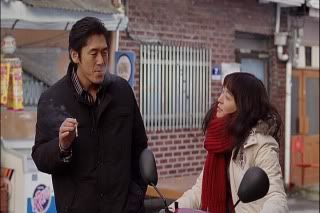
Jae-Mun is a seasoned veteran of the gang. Although a physically imposing black belt in Taekwondo, Chi-Guk is a soft-spoken newcomer to gang life, who is quietly offended by Jae-Mun's arbitrary and random acts of cruelty and rudeness against him and others. They travel to a remote town to perform an assassination of rival gangster Dae-Sik, who was responsible for the death of a friend of Jae-Mun.

While waiting for an opportunity to perform the hit, Jae-Mun coincidentally befriends Dae-Sik's mother (played by actress Na Mun-Hee) and spends some time with her. She comes to treat him as another son, even buying him clothing. A tragic plot develops, culminating in a bloody showdown between Jae-Mun and Dae-Sik.

--via Wikipedia


Photobucket


REVIEW:


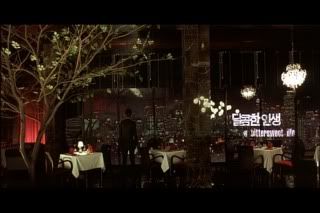
Lee Jeong-beom's CRUEL WINTER BLUES is an impeccable film. It manages to be a revenge movie with very little revenge, an action movie with very little action, and a gangster film with a very low level of crime (comparative to the rest of the genre). You aren't getting the type of revenge you might expect if you come to this with expectations picked up from viewings of Park Chan-wook's Vengeance Trilogy. You might be a little upset if you're expecting the type of action found in a gangster film like Kim Jee-woon's A BITTERSWEET LIFE. No, this film offers an entirely different aesthetic experience. But you won't be disappointed, since CRUEL WINTER BLUES is every bit as good as those films.

What you do get is a very low key film about revenge. Most revenge films depict revenge as an overwhelming impulse capable of overcoming all others (OLD BOY, KILL BILL, etc), and one that offers a surety that, while not strictly moral, at least ensures the overall trajectory of the plot. In CRUEL WINTER BLUES, revenge is an important motivating factor, but so is honour, and cowardice, and compassion. Revenge cannot simply overwhelm these other important motivations, though each can twist around or support the other.

Photobucket

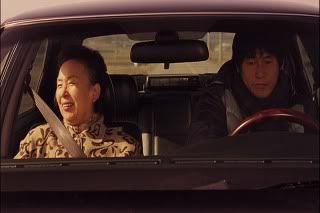
Two characters are central to the film: the gangster Jae-Mun (Sol Kyung-Gu, the actor who portrayed Rikidozan) and his enemy's mother (Na Mun-Hee). Jae-Mun is accompanied on his quest for revenge by Chi-Guk (Jo Han-seon), and the movie plays against expectations by making the elder, meaner gangster (Jae-Mun) the centre of attention, over his younger, more conflicted, and more likable partner. Jae-Mun immediately comes off as unlikeable and mean spirited (he even pees on a dog--that's low), and instead of showing that he's actually a sweetheart underneath it all the movie decides, instead, merely to complicated and articulate his unlikeability and mean spiritedness. And this works; the protagonist of a film need not always be a hero, but if he isn't, he needs to be human.

The mother (if she's named, I can't remember it, or find it anywhere) is an old proprietress of a restaurant that only sells stew, and demands that customers get their own water. She's surly and hard-headed, much like Jae-Mun, but is in no way as corrupt. She's a survivor, one who has gone through two sons leaving her behind.

Photobucket

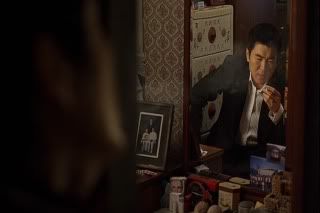
Since Jae-Mun knows only that Dae-Sik, his enemy, will show up in the small town at some point, and that he will inevitably visit his mother, he sticks to the old lady, and in doing so the two unavoidably form something of a relationship. This relationship is rapidly accelerated when Jae-Mun offers to drive her into town for a day of shopping; ostensibly he's being kind to his elder, but in actual fact he needs to make sure that she's not meeting up with Dae-Sik. In the act of keeping tabs on her, he's forced to model clothes for her, since he's roughly the same size as her younger son, Dae-Sik's brother. While the film doesn't dwell on it, you can see from Jae-Min's face that the act of trying on clothes for a man whose brother he intends to kill, and helping out the woman he intends to heinously betray, is weighing on him.

It's an excellent scene, and it speaks to the inherent tension of the film: as time progresses, it's impossible to tell if Jae-Min will go through with his revenge or not. This narrative tension mirrors the viewer's tension: as a compassionate human being, you want Jae-Min to transcend his need for revenge, and take a more humane way of things; as someone watching a revenge film, you demand vengeance, brutal and bloody. And what the film does so well is to make the outcome more and more difficult to foretell.

Everyone should see this movie. Watch it now.


Sunday, September 19, 2010

Jive Turkey (aka Baby Needs a New Pair of Shoes) (1974)

Photobucket

An often jumbled - though quite solid - blaxploitation film, Jive Turkey (also known as Baby Needs a New Pair of Shoes and, um, other names) features some strong performances, some great music, and provides a unique spin on the mafia films of the 70s. While the film struggles against its budget in trying to create a period atmosphere, director Bill Brame lets loose with some fun exploitation elements - a transvestite hired killer with razor sharp nails, an opium den/bordello with bellydancing as entertainment, a tense game of russian roulette - that brings a sense of fun and excitement that (generally) helps the film through some of its slower and more confusing moments.

Paul Harris - who had an unfortunately short acting career - is terrific as Pasha, a crime-lord who runs the "numbers" racket, which keeps him and his men - including the flashy Sweetman (who acts as the number runner), and his right hand man Jimmy Rush - tightly entwined with the community. Unfortunately the Italians - led by the vicious Tony (F-Troop's Frank DeKova) - have decided to expand their operations from drugs to numbers, which makes Pasha a marked man. Pasha protects himself with the help of a hired killer transvestite named Serene, but also has to also dig out the rat that has been feeding information to the Italians, while also dodging raids from the police.

Photobucket

Let's begin by talking a little bit about the setting of Jive Turkey. It's a period piece, taking place in 1956, though it's absolutely full of anachronisms. Hairstyles, fashion, vehicles, slang.. really, aside from a few instances of period clothing and cars this is very, very clearly a product of the mid 1970s. A title card also notes that what we're seeing is based on a true story, though the "names, places and events have been changed to protect the innocent." In other words, it's all a fib. I'm guessing that the attempt at setting things in the 50s was an attempt to ape The Godfather a bit, and it really is an admirable effort - most low budget films of this time period wouldn't even attempt something that ambitious - but unfortunately the attempt here is mostly unsuccessful. In fact, by the end you'll likely forget that what you're watching doesn't take place in - what was at the time - modern day.

I mentioned that things get a bit confusing, and this is mostly because we're introduced to a large number of characters at the beginning of the film, and at first it's hard to gauge just who we're supposed to be focusing our attention on. I'll also admit to not knowing much about what a "numbers game" - the film's core concept - was all about, and the film never elaborates. While I could mostly work out the basics, I had to go to wikipedia  in order to fully grasp it. It's basically an illegal lottery where the better picks a three or four digit number to match a random number from the next day. Pasha and his men are respected and beloved in the city, and focus their attention solely on gambling and prostitution - a common theme in blaxploitation - while staying away from dealing hard drugs.

Photobucket

The acting from the leads is fine, particularly Harris as Pasha, Reginald Farmer (who showed up in some memorable 80s roles) as Sweetman and Frances E. Williams as the opium den/bordello owner Moma Lottie. Unfortunately, as you get deeper into the cast, things take a significant turn for the worse, particularly from the actors playing police officers who seem to be in a competition to see who can read lines more woodenly. Still, Harris brings plenty of gravitas (and a terrific voice) to the lead, and Sweetman has a great moment (echoed at the end) where he (vocally) shoots down a youth who cops him some attitude. These characters have a very lived in feel, though I wish there was more elaboration on their background and how the criminal operation developed.

Director Bill Brame had a long editing career - starting on the 60s Star Trek series and continuing to do plenty of television and features (including Beyond the Poseidon Adventure) -  and he made his directorial debut with the memorable biker film The Cycle Savages, but here you'll see many of the production mistakes common to low-budget 70s blaxploitation efforts: a boom mic is clearly visible in an early scene, there are plenty of dubbed lines and ADR which are obviously meant to connect shaky scenes together, and we even get a car chase with the requisite squealing tires on dirt. Brame keeps the pace moving, but there are plenty of frustratingly confusion moments and the final reveal of the rat doesn't hold the impact that it should.

Photobucket

While the plot doesn't hold many surprises - in fact, things run fairly predictably - co-writers Howard and Elizabeth Ransom have some fun with the dialogue ("Trouble." "Like in white folk's middle name?"), though they rely pretty heavily on the N-word, particularly in any scene featuring a racist white cop (which appears to be all of them). Still, when poor Nathan wrestles with his little brother and tells him he's going to take care of him and will soon be a millionaire, it doesn't a genius to guess that his number will soon be up.

Even low-budget blaxploitation efforts tend to have great, funky soundtracks and Jive Turkey has some wonderful incidental music by Phil Moore - who had a long, memorable career in music - and some fun original songs by Ernie Lee Banks (who also plays the a brief comic relief role of DuDirty). Again, the music doesn't exactly evoke the period in which the film is supposed to take place, but it's really enjoyable - particularly the "Numbers Game" song used in the film's trailer.

Photobucket

The IMDB says that Jive Turkey was intended to be shown in the 1.85:1 ratio, but the DVD version of the film - in this case taken from the Millcreek 50 film Martial Arts collection - is presented in a scratchy full-screen transfer. The image quality and color are considerably better than The Guy From Harlem, but there's still the usual damage and lost frames that are common to low-budget films that have slipped into the public domain. Some dialogue seems to be lost in the opening scene, but the damage isn't distracting. The movie is surprisingly violent, particularly the scenes where Serene goes work, and there are a few welcome scenes of nudity spread throughout.

Since this is Millcreek there are no special features. We'll take four chapter stops, and we'll like it!

Photobucket

While hardly a lost classic, Jive Turkey tries to do some interesting and original things for a blaxploitation film, and while the social commentary - if any - is lost on me aside from the usual jabs at racist cops and drug-pushing criminals, there's still plenty here to enjoy. Some fine music and strong performances help the production rise above the many technical issues and a confusing script with too many extraneous characters. A brisk good time, with specks of the usual exploitation traits, to please fans of the genre.

Tuesday, August 10, 2010

The Friends of Eddie Coyle (1973)

"One of the first things I learned is never to ask a man why he's in a hurry. All you got to know is I told the man that he could depend on me because you told me I could depend on you. Now one of us is gonna have a big fat problem."

THE FRIENDS OF EDDIE COYLE is an underrated slice of 70's crime drama about a lowlife busher running guns for the Mob who finds out he's facing jail time with no appeal. Torn between turning snitch and preserving his loyalty and integrity, Coyle moves glacially towards his final decision, while unbeknownst to him, the machinations of others, moving quickly and wily, are setting an unwitting trap from which Coyle himself cannot escape.

Coyle is played by Robert Mitchum, who gives a performance full of pathos and gravitas, accentuating the weariness and wariness of a two-bit loser looking to cash out before it's too late. Mitchum understands that for a character like Coyle, there is no time for melodrama. Check out how he keeps his cool here while dealing with a snot-nose hot shot who thinks he knows better. Coyle's message is stubborn and worn, easily dismissed were it not delivered with just the right note of casual menace:


Scenes like this make the film great as Mitchum brings the weight of his entire film noir career to bear on a single character whose flaws embody the path a man would take to get out of a situation he's remained in too long. Coyle doesn't want to turn snitch but he no longer wants to risk jail and he's too proud to see his family end up on welfare. Family still means something to him, even if he seems a stranger to his own children. Having spent a life unhurried and unambitious, he now struggles to turn those instincts on. Mitchum is smart in making Coyle slow but not stupid. He tries to play the odds, find an angle, give up the hot-shot to protect his mob buddies but it all backfires (as it must, the film makes you feel as if its outcome is inevitable).

In between the film's quieter, character moments, director Peter Yates stages a series of ever-escalating bank heists, scenes that drip with tension as the scenarios heighten and unfold. The 70s was a bank heist decade and these scenes while good are also cold, calculated, almost sterile -- the complete opposite of the inflamed passions of DOG DAY AFTERNOON. You are witness here to the clinical efficiency of the Mob, who treat home invasions and bank robberies as jobs only, no passion just purpose. The way Yates weaves these storylines together as counterpoint is brilliant. We don't quite see the connection between these high-stakes hits and Coyle's bleak existence until it is almost too late for Coyle to escape. He is the bottom layer, the mud on the boot. When it's time to sever connections, he's the one wiped off.

The film makes great use of Boston as both a location and a character, relying on the setting to tell a greater story. You learn more about the tight-lipped Coyle from where he lives and socializes than you do from any exposition of character. This is the seedy underbelly of a decaying society (strip malls, bowling alleys, dive bars, diners) juxtaposed with the shiny surface of downtown Boston, City Hall, and the suburban banks and homes the Mob hits. Two worlds difficult to bridge, and to survive, Coyle would have to bridge them, though he is slow, beaten to the punch by Peter Boyle's malevolently underhanded Dillon, a character rich in seasoned mistrust and opportunism. Where Coyle is steady in his habits, easy to set up, Dillon is sharp, quick to sell-out.

Peter Yates had directed several incredible crime films previously, including both BULLITT and ROBBERY. This, however, may be his masterpiece. A grim slice of 70's understatement that languished for decades before being faithfully and lovingly restored by Criterion. All fans of 70s cinema, particularly of the crime and noir persuasion, owe this film a viewing.

THE FRIENDS OF EDDIE COYLE (Yates, USA, 1973)


Thursday, February 4, 2010

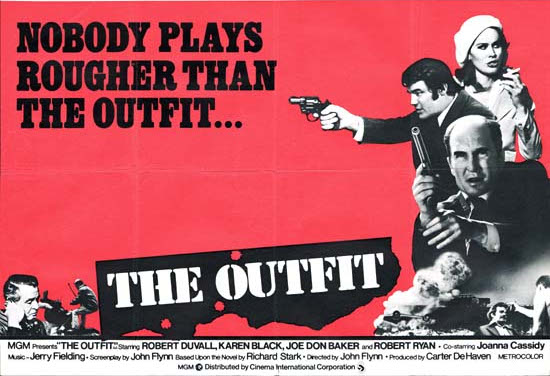
The Outfit (1973)

"You hit my brother and you came after me, that's no good. The Outfit's gonna pay me money for my trouble. I figure $250,000 to make things right."

THE OUTFIT doesn't waste time. As a 70's revenge thriller of the highest order, it sets about its premise quickly and ruthless. Nothing stylish. Nothing fancy. Motives are given and acted upon. Violence is dispensed. Vengeance is served. Characters are dispatched swiftly and brutally. Though nothing truly satisfying comes of it. For a bunch of hard cases like Macklin and Cody, a good laugh at their getaway and some extra cash in their wallet is the only highlight. Those they've hit will soon hit back.

THE OUTFIT takes place in a hard lit, low-rent world full of hustlers, drifters, con-men, and criminals. All jockeying to see what the score is. All afraid of a man like Macklin for whom revenge is the only answer, so long as he profits by it. This is not a sentimental man. He mourns his murdered brother, broods over the contract on his head, wonders if he is finished as a criminal, but never once deviates from his purpose despite having plenty of opportunities to do so. He wants payback. And he wants to get paid for it.

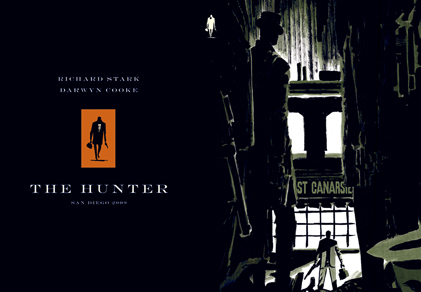
THE OUTFIT is based on the novel of the same name by Donald E. Westlake (writing as Richard Stark). It is the third novel in the infamous Parker series, which also gave us a novel called "The Hunter" which has been made into multiple movies, including POINT BLANK. It was also recently adapted as a graphic novel by Darwyn Cooke (with a version of "The Outfit" on the way).

Westlake wrote his Parker novels under a pseudonym because, compared to his other novels, they are hard-boiled to the extreme. He was also very protective of his character. In none of the film adaptations is the Parker character actually called Parker. The tone of the character is usually off too, though THE OUTFIT comes closest to bringing the amorality and cool- headedness of Parker to life through Duvall's portrayal of Macklin. The scene below, where Macklin heists a poker game, is one of my favorites...


The film also features Joe Don Baker as Cody and Karen Black as Bett. Both of whom are totally bad-ass. Baker stirs some humor in with his grit as an ex-criminal gone legit and Black gives one of her better performances as the protective gun moll whose strained relationship with her family forces her to continue along with Macklin despite many misgivings. Rounding out the cast is a veritable who's who of former film noir stars, including Jane Greer, Marie Windsor, Emily Meyer, Timothy Carey, and Elisha Cook Jr. Robert Ryan also turns up in his final film performance as Mailer, the weary mob kingpin whom Macklin keeps hassling.

THE OUTFIT has never been issued on DVD. There are bootleg copies floating around. VHS copies demand a pretty price, though the quality of the VHS print is below-average at best. I have seen streams as well, though sometimes they are of edited television broadcasts that have been recut into absurdity. Only TCM rebroadcasts the film uncut so catch it there if you can.

I was lucky enough to see THE OUTFIT at Anthology Film Archives in New York City. It was part of a great series of currently unreleased 70's thrillers, including another John Flynn film, the exploitation masterpiece ROLLING THUNDER. Both films deserve to be on DVD.

THE OUTFIT (Flynn, USA, 1973)

Monday, February 1, 2010

The Long Good Friday (1980)

"For more than ten years there's been peace - everyone to his own patch. We've all had it sweet. I've done every single one of you favours in the past - I've put money in all your pockets. I've treated you well, even when you was out of order, right? Well now there's been an eruption. It's like fuckin' Belfast on a bad night. One of my closest friends is lyin' out there in the freezer. And believe me, all of you, nobody goes home until I find out who done it."

THE LONG GOOD FRIDAY does a great job of taking a relatively simple story and elevating it to a tragedy of almost Shakespearean proportions. Harold Shand, a deeply flawed and violent man with little control over his impulses, has clawed and sacrificed his way to the top of the London underground by sheer dint of hard work and determination. He's sowed peace for ten years between the warring factions, bought councilmen and police detectives, established a corporation with the aim of legitimizing his enterprises. And now he's about to seal the deal of a lifetime, a sweeping real estate venture to revitalize the London docklands in preparation for a 1988 Olympic bid. Here, at the cusp of legitimacy, his powers at a pinnacle, with both the American mob and the European Union looking to finance him, it falls apart -- rapidly and violently -- in less than 48 hours over $5,000 of palmed cash from a suitcase intended for the IRA.

From here THE LONG GOOD FRIDAY could easily have devolved into a simple revenge thriller but it has more ambitious things to say, as a character study, a crime film, an examination of late 70's British values. London was undergoing rapid change at the time. Men like Shand were being pushed out by major corporations in the London interior and immigrant drug dealers in the boroughs, places like Brixton, where Shand has to grit his teeth to bear the changes he sees. Shand is smart, stay with the times, legitimize, get corporate. But his own personal failings lead to his undoing -- trust in the wrong people, an unchecked ego, tendencies toward rapid violence. It's funny, we know all along who the traitors are but not what their motives were. The suspense comes not from the mystery of who did it but why they did it and how Harold is going to salvage it. That the whole thing implodes over $5,000 would almost be laughable if it weren't so believable.

The performances here are across the board sensational. Bob Hoskins owns Harold Shand, filling him with a depth of complex emotion: explosive rage, surprising tenderness, layered guilt, inflated ego, short-sightedness and delusion. It is a masterful performance, particularly in the closing shot of the film where the camera just hangs on Hoskins face as we see him mentally work through the last 36 hours, seeing all mistakes and recognizing all possibilities. There is time for regret, anguish, anger, but no despair. Harold is a man who always knew his end would come from the point of a gun.

Helen Mirren absolutely dazzles as Victoria, a high-class lady slumming with a gangster in the hopes of bringing him up to her level. She is intoxicated by his common roots and extraordinary power. She revels in the touch of class she brings him and knows that the ultimate control of his legitimization lies with her. Only she can handle his extraordinary temper (as evidenced by that amazing scene where he emerges, blood soaked from the boat screaming for vengeance, and she stops him, slapping him fiercely and clutching him tight, wrestling and reasoning him into a more intelligent solution). Her handling of the American mob men is delicate yet powerful. Her rejection of all outward advances by other men is firm. She, like Harold, is not to be fucked with. Mirren reportedly worked hard with the screen writer to ensure that Victoria was an equal partner to Harold, a fully developed character and not a typical gun moll. The film is certainly better for it.

Eddie Constantine gets a lot of flack for his portrayal of Charlie. His acting does seem a bit stiff at first but I actually think it works. Charlie is Mafia gone legit, uncomfortable with the implications of dealing with Harold, who he sees as unable to cope with legitimacy. He is also superstitious. I think Constantine does a great job bringing across Charlie's inherent awkwardness coupled with a corrosive seriousness. Stephen Davis is also fun as Tony, the slimy snake-oil lawyer Charlie brings with him. One of my favorite scenes is Shand's evisceration of Charlie and Tony as cowards: "The Mafia? I've shit 'em." Harold Shand takes shit from no one.

The film is loaded with great British character actors like P.H. Moriarty as "Razors" and David King as "Parky" (it felt like Shand took his head off with that vicious backhand) both of whom deliver impressively in their small but vital roles. Derek Thompson does a great job dealing with Jeff's guilty insecurities, the sense that he doesn't belong in this world because he's smart and easily scared. God, he meets a brutal end. This is one of the grittiest, most violent films I've ever seen. But its not excessive. Not exploitational at all. Each violent act has a purpose to it, a method, a major contribution to the story. That said, at the time, it certainly deserved this rating:


THE LONG GOOD FRIDAY (MacKenzie, UK, 1980)

Saturday, January 9, 2010

A Bittersweet Life (2005)

BSL Title

"The Aesthetics of Violence"


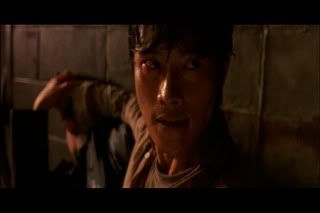
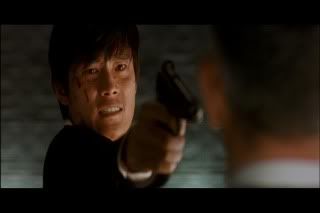
It’s a familiar story: our hero, Sun-woo (Lee Byung-hun), is a serious gangster, an enforcer for Mr. Kang. When Mr. Kang leaves town, he asks Sun-woo to look after his young girlfriend, Heesoo (Shin Min-a). Oh, and Heesoo might have a lover--if she does, kill ’em both.

And so Sun-woo takes on the job, inevitably falling in love with the elegant Heesoo. When he discovers that she does, in fact, have a lover, he is both heartbroken and duty-bound to exterminate them. Except, of course, he shows mercy. Bad form for a gangster.

When Mr. Kang returns, he is less than pleased. Allying himself with Sun-woo’s rival, Baek Jr., Kang sends his son and his men to track down Sun-woo, torture him, and kill him. But Sun-woo won’t go down so easily, and once he decides to go after his old partners in crime, nothing will stop him, not until he kills every last one of those motherfuckers.

BSL 1

So, Kim Ji-woon’s A Bittersweet Life presents nothing new, at least, not insofar as narrative goes. But then again, how many original gangster films are there? It seems like a necessarily limited genre. That’s hardly the point. What A Bittersweet Life does is take a familiar story and tell it with beautiful people wearing beautiful clothing. These beautiful people are filmed with immaculately composed shots--a moving watercolour in Technicolor.

And when violence occurs--and it does, readily--it’s like this veneer of beauty is brutally, horrifically torn open. The violence is at least two-fold--violence to the man, and violence to the image.

BSL 2

What oddly strikes me, on a second viewing of the film, is the focus on clothing. Sun-woo’s suits are sleek, well-tailored, and expensive looking. Hardly what a gangster needs to wear when he’s scheduled for a knife fight. Our (and Sun-woo’s) first glimpse of Heesoo is her feet, as she tries on different shoes. Baek Jr.’s enforcer, when he comes after Sun-woo, is set apart by his eccentric choice of headwear: a shapeless fishing hat. The man’s psychopathology is hinted at, to the audience, not by his actions, but by his hat. A Bittersweet Life is a world of surface. We’re accustomed to looking beneath the surface to find deeper meaning. Here, we just find blood.

In this film, violence hurts. Bullets aren’t just magic dots that render their victims lifeless; instead, they’re little explosions, ripping their victims apart. Bullets don’t just thud into a gangster’s chest, but blow off his fingers, crack open his elbow. Blood smears the aesthetically-designed world around him.

BSL 3>

As I said, the narrative of the film follows a pretty standard trajectory. And that’s part of the fun, I suppose; when you pick up a gangster film, you get some pleasure out of the familiar, out of knowing what you’re in for. The surprise comes from the quality of the acting, and the beauty (there’s that word again) of the film itself.

Kim Ji-woon is a fascinating director. Other than A Bittersweet Life, he’s given us the postmodern “Eastern Western” The Good, The Bad, and The Weird, the psychological horror A Tale of Two Sisters, and the wrestling-centered comedy Foul King, among others. He’s one of Korea’s directors to watch, a group including Park Chan-wook (Oldboy) and Bong Joon-ho (The Host). Korea, to my mind, put out some of the most interesting films of the last decade; here's hoping it only gets better during this one.