"My army is not designed for this kind of fighting. Yesterday, yet again, I had to promote twenty-five sergeants to replace the officers shot down by the sharpshooters. Those snipers are demoralizing my people." - General Paulus, Battle of Stalingrad, 1942.
Jean-Jacques Annaud's ENEMY AT THE GATES is an underrated WWII film that perfectly captures the ice-cold brutality of war without sentimentalizing the combat one iota. Unfortunately, Annaud saves his sentiment for a romantic sub-plot that quickly intertangles itself with the main narrative to the overall detriment of the film. That said, there is much about the movie that is rewarding and worth a second viewing.
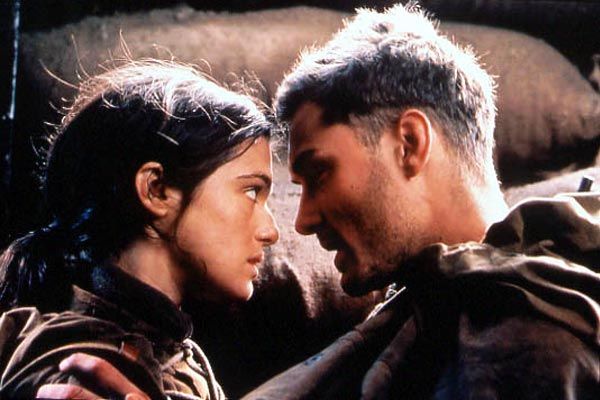
The central conceit is that the Battle of Stalingrad is going poorly for the Russians. The Nazi army has superior numbers, supplies, and equipment and they have swiftly decimated the city, conquering three-quarters of it with ease. The embattled Red Army is loathe to lose the city since it is the capital and its loss would be a huge propaganda boon for the Nazis. In this setting comes Vassili Zeitsev, a young former shepherd whose quick wits and excellent aim quickly draws the attention of Commisar Danilov, a political officer whose life he saves. At the behest of Nikita Khrushchev (a brilliant Bob Hoskins in a small but vital role), they wage a dual campaign to boost the morale of the army with Zeitsev collecting notches in his belt with every Nazi officer he takes out and Danilov writing about it in the army newspaper. The comradery these two men share is quickly scuttled when both fall for the same woman, Tania Chernova, an educated resistance fighter. This trio, played by Jude Law, Joseph Fiennes, and Rachel Weisz respectively, dominate the first half of the film, which balances their romantic triangle with the triangulation of their duties quite nicely until the unspoken romantic tension boils over into unnecessary and distracting melodrama. Each, in turn, gives a good performance, though none of them even attempt to hide their British accents. Weisz, in particular, does her best to elevate the bloated soap story that is her character's only reason for existence. That the film toys with killing her and perhaps redeeming the sub-plot had me excited for a realistic 180 from conventional Hollywood drama. Alas, it was not to be. I agree with Roger Ebert that ENEMY AT THE GATES would be a much stronger film, even a minor masterpiece, had this sub-plot between Tania and the two men been dropped entirely.
 Fortunately, Annaud doesn't hold back from displaying the chaotic cruelties of war. His set pieces are among the best I have seen in a war film. Stalingrad, as filmed by Annaud, has been utterly obliterated with dessicated husks of buildings and factories sticking out of a growing wave of bodies, blood, debris, filth, mud, and excrement. The brutality of the Nazi killing-machine with its tanks and potato smashers is matched only by the Red Army's desperation. The scene where the Commisar's hand out rifles to half their troops and five bullets to the other half is chilling. There aren't enough guns to go around so keep your head down and when the man next to you dies, take his rifle and put your bullets in. That scene, followed by these unarmed men charging into combat, gave me the chills. It feels like an impossible war with nothing to win and almost nothing to fight for. The Red Army is compelled by their own men at gunpoint yet the Nazi Army cannot move forward because they are plagued by snipers and small pockets of local resistance. Into this scene steps the Nazi's answer to Zeitsev, Major Erwin König, the Nazi's master marksman. The ensuing cat-and-mouse between these two men in the second half of the film is some of the most intense and suspenseful stuff I've ever witnessed. Annaud makes use of some extravagant set-pieces (an abandoned department store and a chemical factory) to stage two claustrophobic scenes wherein these two men confront one another in an obsessional game of patience, trying to outmaneuver one another, to capitalize on the slightest mistakes, and to use anything available to their advantage, which Zeitsev does memorably with a piece of glass and König does horrifically with the corpse of a young boy, Tania's brother Sascha.
Ed Harris delivers one of his finest performances as Major Erwin König, the Nazi sharpshooter sent to Stalingrad to contain Zaitsev's threat and present the German Army with the moral victory of his death. The plot also hints at König's ulterior motives. He had a son who fell in Stalingrad, perhaps the victim of a Zaitsev bullet. This is left deliberately unclear. In fact, much about König is left unclear. He doesn't appear to be particularly motivated by valor or medals or cultural pride. His is a personal pride. He wishes to remain the best and Zaitsev's growing fame threatens his supremacy. Though the film makes clear that König is the superior marksman, the issue isn't about technical superiority or even the superiority of propaganda. König dismisses the Nazi hype machine surrounding Zaitsev's purported death with a casual wave of the hand: "He isn't dead, and do you know why? Because I haven't killed him yet." That is all that matters to König and he risks everything to do it, remaining behind after having been ordered to evacuate, roaming Stalingrad with no support, no identification, no real commitment to the Nazi cause. Just a burning desire to the kill the man who has thwarted and nearly bested him.
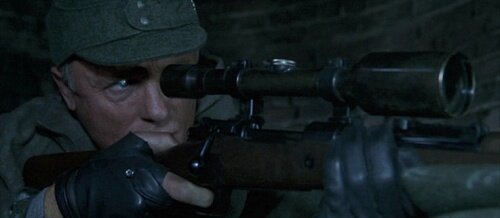
The game they play is dramatic and suspenseful, though it is Harris who grounds the reality in the stark cynicism of his performance. Here is a man with an intense and precise moral code. Someone who appears to abhor killing outside of his own prescribed boundaries as a sniper. When forced to confront Sacha's duplicity, he takes no joy in his duty, particularly since he had given the boy an easy out. That he strings up Sacha's corpse as bait is despicable, more so because it went against König's own paternal instincts towards the boy. Those who question Harris' ability as an actor need only to watch his final scene in the film to see that he is an understated master. His facial expressions of awareness, resentment, understanding, and resignation -- all in the space of a few seconds -- are outstanding. In the test of will between these two opponents, one gains a measure of respect for both men. In the endgame of their human chess, one is almost saddened to realize that König is destined to lie in an unmarked grave. That Harris could so sway you in empathy for a Nazi sniper who'd only minutes earlier strung-up a young boy is a testament to his powers as an actor.
ENEMY AT THE GATES is a fine yet flawed film hinged entirely on Jean-Jacques Annaud's intense direction, excellent cinematography, magnificent set design, and overall vision of horrific combat. The film is tautedly edited for the first two-thirds, building suspense and tension before the rather unfortunate romantic sub-plot takes over, sucking the life out of the film at a most critical juncture. Despite this, and the unnecessarily tacked-on upbeat ending, ENEMY AT THE GATES offers bountiful rewards for WWII film buffs and fans of suspenseful thrillers in general.
 ENEMY AT THE GATES (Annaud, France, 2001)