
Sion Sono’s movie is four hours long. Four hours. Seriously. So, there’s that.
Providing a synopsis, or even an introduction, to a four hour movie provides some challenge, which I’ll try to meet. The movie focuses on three teenagers: Yu (Takahiro Nishijima), an innocent pretty boy; Yoko (Hikari Mitsushima), the troubled girl he loves; and Koike (Sakura Ando), a young recruiter for a cult known as the Zero Church. Those are pretty superficial descriptions, but they’ll have to do. The three have a lot in common, aside from proximity: each has a (very) problematic relationship with his or her parents; each one has problems with sex and sexuality; and each one has a problematic (there’s that word again) relationship with religion.
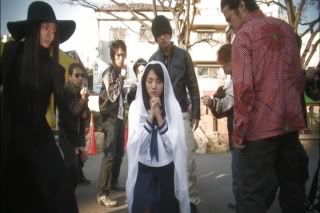
OK, but what is it actually about? It goes something like this: Yu’s Catholic mother dies when he is very young, leaving him with a confused and complicated idea about love that might simply boil down to a good ol’ Oedipal Complex. Yu’s only real memory of his mother is her praying before the Virgin Mary, and telling Yu that, some day, he’ll have to introduce his own Mary to her. Yu’s life-long ambition becomes finding his “Mary,” his one true love (I might as well just tell you it’s Yoko). Yu’s father reacts, well, oddly to his wife’s death, and becomes a Catholic priest. He then becomes embroiled in a love affair, gets even more confused, and begins sadistically forcing his son, Yu, to confess his sins, at length, every day. And they better be good ones.
And there’s the problem. Since Yu is such a nancy boy, he has no sins to confess. So, he joins a gang, and becomes a pervert. He is mentored in the ways of taking peek-a-boo, upskirt panty shots. Utilizing some form of advanced Kung Fu, Yu snaps pictures of girls’ undies with style and panache; once his talent is discovered, he begins working for a porn company, and becomes known as the King of the Perverts. All to impress his dad in the confessional.
During Yu’s perverse odyssey, he encounters, first, Koike, who is the film’s chief antagonist. She decides to manipulate Yu, since she loves him (I suppose), and her love is unrequited. Koike hates men in general, and works for the Zero Church, which gets its money through charitable donations and from kidnapping the families of church members, presumably selling their stuff. Her primary goal in life becomes keeping Yu separate from Yoko, his “Mary,” the one woman he truly loves.
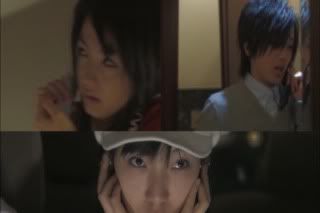
Jesus, this is getting long. Anyway, Yoko is another teenager, whose hatred for men only excludes two examples: Kurt Cobain and Jesus Christ. Yu first sees her when she is being beset upon by a gang of hooligans, who she is all-too-eager to fight. But here’s the complication: though Yu immediately recognizes her as his one true love, he can’t really act upon it, since, due to a forfeit from a pervert competition, he’s currently in drag. And not just any drag: he’s dressed up like the protagonist of the Female Prisoner Scorpion films.
And then shit gets complicated. Koike throws a monkey wrench in things by pretending to be the real Miss Scorpion, and she and Yoko begin a love affair, excluding Yu from the mix. Throw in an ass-ton of heavy-handed Catholic imagery, lots of perverts, Manga-style editing and action, some Kung Fu, and plenty of panty shots--plus more melodrama than you can shake a stick at--and what you end up with is four hours of Love Exposure.
What’s really incredible about Love Exposure is that it even exists. I mean, it’s a four hour epic romance about perverts and cross-dressers and Kung Fu. What the fuck. I couldn’t help but think of Tarsem’s The Fall; both are clearly a labour of love, and their very existence defies the logic of the marketplace and the current status of global cinema. It should also be pointed out that, while four hours hardly fly along (and you should distrust anyone making such a claim), the film hardly seems onerous or dull. And that’s quite an achievement.
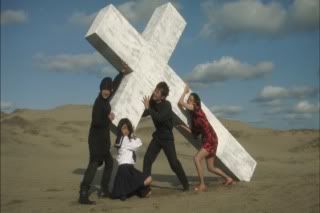
One major issue I have with the film, though, is that I feel, in a way, it wimps out. For four hours, the audience gets an inside look at perversion, from incest to lesbianism to voyeurism to cross-dressing, etc. And Yu makes the point, again and again, that “perverts” are perverts for a reason. They’re shown sympathetically; in fact, they’re shown as the norm, with the straight, monogamous heterosexual relationships almost always being represented as dysfunctional. But, in the end, Yu gets the girl; Love Exposure ends up reinforcing heteronormativity, making the long haul through the rest of the film seem like a long (and perhaps tedious) diversion through juvenile perversions, only to end up with a more mature heterosexual monogamy. And that’s a shame, since it effectively undercuts the subversive intentions (or at least the subversive direction) of the rest of the film. I can’t come down too hard on this ending, though, since it doesn’t betray the film’s other major theme: Catholicism. The crucifix and the Virgin Mary are among the first images that appear on the screen, and recur throughout, adding more complication than clarification.
Sion Sono’s Love Exposure is a hell of an achievement. But does that mean it’s worth seeking out? I … don’t know. I’ve seen the film, and thought about it a great deal, and I can’t tell if it’s genius, or if its boosters are confusing it for genius based on the size of its undertaking. It’s something unlike any film I’ve ever seen before, though, and that’s certainly an accomplishment.



 >
>