Showing posts with label Religious Imagery. Show all posts

Wednesday, February 17, 2010

Love Exposure (2008)

LE Title


Sion Sono’s movie is four hours long. Four hours. Seriously. So, there’s that.

Providing a synopsis, or even an introduction, to a four hour movie provides some challenge, which I’ll try to meet. The movie focuses on three teenagers: Yu (Takahiro Nishijima), an innocent pretty boy; Yoko (Hikari Mitsushima), the troubled girl he loves; and Koike (Sakura Ando), a young recruiter for a cult known as the Zero Church. Those are pretty superficial descriptions, but they’ll have to do. The three have a lot in common, aside from proximity: each has a (very) problematic relationship with his or her parents; each one has problems with sex and sexuality; and each one has a problematic (there’s that word again) relationship with religion.
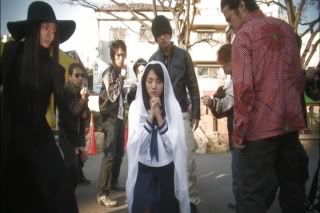
LE 1

OK, but what is it actually about? It goes something like this: Yu’s Catholic mother dies when he is very young, leaving him with a confused and complicated idea about love that might simply boil down to a good ol’ Oedipal Complex. Yu’s only real memory of his mother is her praying before the Virgin Mary, and telling Yu that, some day, he’ll have to introduce his own Mary to her. Yu’s life-long ambition becomes finding his “Mary,” his one true love (I might as well just tell you it’s Yoko). Yu’s father reacts, well, oddly to his wife’s death, and becomes a Catholic priest. He then becomes embroiled in a love affair, gets even more confused, and begins sadistically forcing his son, Yu, to confess his sins, at length, every day. And they better be good ones.

And there’s the problem. Since Yu is such a nancy boy, he has no sins to confess. So, he joins a gang, and becomes a pervert. He is mentored in the ways of taking peek-a-boo, upskirt panty shots. Utilizing some form of advanced Kung Fu, Yu snaps pictures of girls’ undies with style and panache; once his talent is discovered, he begins working for a porn company, and becomes known as the King of the Perverts. All to impress his dad in the confessional.

During Yu’s perverse odyssey, he encounters, first, Koike, who is the film’s chief antagonist. She decides to manipulate Yu, since she loves him (I suppose), and her love is unrequited. Koike hates men in general, and works for the Zero Church, which gets its money through charitable donations and from kidnapping the families of church members, presumably selling their stuff. Her primary goal in life becomes keeping Yu separate from Yoko, his “Mary,” the one woman he truly loves.
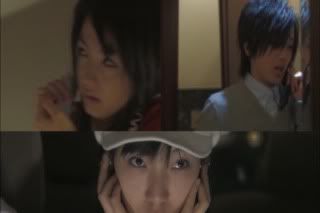
LE 2

Jesus, this is getting long. Anyway, Yoko is another teenager, whose hatred for men only excludes two examples: Kurt Cobain and Jesus Christ. Yu first sees her when she is being beset upon by a gang of hooligans, who she is all-too-eager to fight. But here’s the complication: though Yu immediately recognizes her as his one true love, he can’t really act upon it, since, due to a forfeit from a pervert competition, he’s currently in drag. And not just any drag: he’s dressed up like the protagonist of the Female Prisoner Scorpion films.

And then shit gets complicated. Koike throws a monkey wrench in things by pretending to be the real Miss Scorpion, and she and Yoko begin a love affair, excluding Yu from the mix. Throw in an ass-ton of heavy-handed Catholic imagery, lots of perverts, Manga-style editing and action, some Kung Fu, and plenty of panty shots--plus more melodrama than you can shake a stick at--and what you end up with is four hours of Love Exposure.
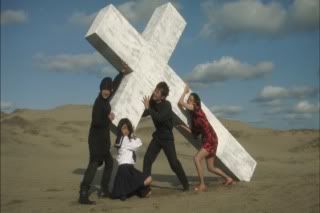
LE 3

What’s really incredible about Love Exposure is that it even exists. I mean, it’s a four hour epic romance about perverts and cross-dressers and Kung Fu. What the fuck. I couldn’t help but think of Tarsem’s The Fall; both are clearly a labour of love, and their very existence defies the logic of the marketplace and the current status of global cinema. It should also be pointed out that, while four hours hardly fly along (and you should distrust anyone making such a claim), the film hardly seems onerous or dull. And that’s quite an achievement.

One major issue I have with the film, though, is that I feel, in a way, it wimps out. For four hours, the audience gets an inside look at perversion, from incest to lesbianism to voyeurism to cross-dressing, etc. And Yu makes the point, again and again, that “perverts” are perverts for a reason. They’re shown sympathetically; in fact, they’re shown as the norm, with the straight, monogamous heterosexual relationships almost always being represented as dysfunctional. But, in the end, Yu gets the girl; Love Exposure ends up reinforcing heteronormativity, making the long haul through the rest of the film seem like a long (and perhaps tedious) diversion through juvenile perversions, only to end up with a more mature heterosexual monogamy. And that’s a shame, since it effectively undercuts the subversive intentions (or at least the subversive direction) of the rest of the film. I can’t come down too hard on this ending, though, since it doesn’t betray the film’s other major theme: Catholicism. The crucifix and the Virgin Mary are among the first images that appear on the screen, and recur throughout, adding more complication than clarification.

Sion Sono’s Love Exposure is a hell of an achievement. But does that mean it’s worth seeking out? I … don’t know. I’ve seen the film, and thought about it a great deal, and I can’t tell if it’s genius, or if its boosters are confusing it for genius based on the size of its undertaking. It’s something unlike any film I’ve ever seen before, though, and that’s certainly an accomplishment.

Saturday, February 21, 2009

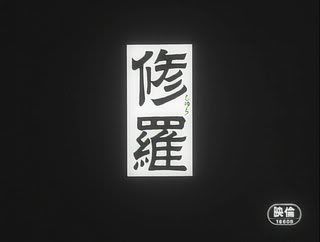
Shura (1971)

PanTit

Shura begins with the setting of the sun. It is the last time color, or the light of day, will enter into the world of the film. Only darkness remains.

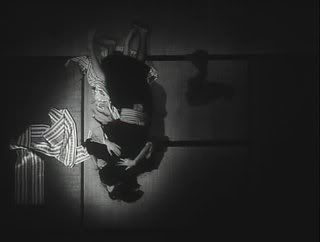
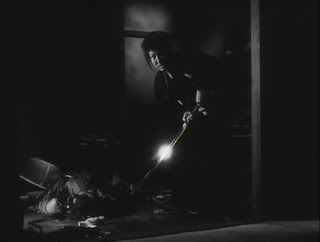
Certainly Toshio Matsumoto’s Shura is a dark film. In fact, that’s an understatement; in Shura, light has ceased to exist. Darkness encloses the actors, and the sets. Each and every shot seems to be crafted in such a way that the screen is almost 50% black. This striking visual scheme certainly fits the mood, which is one of utter desolation and despair.

Pan1

Gengo (Katsuo Nakamura) is a broke ronin, living with one loyal retainer in a Spartan house with bare walls. He’s sold everything he owns, except his sword, seemingly to “keep” a woman, a low-level geisha named Koman (Yasuko Sanjo) with whom he has fallen in love. In actuality, he is a samurai named Soemon, who needs all the money he can get to pay off a 100 ryo debt. In doing so, he can return to favor with his lord and join 47 other ronin--the 47 samurai (or loyal ronin) of Japan’s national legend.

The catalyst which causes the ensuing tragedy comes when the ronin’s retainer, Hachiemon, arrives with the 100 ryo Gengo needs to buy his way back into the honorable vendetta. It's always money, isn't it? Sango (Juro Kara), a beneficiary of Gengo’s patronage, shows up immediately after this, explaining that Koman is going to be sold to another samurai. Her cost? 100 ryo.

To get to the point: Gengo, after much prodding, spends the 100 ryo he so desperately needs, in order to save Koman, who agrees to marry him. But, there’s a problem. Koman can't be married, at least, not again. Sango is actually Koman’s husband. The two of them have played Gengo, and in doing so have stripped him of his love, his money, and his honor.

Gengo doesn’t take this well.

Pan2

Though he’s initially ruined by the revelation, Gengo soon comes to realize the extent of the dishonor that's been done to him. The rest of the film details Gengo’s all-consuming quest for vengeance, and it does so with bleak, powerful visuals that seem to bring into clear focus the true horror of violence.

To the average viewer of samurai cinema, Gengo’s initial actions hardly seem beyond the pale. He is, after all, a samurai, a member of a cast distinguished by its two swords and its exclusive franchise on violence. That he chooses to wield his swords against those who wronged him seems quite in keeping with the cinematic samurai tradition.

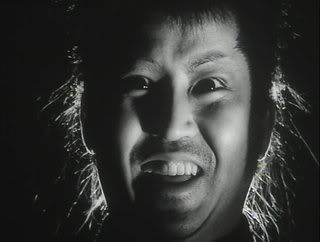
Not so fast, says Matsumoto. Violence is not a clean, sanitized event, and vengeance can never truly be justified. As Gengo becomes consumed by his fury, he becomes less and less a man, and more a demon. When people die by his sword, they die terribly, and the graphic and intense depictions of their deaths only reinforces the brutality of Gengo’s “justice.”

Pan3

Matsumoto is primarily an experimental filmmaker, with the vast majority of his work done in the genre of the short film. Only four times, to my knowledge, did he make full length features. He’s probably most well known (this is a relative term) as the director of Funeral Parade of Roses, the film that (supposedly) inspired Stanley Kubrick when he made A Clockwork Orange. While Shura is a very straightforward story, elements of Matsumoto’s background in experimental film seem to find their way in. The film is certainly shot by someone who is just as concerned with the visual look as he is with the story itself.

While Shura never dips off into total surrealism, the film remains oneiric throughout. The viewer is never absolutely sure that what he is seeing is actually taking place, or if it is actually a dream. After all, the film starts with a precognitive dream, and more than once the film depicts the contents of Gengo’s mind--how he hopes things might play out--as though they were real. Finally, it’s never really certain if Gengo is becoming “demon-like” with his actions, or if it should be understood like a horror movie, in that Gengo is actually becoming a monster. In a sense, it hardly matters; the evil wrought by Gengo is the evil wrought by man, and the evils against him (there are plenty) are certainly human as well.

To date, Shura doesn’t have a DVD release (that I know of) outside of Asia. It’s a shame, really. Hopefully Masters of Cinema, who released Funeral Parade of Roses in Britain, might look into this one in the future. It would certainly be worth it.

Tuesday, October 7, 2008

Jacob's Ladder (1990)


PLOT:

Jacob Singer (Tim Robbins), a Vietnam veteran, begins to have strange demonic visions that seem connected to his experiences during the war. Discovering that the surviving members of his platoon are experiencing similar dreams, Jacob begins to believe that his unit were the subject of tests by the American military. As the walls of his reality break down, and his hallucinations become more frequent, Jacob begins to uncover what seems like a massive conspiracy. Haunted by visions of death, including that of his young son, what is fantasy and what is delusion soon become difficult to discern.


REVIEW:

Director Adrian Lyne is best known for erotic thrillers like Fatal Attraction, but with Jacob's Ladder he proves to have some serious chops when it comes to psycho-horror. Hanging off an amazing performance by Tim Robbins, the film creates some wonderful tension with its dream within a dream state, and has a memorable shock ending that still remains a bit shocking even after the audience has been bombarded with decades of of M. Night Shyamalan twists.

Admittedly, some of the fun of the film comes from picking out the many actors in the cast who went on to some degree of fame. Ving Rhames (Pulp Fiction), Eriq La Salle (E.R.), Jason Alexander (Seinfeld), Macaulay Culkin (Home Alone), and even blink-and-you'll-miss-'em appearances by Lewis Black (The Daily Show) and Kyle Gass (Tenacious D!). However, at times this is a relentlessly bleak film with some rather disturbing imagery in the Cronenberg vein. It's often only Robbins' boyish charm, along with a winning supporting performance from Danny Aiello as Louis, Robbins' chiropractor, that add a little light to the subject matter.

In the most telling dialogue in the film, Louis (Aiello) tells Jacob (referring to Meister Eckhart):
Eckhart saw Hell too. He said: The only thing that burns in Hell is the part of you that won't let go of life, your memories, your attachments. They burn them all away. But they're not punishing you, he said. They're freeing your soul. So, if you're frightened of dying and... and you're holding on, you'll see devils tearing your life away. But if you've made your peace, then the devils are really angels, freeing you from the earth.

This surprising bit of enlightenment informs the second half of the film greatly, and is a hint at Jacob's final fate.


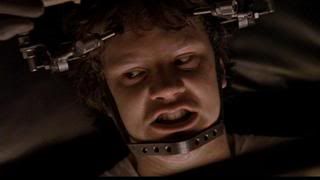
Robbins plays Jacob as a disturbed, but very sympathetic character unable to deal with his reality slowing melting away. It's a charged performance, particularly in the scene (burned into my young consciousness) where he's wheeled into an operating room, tied to what appears to be some awful piece of medical equipment, and told that he's dead before they start operating on him. In the commentary, Lyne says that Robbins' acting in this scene made himself and his cameramen weep, and it remains a very disturbing, powerful scene.

The supporting cast is fine, with Elizabeth Peña giving a strong performance as Jezzie (short for Jezebel), Jacob's girlfriend. She has to strike the right note of sympathy, while maintaining moments of anger and frustration with Jacob's state, and her character has a strange sexiness even as her demonic tendencies are hinted at. Jason Alexander has a nice turn as a ice-chewing, frustrated lawyer, and Eriq La Salle gets a few nice character moments late in the film.


Lyne chose to go with all practical effects for the film, and the choice proved to be a strong one. The repeated effect of a person's head wailing around in fast motion (created by filming the actor at 4 frames a second) works exceedingly well, and is a technique aped in countless music videos and films (and video games, it would be hard to imagine Silent Hill without this film as reference). The choice to show some of the demonic imagery in flashes, or for just a few frames, makes the slow descent into hell feel very real.

The bad trip imagery can be effective, but sometimes (like in the appearance of tentacles in the subway scene) come off as a little hokey. The jumping around in time (and, apparently, reality) can be a bit difficult to take as well, sometimes coming off like an average Twilight Zone episode rather than a fully fleshed out film, but things tighten up in the final act. The religious imagery (particularly in the naming of the characters) can be a little obvious, but Lyne seems very comfortable with his pretensions and is deftly able to deliver the psychological goods.


The Special Edition DVD was originally released in 1998, and while the film is shown in it's original 1.85:1 format, the print is very grainy looking. Still, for a film that originally bombed, some care has been taken with the supplementary materials.

First, we have a commentary with director Adrian Lyne. It's screen specific, and often quite interesting, but there are long gaps (particularly near the end) that slow the whole thing to a crawl. Lyne is obviously quite fond of the film, and his memories of the production are sporadic but very entertaining.

Unfortunately, most of the interesting information is repeated in the half hour Building Jacob's Ladder featurette which also features talking head interviews with writer Bruce Joel Rubin (writer of Jacob's Ladder and Ghost) as we as some small interview snippets with Tim Robbins, Elizabeth Peña and Danny Aiello. Rubin seems appreciative of the changes which Lyne brought to his script, but is critical of the removal of a scene with Peña late in the film. The behind the scenes footage, particularly of the terrifying decent into hell, is quite interesting.

We are also treated to three rather significant deleted scenes with optional director's commentary. All come near the end of the film, though it's the Peña scene which is most significant. Its inclusion would have made the film a bit easier to interpret, but I don't think the film feels like it's missing the scene. The other two would have made the transition to the ending less abrupt, but would have slowed the pace at a critical time.

A theatrical trailer, television spot, cast & crew information and production notes round off the package.


Looking back, Jacob's Ladder seems to have had more influence on popular culture than one might think. While the director was going over territory mined by directors like David Cronenberg and David Lynch, this Vietnam variation on An Occurrence at Owl Creek Bridge remains slightly more palatable while still featuring some shocking and disturbing imagery. A terrific psychological horror film featuring one of Tim Robbin's most impressive performances.