"Money breeds money. Mine must be on the pill."
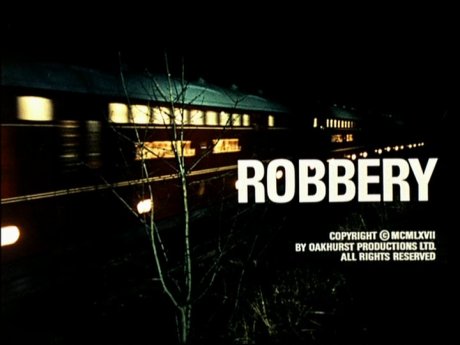
They don't make heist movies like this anymore. Hell, they don't make movies like this anymore at all. These were the thoughts I had while sitting through a special screening of ROBBERY at The Film Society At Lincoln Center last week. Peter Yates, one of the UK's most influential and important directors, had died earlier this year and Lincoln Center was screening one of his best films, one that is still completely unavailable in any format in the United States.
It is a film of extreme historical importance -- a film that prefigures the explosive craze of 70's crime films, of gritty tough-minded sociological realism and a scaling back of 50's & 60's epic melodrama. It was ROBBERY that brought Yates to the attention of Steve McQueen and it was BULLITT that begat THE FRENCH CONNECTION which begat THE SEVEN-UPS and so on: an endless cavalcade of elaborate heists and careening car chases -- this is their genesis.
It is a film of extreme historical importance -- a film that prefigures the explosive craze of 70's crime films, of gritty tough-minded sociological realism and a scaling back of 50's & 60's epic melodrama. It was ROBBERY that brought Yates to the attention of Steve McQueen and it was BULLITT that begat THE FRENCH CONNECTION which begat THE SEVEN-UPS and so on: an endless cavalcade of elaborate heists and careening car chases -- this is their genesis.
We are left with more questions than answers at this point. The film, having thrown us in at the deep end, leaves us plenty of time to tread water. It's only with the arrival of crime boss Paul Clifton (played with lived-in gravitas by Stanley Baker) that the film's cards are actively laid on the table. He's putting a gang together to knock over a post-bank holiday mail train worth over 10 million pounds. The film goes into elaborate detail on the set-up: meticulous coordination and planning of routes and maps, exits and entrances; the rounding up of collaborators and drilling them on their timing and duties; the financing of supplies, including shake-downs and pay-offs. No modern film could withstand this level of deliberate pacing but it pays off huge dividends at the end as each element previously hashed over is executed in a thrilling, suspenseful, (and most important of all) plausible manner.
Layering the suspense, of course, is a smart, world-weary Scotland Yard detective (played by James Booth) who pinched one of the gang earlier on but can't make him squeal. He leans on every possible angle and doggedly pursues Clifton and co. at all turns. The film doesn't shy away from the simple truth that one cannot be truly clandestine in one's operations. Cops know who the criminals are and what they are doing, even if they can't prove it. While Booth seemingly gets nowhere near the gang until the very end, his mere shadowy presence is enough to unnerve them, allowing a tightly-coiled spring of a plan to slowly unravel.
 It's hard not to over-hype this film, it really has it all: heists, car chases, a prison break, an intense game of procedural cat-and-mouse, and a double-cross romantic sub-plot that actually pays off. How often can a crime film say that? ROBBERY hits all these bases and more, setting a crime film template that has been often imitated but rarely duplicated.
Given its pedigree, it's hard to believe this film has languished as long as it has. The original print I saw Lincoln Center was grainy and faded, one of the only ones remaining. The DVD copies in England are lifted from the television master, compromising the original cinematic vision. Given how inexpensive it is to transfer 35mm to streaming digital, one wonders how, especially with Yates' passing and the subsequent renewed interest in his work, this film can continue to languish. The print I saw won't last much longer and shouldn't be allowed to deteriorate further.
Layering the suspense, of course, is a smart, world-weary Scotland Yard detective (played by James Booth) who pinched one of the gang earlier on but can't make him squeal. He leans on every possible angle and doggedly pursues Clifton and co. at all turns. The film doesn't shy away from the simple truth that one cannot be truly clandestine in one's operations. Cops know who the criminals are and what they are doing, even if they can't prove it. While Booth seemingly gets nowhere near the gang until the very end, his mere shadowy presence is enough to unnerve them, allowing a tightly-coiled spring of a plan to slowly unravel.
It's hard not to over-hype this film, it really has it all: heists, car chases, a prison break, an intense game of procedural cat-and-mouse, and a double-cross romantic sub-plot that actually pays off. How often can a crime film say that? ROBBERY hits all these bases and more, setting a crime film template that has been often imitated but rarely duplicated.Given its pedigree, it's hard to believe this film has languished as long as it has. The original print I saw Lincoln Center was grainy and faded, one of the only ones remaining. The DVD copies in England are lifted from the television master, compromising the original cinematic vision. Given how inexpensive it is to transfer 35mm to streaming digital, one wonders how, especially with Yates' passing and the subsequent renewed interest in his work, this film can continue to languish. The print I saw won't last much longer and shouldn't be allowed to deteriorate further.