Monday, August 30, 2010

Day Of The Panther (1988)

Photobucket

This slice of 80s kung-fu cheese is brought to us by Brian Trenchard-Smith, who young genre fans know from his diefication by Quentin Tarantino in the Ozploitation documentary Not Quite Hollywood. Trenchard-Smith cut his teeth on entertaining exploitation efforts like Escape 2000 and Dead-In Drive In, and even tackled kung-fu quite well in the Jimmy Wang Yu vehicle The Man From Hong Kong, but in Day Of The Panther (shot simultaneously with its sequel Strike Of The Panther) he definitely had his work cut out for him. Saddled with an action star almost totally devoid of charisma (or acting talent) and a script that was completely by the numbers, this was a work-for-hire gig after the original director was fired four days in. What remains has flashes of inspiration, but is generally a forgettable and generic action effort.

Jason Blade (the bland Edward John Stazak) is with the Hong Kong special branch and, along with his friend and mentor William Anderson (John Stanton) and William's daughter - and Jason's partner - Linda, is a member of the Order of the Panther - a secret kung-fu society. After witnessing a drug deal gone wrong, Linda follows the Australian dealer back to Pearth, Australia where - after a punch up with some masked thugs - she's killed. Her killer is Jim Baxter (Jim Richards), the head goon of entrpreneurial scum-bag Damien Zukor (Michael Carman) and mastermind of all of the illegal transpirings. Blade comes to Australia to track down his partner's killer, going undercover as a Triad enforcer to try and find work with Zukor, while receiving advice from the grieving William Anderson and romancing his niece Gemma. Things go well until Baxter discovers Blade's secret, revealing it to Zukor before their big (fixed) fight at an underground kung-fu tournament and leading to the requisite confrontation and fight between Blade and Baxter.

Photobucket

There's little glamourous about being brought in to save a troubled production, but Trenchard-Smith does deserve credit for creating a perfectly comprehensible action film. He obviously knows how to stretch a dollar, but while the production looks cheap - the 16mm film gives everything a vaguely made-for-TV look - it doesn't look nearly as cheap as it actually was. His camerawork is strong, and he shoots the action scenes with a sure hand, though with an over-reliance on slow motion.

More troubling are the performances - particularly Stazak, who is an obviously talented martial artist, but has more trouble when he's asked to deliver dialog. Most - if not all - of the lines appear to be dubbed, which only adds to the low-budget feel. Part of the problem is the character itself who, aside from having a goofy name (Jason Blade? Seriously?), is given very little to do. He's supposed to be devastated by the loss of his partner and desperate for revenge, but all of his scenes feature the same vanilla expression on his face and monotone line delivery. And don't get me started on his attempts at witty banter ("So, you weren't impressed by my little theatrical piece" "I wasn't, but they almost died laughing").

Photobucket

Thankfully the supporting performances are a lot stronger, particularly Michael Carman as the slimy Damien Zukor, who gets the best lines and a pair of flip-up sunglasses. John Stanton doesn't have much to do, but he at least has a great voice - which allows him to give some introductory narration that momentarily makes Day Of The Panther feel like a legit crappy kung-fu film instead of an Australian knock-off. Paris Jefferson as Blade's love interest is asked only to flashdance seductively while Jason attempts to work out, before eventually falling for his charms and bedding him. It's very, very silly.

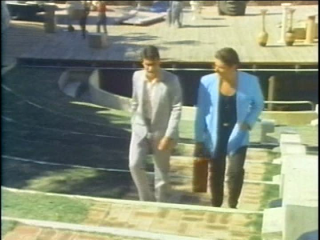
I do want to briefly mention Jim Richards as Blade's martial arts foil - and general prick-around-town - Jim Baxter. He's only a few steps above Stazak on the charisma-meter, but he gets points for dressing like Don Johnson in Miami Vice and kicking and punching quite convincingly.
Photobucket

But the fight scenes are the reason we're here, and despite being a little too spread out - the script fills in the slow moments with groan-worthy comedic scenes of bumbling cops attempting to tail Blade - are perfectly acceptable. Stazak may have been born without emotions, but he can throw a convincing spin kick, and does so dozens of times as his opponents crash through walls, windows and whatever other hard surface is close by. The choreography isn't very unique - and it's actually Linda's early fight with the masked assailants which take her through an abandoned building that is most memorable - but the kicks and punches definitely have impact. It's actually a shame that the film didn't take the obvious route of actually having a kung-fu tournament, as it might have spiced up things with a few extra fights.

Photobucket

Part of the Millcreek 50 Martial Arts movie pack, Day Of The Panther seems to be transferred from a VHS copy of the film, and therefore has the faded look of an old videocassette. There doesn't seem to be much information lost on the left and right parts of the screen, so I would imagine the film was shot 1.33:1 - which makes sense, since most (if not all) of its screenings would be on video. There is a PAL DVD of the film which is almost certainly of better quality, but you probably wouldn't be watching this to take in the lush greenery of Perth, Australia.

Lots of dubbing means that the sound is never going to be ideal, but the impact from the kicks and punches comes through loud and clear. The soundtrack is full of cheesy 80s synthesizers, and is par for the course for action movies from the time period. 

Photobucket

While peppered with moments of interest, Day Of The Panther remains a forgettable kung-fu effort, not even worth the time of devoted fans of Trenchard-Smith. Serviceable action and some enjoyable supporting performances can't make up for a bland lead and a story that fizzles at the end. I've read that the sequel is an improvement, but it's hard to round up much curiosity after this dull exhibition.

Sunday, August 29, 2010

Bloody Nightmares #25: Dr. Shock's Tales of Terror (2003)

Photobucket

I can be excused for not having much hope for Dr. Shock's Tales of Terror after taking in the first twenty minutes or so. Anthology films are notoriously difficult to pull off, and the first segment of the film is particularly wretched. Add to that the irritating presences of Dr. Shock - apparently an Ohio horror host legend - who introduces each segment with sub-Crypt Keeper puns and a pair of X-ray specs - and you have a recipe for pain. Thankfully things eventually improve, and the film - or, more accurately, the collection of short films - ends up having enough fun (and wacky) moments to make the experience worthwhile.

The usual mix of credit and blame must be given to Douglas Agosti (who actually plays Dr. Shock) and Lance Otto Smith who obviously put a lot of their time into the production as writers, directors, producers, actors, as well as providing the special effects. The pair clearly have a lot of affection for genre films, though the films in this collection with their minimal (often confusing) plots lend more to H.G. Lewis than some of the more stylish filmmakers he influenced. As they are presented as separate "features" (each with their own opening and closing credits), i'm going to comment on each in order.

Photobucket


We begin with Bullet For a Vampire, which despite apparently being the most recently filmed of the productions - and the one with the highest production value - is by far the least of the films in the collection. The daughter of Vyto Lucciani, a notorious mafia boss, manages to insult a gypsy (never a good idea), who proceeds to awaken a vampire in the form of the handsome and mysterious - sigh - Drake Uala. Vyto soon finds himself fighting off his now-vampiric daughter and henchmen before taking care of Drake, only to be done away with by his mafia buddies who don't take kindly to vampire stories.

As mentioned, Agosti and Smith manage to do quite a bit with the resources available to them on this production, with a number of different sets and quite a large cast. Unfortunately, this still doesn't save this plodding, often painful to watch tale. Some wrongheaded day-for-night shooting - which looks washed out and terrible - is bad enough, but the acting - most notably Timide as Drake Uala and Chris-May Zeithaml as Vyto's daughter - is just wretched. The vampire make-up, which looks to be influenced by the gangster/horror combination of From Dusk Till Dawn, looks quite good, and Mark Standriff as Vyto seems to be trying his best, but even with a half hour run time this seems to go on forever.

Photobucket


Things pick up significantly with The Town That Loved Pizza (coming up with titles is obviously not Agosti and Smith's strong suit). While filmed earlier, this production feels considerably less restrained which works in its favor. Brothers Obediah and Jebediah arrive in a small (and surprisingly snow-covered) Texas town to open up a new meat-only pizzeria, much to the chagrin of the local redneck Sheriff. When citizens start going missing the Sheriff is rightfully suspicious of the newcomers, and things get plenty bloody in a climax involving a wood-chipper and a bucket of "fixins". While the constant mugging of the actors get irritating - particularly Smith as the Sheriff - and things definitely look cheap, the persistent sense of fun makes this offering a lot more tolerable. Even the most naive viewer will know exactly how things are going to pan out from the opening moments, but there's some decent gore and the whole thing is fast-paced. I'm not sure why they chose to set the story in Texas - especially as it's rather obviously filmed in Ohio - but there a few moments obviously cribbed from The Texas Chainsaw Massacre (most notably a scene featuring Obediah, a meathook and a chainsaw).

Photobucket


Story number three is The Garden Tool Murders, which serves mostly to throw some innovative - though not particularly stylish - gore at the screen. Caleb (Smith again) is a dedicated groundskeeper, but doesn't take kindly to those who litter - even going as far as to (seemingly) kill random passers-by with assorted garden implements. The most violent of the segments, this time we get death by lawn-mower, decapitation by weed-wacker and (my personal favorite) a face mangled in a car motor. Agotsi must have been working overtime to get the cheesy effects together, and while they are never realistic, that's sort of the point. Cheesy violence and a groan-worthy twist at the end makes this segment tolerable, though visually very flat.

Photobucket


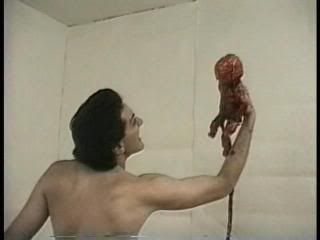
Thankfully the final segment - Demon's Day - is suitably bat-shit, though it features such a bizarre plot that it's difficult to summarize. A coroner finds some demon flesh under the fingernails of a fresh corpse, which is exactly what he needs for his cloning experiments. Yep, the guy decides to clone Lucifer, who comes out of the fish tank as a rubbery baby puppet second only to Las Vegas Bloodbath in goofiness. Soon demons and troll-like creatures are popping up, and this clone of Lucifer is setting pimps on fire (my own favorite moment), killing prostitutes, and pulling the heads off of other demons. The whole thing climaxes in a circle of fire, with some demon on demon action that is enjoyably ludicrous. Disjointed doesn't really begin to explain the problems with Demon's Day, as it feels like most of the exposition has been sliced out for pacing reasons - though considering the quality of the exposition in the other features, it would be wrong to complain. It does move very fast, and there's certainly plenty to look out, but it might just leave you shaking your head and wondering what the heck you've just seen..


Photobucket


Dr. Shock's Tales of Terror is presented in its original full-screen ratio, and it could easily pass for a shot-on-video production from the mid-90s rather than one compiled in the last decade. Colors are muted and often fuzzy, and there are the usual glitches to be found. Aside from some awful sound-effects - some of the punching in Bullet For a Vampire sounds like something out of a cartoon - sound is consistent, with only the demon dialogue in Demon's Day being difficult to make out. The music doesn't call much attention to itself, but it's appropriately subdued.

This being a Bloody Nightmares disk, we're once again left with no chapter stops, which is a shame since anthologies lend themselves well to being able to skip over segments. Both Bullet and The Town That Loved Pizza have some welcome outtakes during their respective closing credits. That said, since each production (and the host segments) have their own opening and closing credits, you might be reaching for the remote instead of sitting through all of them.


Photobucket


Perhaps still a bit wary following Dead is Dead, I ended up being pleasantly surprised by Dr. Shock's Tales of Terror, which ended up fulfilling my (admittedly low) expectations. While the first segment is plodding, and the wraparound bits are painfully unfunny, there are enough moments of inspired goofiness in the three remaining films to prevent total brain damage. It might take some effort to get there, but for those looking for minor thrills Dr. Shock does eventually deliver.


Thursday, August 26, 2010

Capsule Review: Suspicion (1941)

Cary Grant plays an almost impossibly charming playboy who sweeps the naive (and rich) Joan Fontaine off of her feet, until she discovers that he's near-penniless. Soon he's forced into some get-rich schemes with the bumbling Beaky (Nigel Bruce). No, this isn't a romantic comedy, but it would be tough to know that from the first 45 minutes, where Grant (as Johnnie Aysgarth) could easily have walked in from some of his lighter efforts. The brilliance comes when Fontaine's Lina begins to suspect that Johnnie - who is being accused of stealing from his employer - might be willing to murder to avoid his possible jail sentence. The tension builds rapidly, climaxing in a famous scene where Johnnie brings Lina some milk that she believes to be poisoned. The ending - which Hitchcock disliked - really does seem tacked on and incongruous, but it hardly takes away from the brilliance that comes before. Not as terrifying as Hitchcock's very best, this one has a unique menace.

Wednesday, August 25, 2010

Capsule Review: Seven Chances (1925)


Like Steamboat Bill Jr., Seven Chances builds its plot - which involves Buster Keaton's Jimmie Shannon having to get married by seven o'clock on his 27th birthday in order to inherit 7 million dollars - to an absolutely manic climax, in this case a chase scene featuring dozens of perturbed women flooding the street. Keaton is in top form, showing off his acting chops in several raucous failed proposals, as well as his directing chops - particularly when  the angry ladies start to give chase. What follows is absolute perfection, with Keaton once again throwing his entire body into the numerous gags - climaxing in the earth itself turning on him as dozens of boulders chase him down an embankment. Less than an hour long, but the final fifteen minutes are as good as anything he ever did.

Monday, August 23, 2010

Capsule Review: Nanook of the North (1922)


Considered the first feature length documentary, Nanook of the North dramatizes a number of events in the life of the Inuit Nanook and his family as they survive in the barren frozen tundra of northern Quebec. These events - ranging from Nanook's hunting of seals and other animals, to the building of an igloo - were all in some part staged for the cameras, even Nanook's family are not real and were chosen for their photogenic qualities. Of course, this sort of staged reality is nothing new to modern viewers raised on reality television, and it doesn't take anything away from the brilliant beauty of the desolate landscape, or the sheer wonder in the demonstrations of Nanook's skills. Nature documentaries up to present day have borrowed much of their structure from Robert J. Flaherty's film, and it remains essential viewing for those interested in the documentary form and its evolution.

Bloody Nightmares #24: Dead is Dead (1992)

Photobucket

Oh boy. I'm trying to restrain myself a little here, as there's really no reason to take the awfulness of Mike Stanley's auteur effort Dead is Dead personally. It wasn't created specifically as an affront to me, and i'm sure Mr. Stanley - who wrote, edited, produced, starred, directed, and almost certainly wrote this imdb comment - worked very hard to make this as good as he possibly could. Unfortunately, this still leaves a film that feels painfully padded despite being barely over an hour, and features a plot that I just can't figure out despite almost certainly paying more attention to it than anyone not directly tied to the production ever has. I wanted to find something to like here, but it's seriously an artless, ugly mess with few redeeming features.

Eric (Mike "the man" Stanley) has just returned to his home state of Michigan after leaving years earlier following the death of his institutionalized brother in a fire. Eric had borrowed some money to help his brother out, but used the money on drugs instead so the guy he borrowed the money from burned down the institution. Got that? Because things are about to get stupid. Eric goes to the middle of a field to retrieve some money he has stashed, and almost immediately gets his hand eaten off by some creature. He wakes up to find himself cared for by the friendly ex-nurse Laura, who had worked at the Institution before it burned, and who she smuggled out drug Doxitol - a re-animating agent that can grow back severed limbs and even bring the recently dead back to life. She apparently doesn't see how such a drug might have some value.

Eric steals/is given the drug, which he immediately attempts to sell to the nerdy Tony (Rob Binge who also composed the synth soundtrack), in exchange for having his debts erased. Instead, Tony attempts to have Eric run over in the closest thing this movie has to an action scene. Eric is understandably upset, and shoots Tony a few times until he reveals the location of Doug Hamil - apparently the brains of the operation. Hamil is in New York, which leads to endless scenes of the actor walking around the city, visiting Time Square, riding the ferry. Production value! Eric confronts him in his hotel room looking for the missing stash of Doxitol, which Hamil reveals is actually in a school back in Michigan. The irony! Thanks for wasting our time, Doug!

Photobucket

A few seconds of actual news footage shows us that Eric's plane crashes on the way back (leaving Laura very sad, apparently). But he's now powered by Doxitol, so he just hops up from the crash (aka some dirt, caution tape, and a small fire) and heads for the school. But it was a trap! Maybe! And he has.. his heart? or something pulled out of him before being beaten by Tony and left for dead. But, despite the title dead AINT dead and he gets his revenge by killing Tony (a couple of times) before going after the dastardly Doug (actual quote: "I advise you to go out and get baptized, see a priest, pray for your sins, 'cause Santa Claus is comin' to town and he's gonna kick your ass!"). Now, I thought I was paying attention, but apparently Doug just dies for some reason. I think the implication is that he had a bad batch of doxitol, but I really have no idea.

This sends Eric into a deep depression as he throws the formula for the drug into a lake before - I believe - attempting to commit suicide. Instead he runs into Laura at the bus-stop, and goes to see a priest again to explain everything that has happened up to this point, before killing himself. Apparently he also failed at this, since Stanley would return as Eric in Dead is Dead 2: The Incarnation.

Photobucket

If that plot summary was confusing, it's nowhere near as baffling as actually watching this tedious, near-unwatchable mess of a film. I can ignore the fact that it appears to have been transferred from a fourth generation VHS tape. I can ignore Stanley's ridiculous bowl-mullet haircut. I can ignore the entirely superfluous New York footage. But I can't ignore the bewildering plot, wretched acting and total lack of coherency. You don't want this.

The direction (by Mike "Orson who?" Stanley) is strictly of the plant-the-camera variety, with the tiny cast (only four people!) often appearing to have been filmed at different times. Characters interact, but are rarely in the same frame together. Stanley is obviously from the "tell, don't show" school of filmmakers, as most potentially interesting scenes (like, say, the plane crash) happen off-screen. I will give Stanley some credit for making early-90s Michigan appear to be the most unpleasant, post-apocalyptic looking place i've ever seen. I try to give points for effort - we're still not in Hip Hop Locos territory - but there's so little material here that has any potential.

Photobucket

Stanley's acting - where he spouts such classic lines as "you look and sound like a penis with dry heave" - isn't quite as bad as his direction, though his goofy look prevents him from ever looking as bad-ass as he wishes. Rob Binge as Tony and Dave Hildwein as Doug Hamil appear to be reading their lines from a sheet of paper which may or may not have occasional words misspelled, and both are about as menacing as children's cough syrup. It's hard to gauge Connie Cocquyt's performance as Laura, since she vanishes from the film at the half way point only to reappear confusingly in the final few minutes. I'll just go with "bad" to be safe.

As knievelcrash reminds us in the IMDB review, "director Mike Stanley doesn't throw the gore in your face", and that's absolutely correct. In fact, violence is used minimally in a way that implies that perhaps it would have taken time and/or money to put more of it on the screen. There are a few shots of a zombie mask before Eric gets his hand munched, though unless organ meat and Halloween props are your cup of tea, I wouldn't expect to be too impressed by the effects on display.

Photobucket

Dead is Dead is presented in its original fullscreen ratio, and the video quality here is really, really rough. It's blurry, the color is all over the place, and there are even occasional tracking issues. This is obviously just a direct conversion of the VHS, and not a very good one. Sound is a little better, as most dialogue scenes take place indoors and are generally audible. The synth-heavy soundtrack by Rob Binge is cheesy, but actually underscores things decently and is appropriate to the contemptible material on display.

No chapter stops. No special features. No subtitles. No nothing. This film really is a bloody nightmare.


Despite being awful, confusing, and confusingly awful, Dead is Dead actually has a sequel, which - once again according to knievelcrash - has been edited together with this one for a 2008 Dead is Dead: Director's Cut. While this film doesn't really have the potential to be good, more footage might actually help the plot make a little more sense, though its brevity is one of the few redeeming features of the film as is. Far from fun or amusing, Dead is Dead is simply tedious, and better left buried. 

Friday, August 20, 2010

Capsule Review: Children of Men (2006)

I remember seeing Children of Men in theatre back in 2006 and having my mind completely blown by Alfonso Cuarón's dystopian science fiction film. I'll admit that it was the flashy one-take sequences - stitched together digitally - which first captured my imagination, but on repeated viewings the film proves to be densely layered and with some unforgettable moments. Clive Owen gives one of his best performances as Theo Faron, a former activist who finds himself having to escort the pregnant Kee (Claire-Hope Ashitey) to safety in a future where infertility has brought humanity to the brink of extinction. Futuristic without falling into usual sci-fi trappings, Cuarón's vision of the near future (the film takes place in 2027) seems frighteningly plausible, and - as the best science fiction films do - comments strongly on the post world post-9/11.