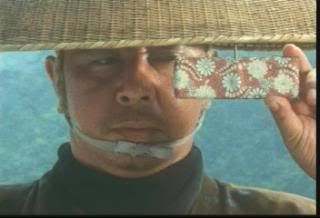
As the 1960s closed, The Japanese film industry was in shambles. American films had already begun to dominate the Japanese box office, and less and less people were seeing locally made productions. The studios. desperate to drum up interest, began packing their films full of stars to bring in crowds, a technique that was a short term solution but burned audiences out in the long rum. Two of the biggest stars of the time, particularly in regards to Samurai films, were Toshirô Mifune who became a worldwide star from the success of Akira Kurosawa's films like Yojimbo and The Seven Samurai, and Shintarô Katsu, the star of the Zatôichi films (as well as the producer of the Lone Wolf and Cub series), and combining their own particular talents seemed like a tremendous opportunity to draw in major crowds. In fact, in 1970 these two actors starred together twice; first in Zatôichi to Yôjinbô (Zatôichi Meets Yojimbo) which was produced by Katsu and then in Machibuse (Incident At Blood Pass) which was produced by Mifune.
And Mifune and Katsu were not the only draws. Director Hiroshi Inagaki had worked with Mifune before on his famous Samurai Trilogy (for which he won the best Foreign Film Oscar), and female lead Ruriko Asaoka was a major star at the time, starring in 121 films between 1955 and 1967. The supporting players, including Yûjirô Ishihara (Washi to taka, Man Who Causes a Storm) and Kinnosuke Nakamura (who later would play Ogami Itto in the Lone Wolf And Cub television series) were also name actors, making this truly a star studded film. With a pedigree this impressive, it would be expected that audiences would have high expectations.
And Mifune and Katsu were not the only draws. Director Hiroshi Inagaki had worked with Mifune before on his famous Samurai Trilogy (for which he won the best Foreign Film Oscar), and female lead Ruriko Asaoka was a major star at the time, starring in 121 films between 1955 and 1967. The supporting players, including Yûjirô Ishihara (Washi to taka, Man Who Causes a Storm) and Kinnosuke Nakamura (who later would play Ogami Itto in the Lone Wolf And Cub television series) were also name actors, making this truly a star studded film. With a pedigree this impressive, it would be expected that audiences would have high expectations.

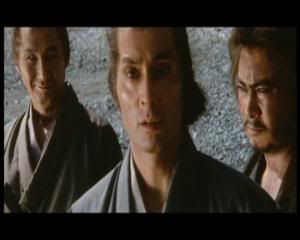
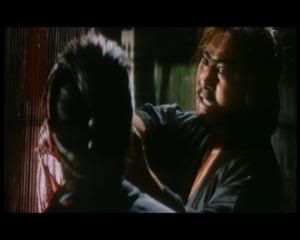
Mifune plays an obvious variation on his Yojimbo ("bodyguard") character from the Kurosawa films, a nameless Ronin roving from city to city. After revealing a cryptic clue from his employer, he travels to Sanshuu pass where he's told "something" will occur if he waits there. On his way, he rescues Okuni (Ruriko Asaoka) from her abusive husband and agrees to let her accompany him, eventually dropping her at the Minoya Inn where she quickly finds employment. There they meet an array of characters; the young gambler Yataro (Yûjirô Ishihara), the passionate policeman Ibuki (Kinnosuke Nakamura), a group of drummers, some pissed off gangsters, and Gentetsu (Shintarô Katsu), a former doctor who lives in a barn behind the inn. When the Ronin discovers his true purpose, the robbery of Shogunate gold, his loyalties are soon tested as characters are crossed and double-crossed before the final, bloody climax.

Taking place almost entirely on the snowy banks by the inn, Incident At Blood Pass provides some fairly unique visuals, particularly during some of the swordplay featured in the later parts of the film. But this wouldn't be mistaken for an action film, as instead the vast majority takes place inside the inn as we witness the development of the various relationships between the characters. In fact, much of the film resembles a play more than a Samurai epic, and even an experienced viewer can be forgiven for getting a little impatient waiting for some significant action to occur over its nearly two hour run-time. The film's greatest flaw is that it simply doesn't tell a very interesting story, and no amount of onscreen or behind-the-scenes talent can really save a boring film.
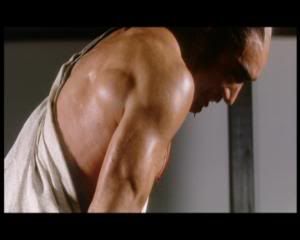
But they certainly try. Mifune is on familiar ground playing a resourceful Ronin, and he's fun to watch whether verbally sparring with Yataro, barely fighting off the advances of Okuni, or when he finally gets some face (and, too briefly, sword) time with Gentetsu. After his working relationship with Kurosawa ended, Mifune went on to make films of varying quality, but he's obviously working hard here. However, it's Shintarô Katsu who really bares his teeth playing a character very different than his blind masseuse and obviously relishing the opportunity to be such an unlikeable bastard. His sword skills are as impressive as ever, and he even manages to wring some surprising sympathy by the film's end (though, not as much as the filmmakers seem to think, as he's still rather despicable).
But they certainly try. Mifune is on familiar ground playing a resourceful Ronin, and he's fun to watch whether verbally sparring with Yataro, barely fighting off the advances of Okuni, or when he finally gets some face (and, too briefly, sword) time with Gentetsu. After his working relationship with Kurosawa ended, Mifune went on to make films of varying quality, but he's obviously working hard here. However, it's Shintarô Katsu who really bares his teeth playing a character very different than his blind masseuse and obviously relishing the opportunity to be such an unlikeable bastard. His sword skills are as impressive as ever, and he even manages to wring some surprising sympathy by the film's end (though, not as much as the filmmakers seem to think, as he's still rather despicable).

While all of the supporting players do a good job (though Kinnosuke Nakamura hams it up a little as Ibuki), they are all saddled with various back-stories which serve to slow the pace rather than distinguish their characters. When Yataro's history is revealed (along with his relationship with one of the other characters in the inn), it seems shoehorned in to give his character a little more to do. This unfortunate padding leads to the film's big reveal not occurring till quite late in the movie, leaving the final confrontation feeling rushed and confusing. In all, the whole thing feels more like a pilot for a television series featuring Mifune's Ronin traveling from town to town rather than a complete work.
Surprisingly, it's also not a very attractive film. Inagaki may not deserve blame, as this is quite a weak DVD transfer, but the scenery feels dull and muted with some impressive scenery shots being the only break from the rather muddy surroundings of the inn. There are some terrific scenes, particularly one where the Ronin and Yataro save Ibuki from being murdered by gangsters posing as officers, but things just drag on too long to sustain interest. As mentioned, the later scenes contain some impressive swordplay, though an early fistfight between Mifune and Yataro is embarrassing.
Surprisingly, it's also not a very attractive film. Inagaki may not deserve blame, as this is quite a weak DVD transfer, but the scenery feels dull and muted with some impressive scenery shots being the only break from the rather muddy surroundings of the inn. There are some terrific scenes, particularly one where the Ronin and Yataro save Ibuki from being murdered by gangsters posing as officers, but things just drag on too long to sustain interest. As mentioned, the later scenes contain some impressive swordplay, though an early fistfight between Mifune and Yataro is embarrassing.

The ANIMEIGO DVD of Incident At Blood Pass is a bit of a disappointment compared to many of the companies other releases of Samurai films. The film is presented in its original 2.35:1 aspect ratio, but the image is soft and dull. It's certainly watchable, but a better transfer may have shown more respect for Inagaki's compositions. Luckily, the film sounds quite good, and the soundtrack by Masaru Satô (Yojimbo) is striking and memorable. Subtitles are available in both Full and Limited english, and seem to be quite well translated.
Special features are limited, though there are trailers for Incident At Blood Pass, Samurai Assassin (also starring Mifune), Lone Wolf and Cub - White Heaven In Hell, Zatoichi the Outlaw, Zatoichi Meets The One-Armed Swordsman (with Jimmy Wang Yu) and Lady Snowblood. Also included are brief filmographies, character biographies and some impressive Program Notes which explains some of the historical background of the film. However, these 48(!) pages of notes can be a little difficult to read, so i'd recommend just checking them out on the Animeigo website.

Occasionally interesting but frequently uneventful, Incident At Blood Pass wastes a great cast on a talky script that provides little in the way of interesting plot developments. The scenes with Mifune and Katsu facing off are electric, but the climax fizzles out and is confusing, and the picture never manages to build up any momentum. Disappointing considering the talent involved.