

Friday, August 20, 2010
Capsule Review: The Last King of Scotland (2006)

Sunday, August 15, 2010
Bloody Nightmares #23: Dead 7 (2000)
What surprises me as I work my way through this collection of ultra low budget films is just how much variation there is in terms of quality and skill level, even when dealing with equally minimal resources. Actual talent shines very brightly when surrounded by mediocrity (at best), even when that talent is still in a developing stage. Dead 7 is a slasher movie with a zombie twist, and - though it was shot on video with the usual low budget trappings - it overcomes many of its limitations through the sheer efforts and talent of the production crew. It's a quite professional looking film, and when technical credits are solid it means a lot fewer distractions when actually watching.
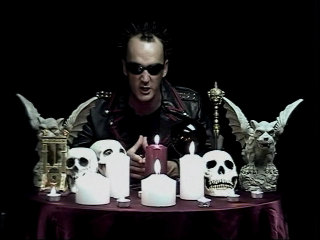
I would be remiss if I didn't mention the ludicrous introduction featuring a leather-jacket adorned "punk" doing his best growly metal voice as he sits on a skull-covered table. He gives a brief plot synopsis and then ends with "..you are Dead 7". Whatever the hell that means. I'm guessing this section was tacked on by Brain Damage Inc. - the original distributor - so, i'm not going to hold it against actual director Garrett Clancy.
In fact, the watch-ability of this production is almost solely because of Clancy's directorial chops, as while it never quite feels like a feature film (these shot-on-video productions always have an amateur feel), his approach feels like that of an experienced director. There's a polish - and I almost hate to use that word - missing from most of the films in this collection, and there's very little of the sound problems, video glitches, terrible lighting and awful continuity which have typified the productions so far. It's actually rather refreshing.
The plot is fairly standard. Meth dealer Brownley Dawkins (Joe Myles), along with his cronie Franky, murder a crooked associate who has ripped them off, dumping his body in an abandoned mine shaft in the woods. Unfortunately for Franky, he accidentally leaves his wallet at the scene of the crime, and even worse the pair run into their respective girlfriends (along with tag-along Drusilla (Gina Zachory), a significantly more sympathetic friend) who they drag back with them. Meanwhile, the rather unstable Venus Equinox (Delia Copold) is searching the area for her deaf and mute brother Harley, who accidentally stumbles upon the group before being unceremoniously left to die in the shaft.
Jump ahead three years and.. guess what? The group start being killed off one by one by a mystery murderer who may or may not be the zombiefied corpse of poor Harley. Drusilla runs into the now totally batshit Venus, only then becoming aware of the heinous crime she was part of, but it's already too late for her pals who suffer death by stabbing, death by OD, and other nasty ways of disposal. Brownley - who likes to get off while looking at polaroids of his victims - finally confronts Venus, before meeting a terrifically ironic fate.
Won't win any points for originality, and certainly it's not actually scary - the victims are all pretty much reprehensible, and since their murders are always shown from the first person their deaths don't tend to be very creative. But it's all actually surprisingly entertaining, as there's some fun dialogue (and plenty of strange line deliveries), and smatterings of nudity and gore from a very game cast. No academy award winners here, but everyone is obviously trying hard, particularly Myles as Brownlee who gives the oddest, but somehow most enjoyable, performance.
As mentioned, the film looks fine - though relies rather heavily on only a few locations (it makes Brownley look rather silly to hide a body in what appears to be quite a popular hangout) and there are only a couple of scenes which feel underlit. I was actually very impressed by the score composed by Jon Greathouse, which suits the action very well without being repetitive, or relying on generic rock songs.
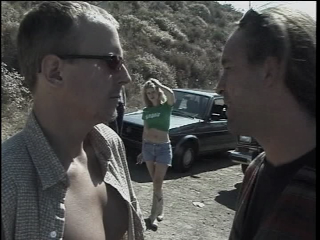
Dead 7 is presented full frame, shot on video. There appear to be a few dropped frames, but nothing too distracting and the film looks fine - despite being packed on a disc with three other movies. Oh, and being part of the Bloody Nightmares we of course get absolutely no extras and no chapter stops. Because apparently that would be too darn difficult.
A pleasant enough time waster, Dead 7 is one of the more adept of the no-budget offerings encountered in the Bloody Nightmares box-set. It's directed with style, but doesn't overwhelm with visual tricks, and it's easy to see why director Garrett Clancy has gone on to slicker fare - or, at least straight-to-dvd productions starring C. Thomas Howell. I would still hesitate to actually call it a good film, but it goes down easy and horror fans should get some decent kicks out of it.
Tuesday, August 10, 2010
The Friends of Eddie Coyle (1973)
 "One of the first things I learned is never to ask a man why he's in a hurry. All you got to know is I told the man that he could depend on me because you told me I could depend on you. Now one of us is gonna have a big fat problem."
 THE FRIENDS OF EDDIE COYLE is an underrated slice of 70's crime drama about a lowlife busher running guns for the Mob who finds out he's facing jail time with no appeal. Torn between turning snitch and preserving his loyalty and integrity, Coyle moves glacially towards his final decision, while unbeknownst to him, the machinations of others, moving quickly and wily, are setting an unwitting trap from which Coyle himself cannot escape.
Coyle is played by Robert Mitchum, who gives a performance full of pathos and gravitas, accentuating the weariness and wariness of a two-bit loser looking to cash out before it's too late. Mitchum understands that for a character like Coyle, there is no time for melodrama. Check out how he keeps his cool here while dealing with a snot-nose hot shot who thinks he knows better. Coyle's message is stubborn and worn, easily dismissed were it not delivered with just the right note of casual menace:
Scenes like this make the film great as Mitchum brings the weight of his entire film noir career to bear on a single character whose flaws embody the path a man would take to get out of a situation he's remained in too long. Coyle doesn't want to turn snitch but he no longer wants to risk jail and he's too proud to see his family end up on welfare. Family still means something to him, even if he seems a stranger to his own children. Having spent a life unhurried and unambitious, he now struggles to turn those instincts on. Mitchum is smart in making Coyle slow but not stupid. He tries to play the odds, find an angle, give up the hot-shot to protect his mob buddies but it all backfires (as it must, the film makes you feel as if its outcome is inevitable).
In between the film's quieter, character moments, director Peter Yates stages a series of ever-escalating bank heists, scenes that drip with tension as the scenarios heighten and unfold. The 70s was a bank heist decade and these scenes while good are also cold, calculated, almost sterile -- the complete opposite of the inflamed passions of DOG DAY AFTERNOON. You are witness here to the clinical efficiency of the Mob, who treat home invasions and bank robberies as jobs only, no passion just purpose. The way Yates weaves these storylines together as counterpoint is brilliant. We don't quite see the connection between these high-stakes hits and Coyle's bleak existence until it is almost too late for Coyle to escape. He is the bottom layer, the mud on the boot. When it's time to sever connections, he's the one wiped off.
 The film makes great use of Boston as both a location and a character, relying on the setting to tell a greater story. You learn more about the tight-lipped Coyle from where he lives and socializes than you do from any exposition of character. This is the seedy underbelly of a decaying society (strip malls, bowling alleys, dive bars, diners) juxtaposed with the shiny surface of downtown Boston, City Hall, and the suburban banks and homes the Mob hits. Two worlds difficult to bridge, and to survive, Coyle would have to bridge them, though he is slow, beaten to the punch by Peter Boyle's malevolently underhanded Dillon, a character rich in seasoned mistrust and opportunism. Where Coyle is steady in his habits, easy to set up, Dillon is sharp, quick to sell-out.
In between the film's quieter, character moments, director Peter Yates stages a series of ever-escalating bank heists, scenes that drip with tension as the scenarios heighten and unfold. The 70s was a bank heist decade and these scenes while good are also cold, calculated, almost sterile -- the complete opposite of the inflamed passions of DOG DAY AFTERNOON. You are witness here to the clinical efficiency of the Mob, who treat home invasions and bank robberies as jobs only, no passion just purpose. The way Yates weaves these storylines together as counterpoint is brilliant. We don't quite see the connection between these high-stakes hits and Coyle's bleak existence until it is almost too late for Coyle to escape. He is the bottom layer, the mud on the boot. When it's time to sever connections, he's the one wiped off.
 The film makes great use of Boston as both a location and a character, relying on the setting to tell a greater story. You learn more about the tight-lipped Coyle from where he lives and socializes than you do from any exposition of character. This is the seedy underbelly of a decaying society (strip malls, bowling alleys, dive bars, diners) juxtaposed with the shiny surface of downtown Boston, City Hall, and the suburban banks and homes the Mob hits. Two worlds difficult to bridge, and to survive, Coyle would have to bridge them, though he is slow, beaten to the punch by Peter Boyle's malevolently underhanded Dillon, a character rich in seasoned mistrust and opportunism. Where Coyle is steady in his habits, easy to set up, Dillon is sharp, quick to sell-out.
Peter Yates had directed several incredible crime films previously, including both BULLITT and ROBBERY. This, however, may be his masterpiece. A grim slice of 70's understatement that languished for decades before being faithfully and lovingly restored by Criterion. All fans of 70s cinema, particularly of the crime and noir persuasion, owe this film a viewing.
 THE FRIENDS OF EDDIE COYLE (Yates, USA, 1973)
Friday, August 6, 2010
Capsule Review: The Princess Bride (1987)

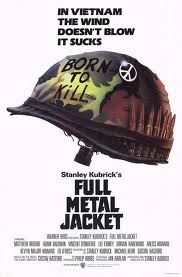
Capsule Review: Full Metal Jacket (1987)
Tuesday, August 3, 2010
Capsule Review: Raise The Red Lantern (1991)

Capsule Review: Blade Runner (1982)

Subscribe to:
Posts (Atom)


