Showing posts with label Noir. Show all posts

Monday, July 11, 2011

Night Moves (1975)

"You mind if I ask you what the set-up is?"

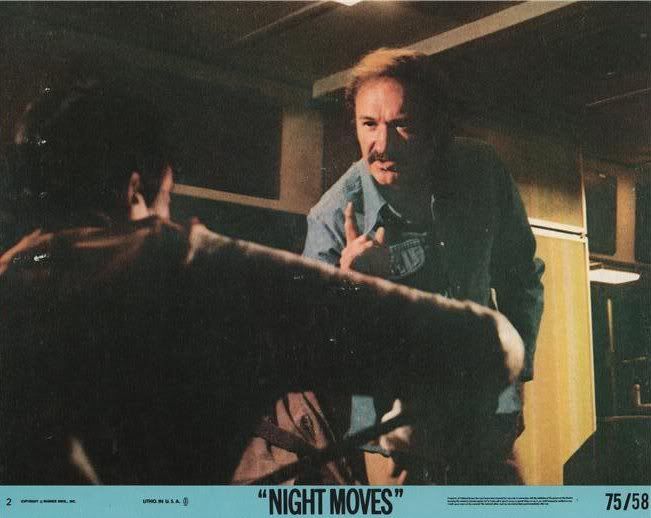
NIGHT MOVES rests almost entirely on the character of Harry Moseby, a retired football player turned cut-rate private eye who stumbles into a complex smuggling operation while tracking a missing girl. Gene Hackman plays Moseby with a weary eye and wounded pride. He's an average operator, often behind on the score. He trades on his lingering sports fame and a kind of blustery toughness to make easy cases. Harry Moseby is no hero. He's too tired, too depressed, and too slow on the uptake to be of any real use to anyone, including his wife and the client he's trying to find.

That we buy into Moseby's character is essential because the plot of the film is deliberately misleading, hiding and revealing in equal amounts to leave both character and audience in the dark: there's a missing girl, some shady stuntmen, sailors, and mechanics, a boozed out mother with a bad history, and a wary ex-stripper whose motivations are suspect only because it seems Harry can't trust a woman regardless of her intentions. These characters revolve around each other in a sort of pointless circling centered around Harry and his inability to make heads-or-tails out of their greater relationship. When the final piece of the puzzle is revealed, the result is only more enigmatic, bleak, and disheartening. There's no answer for Harry, nothing to solve. As he himself stated, Harry Moseby doesn't so much solve cases as stumble into their resolution. In that sense, it's almost classically noir, in that he did a lot of work but little good. Almost everyone involved is dead and Harry's got nothing to show for it except a wounded leg.

Arthur Penn directed NIGHT MOVES as a meditation through genre on the existential ennui of the post-Watergate era. And as an ambitious experiment in that direction, it fails to deliver. A straight forward, slightly nuanced noir would've worked better in keeping the pace and setting out the detail. Instead, NIGHT MOVES feels waterlogged. A sub-plot involving Moseby and his wife starts promising on the thrill of adultery but settles into a mawkish exploration of Moseby's childhood abandonment issues and his resultant false bravado in the face of emotion. This really sidetracks the main premise and undermines the nuanced work that Hackman was doing with the character. All the layering was already there, in his face and movement and terseness. Hackman nailed the character, no explication necessary.

Another fault is Penn's overall direction and cinematic vision. The film is visually unengaging. Aside from a thrilling stunt and some beautiful shots at the finish, the composition, framing, and editing are all sub-standard (even by 70's thriller standards). You'd never guess that such an acclaimed director was at the helm. The entire films looks and feels flat. If it weren't for Hackman's magnetism and profound abilities as an actor, NIGHT MOVES really wouldn't be worth watching. For all it's acclaim, I was left wanting, intrigued more by the squandered potential than by what was actually delivered.

One thing I did like about the film is that it proves that not all noir films need dark alleys and deepening shadows to bring across their brooding cynicism and despair. NIGHT MOVES is so sun-drenched as to be bleached out. There's no room for romance, hope, and optimism under such a bright and unrelenting sky.
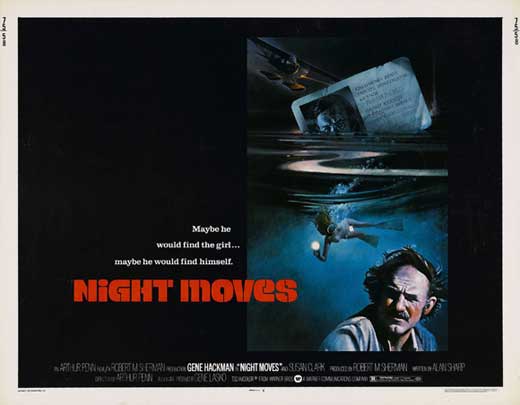
NIGHT MOVES (Penn, USA, 1975)

Tuesday, August 10, 2010

The Friends of Eddie Coyle (1973)

"One of the first things I learned is never to ask a man why he's in a hurry. All you got to know is I told the man that he could depend on me because you told me I could depend on you. Now one of us is gonna have a big fat problem."

THE FRIENDS OF EDDIE COYLE is an underrated slice of 70's crime drama about a lowlife busher running guns for the Mob who finds out he's facing jail time with no appeal. Torn between turning snitch and preserving his loyalty and integrity, Coyle moves glacially towards his final decision, while unbeknownst to him, the machinations of others, moving quickly and wily, are setting an unwitting trap from which Coyle himself cannot escape.

Coyle is played by Robert Mitchum, who gives a performance full of pathos and gravitas, accentuating the weariness and wariness of a two-bit loser looking to cash out before it's too late. Mitchum understands that for a character like Coyle, there is no time for melodrama. Check out how he keeps his cool here while dealing with a snot-nose hot shot who thinks he knows better. Coyle's message is stubborn and worn, easily dismissed were it not delivered with just the right note of casual menace:


Scenes like this make the film great as Mitchum brings the weight of his entire film noir career to bear on a single character whose flaws embody the path a man would take to get out of a situation he's remained in too long. Coyle doesn't want to turn snitch but he no longer wants to risk jail and he's too proud to see his family end up on welfare. Family still means something to him, even if he seems a stranger to his own children. Having spent a life unhurried and unambitious, he now struggles to turn those instincts on. Mitchum is smart in making Coyle slow but not stupid. He tries to play the odds, find an angle, give up the hot-shot to protect his mob buddies but it all backfires (as it must, the film makes you feel as if its outcome is inevitable).

In between the film's quieter, character moments, director Peter Yates stages a series of ever-escalating bank heists, scenes that drip with tension as the scenarios heighten and unfold. The 70s was a bank heist decade and these scenes while good are also cold, calculated, almost sterile -- the complete opposite of the inflamed passions of DOG DAY AFTERNOON. You are witness here to the clinical efficiency of the Mob, who treat home invasions and bank robberies as jobs only, no passion just purpose. The way Yates weaves these storylines together as counterpoint is brilliant. We don't quite see the connection between these high-stakes hits and Coyle's bleak existence until it is almost too late for Coyle to escape. He is the bottom layer, the mud on the boot. When it's time to sever connections, he's the one wiped off.

The film makes great use of Boston as both a location and a character, relying on the setting to tell a greater story. You learn more about the tight-lipped Coyle from where he lives and socializes than you do from any exposition of character. This is the seedy underbelly of a decaying society (strip malls, bowling alleys, dive bars, diners) juxtaposed with the shiny surface of downtown Boston, City Hall, and the suburban banks and homes the Mob hits. Two worlds difficult to bridge, and to survive, Coyle would have to bridge them, though he is slow, beaten to the punch by Peter Boyle's malevolently underhanded Dillon, a character rich in seasoned mistrust and opportunism. Where Coyle is steady in his habits, easy to set up, Dillon is sharp, quick to sell-out.

Peter Yates had directed several incredible crime films previously, including both BULLITT and ROBBERY. This, however, may be his masterpiece. A grim slice of 70's understatement that languished for decades before being faithfully and lovingly restored by Criterion. All fans of 70s cinema, particularly of the crime and noir persuasion, owe this film a viewing.

THE FRIENDS OF EDDIE COYLE (Yates, USA, 1973)


Thursday, February 4, 2010

The Outfit (1973)

"You hit my brother and you came after me, that's no good. The Outfit's gonna pay me money for my trouble. I figure $250,000 to make things right."

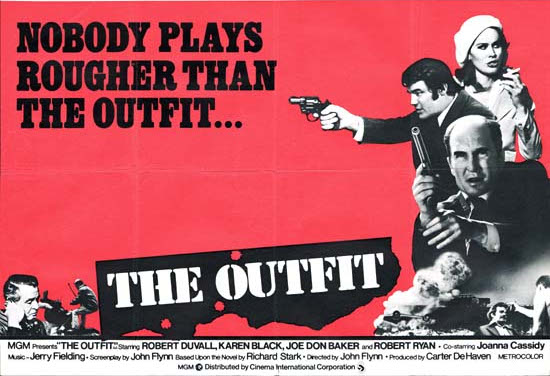
THE OUTFIT doesn't waste time. As a 70's revenge thriller of the highest order, it sets about its premise quickly and ruthless. Nothing stylish. Nothing fancy. Motives are given and acted upon. Violence is dispensed. Vengeance is served. Characters are dispatched swiftly and brutally. Though nothing truly satisfying comes of it. For a bunch of hard cases like Macklin and Cody, a good laugh at their getaway and some extra cash in their wallet is the only highlight. Those they've hit will soon hit back.

THE OUTFIT takes place in a hard lit, low-rent world full of hustlers, drifters, con-men, and criminals. All jockeying to see what the score is. All afraid of a man like Macklin for whom revenge is the only answer, so long as he profits by it. This is not a sentimental man. He mourns his murdered brother, broods over the contract on his head, wonders if he is finished as a criminal, but never once deviates from his purpose despite having plenty of opportunities to do so. He wants payback. And he wants to get paid for it.

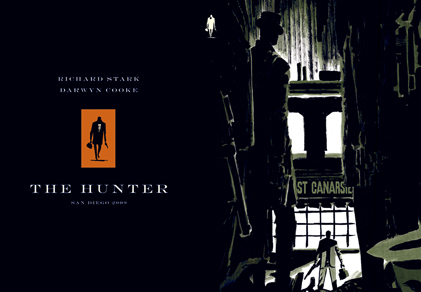
THE OUTFIT is based on the novel of the same name by Donald E. Westlake (writing as Richard Stark). It is the third novel in the infamous Parker series, which also gave us a novel called "The Hunter" which has been made into multiple movies, including POINT BLANK. It was also recently adapted as a graphic novel by Darwyn Cooke (with a version of "The Outfit" on the way).

Westlake wrote his Parker novels under a pseudonym because, compared to his other novels, they are hard-boiled to the extreme. He was also very protective of his character. In none of the film adaptations is the Parker character actually called Parker. The tone of the character is usually off too, though THE OUTFIT comes closest to bringing the amorality and cool- headedness of Parker to life through Duvall's portrayal of Macklin. The scene below, where Macklin heists a poker game, is one of my favorites...


The film also features Joe Don Baker as Cody and Karen Black as Bett. Both of whom are totally bad-ass. Baker stirs some humor in with his grit as an ex-criminal gone legit and Black gives one of her better performances as the protective gun moll whose strained relationship with her family forces her to continue along with Macklin despite many misgivings. Rounding out the cast is a veritable who's who of former film noir stars, including Jane Greer, Marie Windsor, Emily Meyer, Timothy Carey, and Elisha Cook Jr. Robert Ryan also turns up in his final film performance as Mailer, the weary mob kingpin whom Macklin keeps hassling.

THE OUTFIT has never been issued on DVD. There are bootleg copies floating around. VHS copies demand a pretty price, though the quality of the VHS print is below-average at best. I have seen streams as well, though sometimes they are of edited television broadcasts that have been recut into absurdity. Only TCM rebroadcasts the film uncut so catch it there if you can.

I was lucky enough to see THE OUTFIT at Anthology Film Archives in New York City. It was part of a great series of currently unreleased 70's thrillers, including another John Flynn film, the exploitation masterpiece ROLLING THUNDER. Both films deserve to be on DVD.

THE OUTFIT (Flynn, USA, 1973)