Showing posts with label 70s. Show all posts

Monday, July 11, 2011

Night Moves (1975)

"You mind if I ask you what the set-up is?"

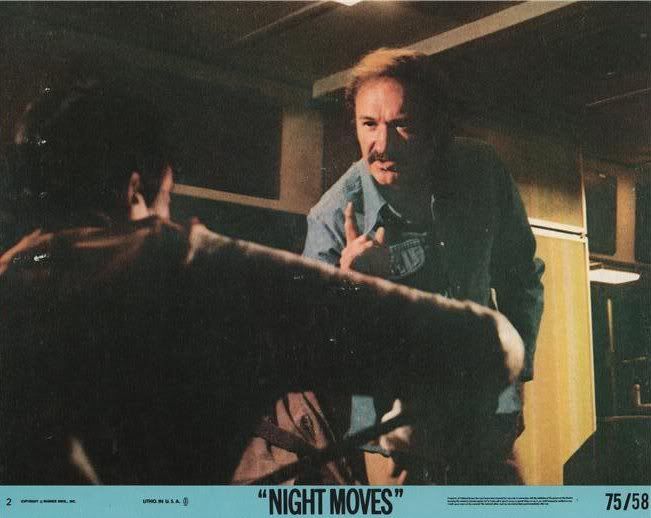
NIGHT MOVES rests almost entirely on the character of Harry Moseby, a retired football player turned cut-rate private eye who stumbles into a complex smuggling operation while tracking a missing girl. Gene Hackman plays Moseby with a weary eye and wounded pride. He's an average operator, often behind on the score. He trades on his lingering sports fame and a kind of blustery toughness to make easy cases. Harry Moseby is no hero. He's too tired, too depressed, and too slow on the uptake to be of any real use to anyone, including his wife and the client he's trying to find.

That we buy into Moseby's character is essential because the plot of the film is deliberately misleading, hiding and revealing in equal amounts to leave both character and audience in the dark: there's a missing girl, some shady stuntmen, sailors, and mechanics, a boozed out mother with a bad history, and a wary ex-stripper whose motivations are suspect only because it seems Harry can't trust a woman regardless of her intentions. These characters revolve around each other in a sort of pointless circling centered around Harry and his inability to make heads-or-tails out of their greater relationship. When the final piece of the puzzle is revealed, the result is only more enigmatic, bleak, and disheartening. There's no answer for Harry, nothing to solve. As he himself stated, Harry Moseby doesn't so much solve cases as stumble into their resolution. In that sense, it's almost classically noir, in that he did a lot of work but little good. Almost everyone involved is dead and Harry's got nothing to show for it except a wounded leg.

Arthur Penn directed NIGHT MOVES as a meditation through genre on the existential ennui of the post-Watergate era. And as an ambitious experiment in that direction, it fails to deliver. A straight forward, slightly nuanced noir would've worked better in keeping the pace and setting out the detail. Instead, NIGHT MOVES feels waterlogged. A sub-plot involving Moseby and his wife starts promising on the thrill of adultery but settles into a mawkish exploration of Moseby's childhood abandonment issues and his resultant false bravado in the face of emotion. This really sidetracks the main premise and undermines the nuanced work that Hackman was doing with the character. All the layering was already there, in his face and movement and terseness. Hackman nailed the character, no explication necessary.

Another fault is Penn's overall direction and cinematic vision. The film is visually unengaging. Aside from a thrilling stunt and some beautiful shots at the finish, the composition, framing, and editing are all sub-standard (even by 70's thriller standards). You'd never guess that such an acclaimed director was at the helm. The entire films looks and feels flat. If it weren't for Hackman's magnetism and profound abilities as an actor, NIGHT MOVES really wouldn't be worth watching. For all it's acclaim, I was left wanting, intrigued more by the squandered potential than by what was actually delivered.

One thing I did like about the film is that it proves that not all noir films need dark alleys and deepening shadows to bring across their brooding cynicism and despair. NIGHT MOVES is so sun-drenched as to be bleached out. There's no room for romance, hope, and optimism under such a bright and unrelenting sky.
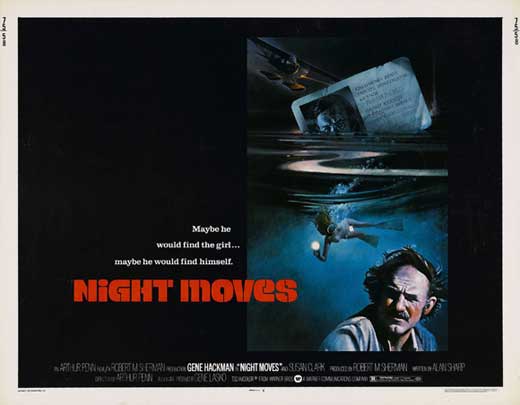
NIGHT MOVES (Penn, USA, 1975)

Wednesday, January 12, 2011

RIP, Peter Yates

Peter Yates passed away on Sunday, January 9th, 2011. He was 81 years old. I recently reviewed one of Yates' many masterpieces, "The Friends of Eddie Coyle," here last year. The performance that Yates gets out of Robert Mitchum is one of the best of his career

Yates is most famous for "Bullitt" and its masterful car chase sequence -- a scene barely topping another amazing chase sequence in Yates' other great crime masterpiece, "Robbery."


This is one of several excellent chase scenes throughout the film. It was Steve McQueen who saw this film in England and then recommended Yates for the Bullitt gig asking that he replicate and top the London car chase sequences, which he did. Unfortunately, "Robbery" is currently unavailable on DVD in the states, though streams of it pop-up on-line from time to time.

Though best known for this trio of crime films, Yates also directed the cult-fantasy epic "Krull," as well as some more mainstream dramas like "Breaking Away" and "The Dresser."

The New York Times has posted a detailed obituary for Yates here:

http://www.nytimes.com/2011/01/11/movies/11yates.html

Wednesday, October 27, 2010

Interiors (1978)

"At the centre of a sick psyche is a sick spirit."

INTERIORS was Woody Allen's first stab at drama. It is icy, murky, dark, and sick at heart. It unfolds at a glacial pace, quiet and self-absorbed, content to let silence speak louder than words.

INTERIORS has often been derided as dull, derivative, and pretentious; yet also praised for the miracle of its composition. That Allen is mired in his influences is obvious. This is his "Bergman" movie. His LONG DAY'S JOURNEY INTO NIGHT. His Chekovian familial portrait. And Allen, in the awkwardness of his first serious drama, does not adequately surpass these influences. His direction is at times heavy-handed pushing the actors into moments of unnecessary melodrama.That said, there is a hell of a lot going on here that is worthy of attention.

As mentioned above, the cinematography is breathtaking, elevating the material through deft additions of texture and mood. Particularly in the framing and lighting of scenes wherein the rooms are often sparely lit with lots of shadows and gray spaces for the actors to hide in. These stark, arresting images set the stage. Silence factors in as Allen moodily allows for sound to naturally develop. The stillness of the images coupled with the silence and natural ambient noises of creaking wood and distant breaking waves set the tone for the entire film within the first two minutes.

Allen assembles another one of his great casts and, though the cold dysfunctional family plot may be routine, gives them avenues to explore different sides of their abilities. Diane Keaton does her usual great work, pushing her character to a critical depth often unseen in many of her other comic performances. That Keaton's character is depressed and upset is often obvious despite her character's internalization. The tension between her and her husband is well-handled, commenting on its own cliches without pandering into irony. Richard Jordan hits the right notes as her alcoholic husband, though his character is underwritten making the deeper core of their misunderstandings difficult to interpret.

My favorite performance comes from Mary Beth Hurt, whose indecisive, guilt-riddled character is a throbbing ball of violent rage well-caged. When she finally unleashes her vitriol, the film comes briefly alive -- a cathartic release that Allen's been building towards the entire time. Hurt gives a well-controlled performance, building sympathy for a very unsympathetic character.

Unfortunately, the other characters never come quite into the fullness necessary to convey the impact Allen is seeking. Geraldine Page's Oscar-nominated turn as the family matriarch is sadly underwhelming. We recognize her hurt and despair but the key scenes of her mental anguish are discussed without clear demonstration. Her violent, sobbing rages are agonizing to watch but lack a grounding as the script glosses over the crucial moment that conflicts these characters and binds them altogether. Ditto for E.G. Marshall's careworn patriarch. His motivations and justifications are clear but we never get a sense of his true feelings. His stoicism feels a pose but we are not privileged to find out more.

Perhaps that's Allen aim after all. INTERIORS, as its name suggests, is a very closed film. We are on the outside looking in on a family that cannot be open. Those who do reveal themselves are quickly hurt, resealing themselves within. There is no real access and we, as an audience, are often left as adrift as they are. Despite these criticisms, INTERIORS is a film well worth watching.

INTERIORS (Allen, USA, 1978)


Tuesday, August 10, 2010

The Friends of Eddie Coyle (1973)

"One of the first things I learned is never to ask a man why he's in a hurry. All you got to know is I told the man that he could depend on me because you told me I could depend on you. Now one of us is gonna have a big fat problem."

THE FRIENDS OF EDDIE COYLE is an underrated slice of 70's crime drama about a lowlife busher running guns for the Mob who finds out he's facing jail time with no appeal. Torn between turning snitch and preserving his loyalty and integrity, Coyle moves glacially towards his final decision, while unbeknownst to him, the machinations of others, moving quickly and wily, are setting an unwitting trap from which Coyle himself cannot escape.

Coyle is played by Robert Mitchum, who gives a performance full of pathos and gravitas, accentuating the weariness and wariness of a two-bit loser looking to cash out before it's too late. Mitchum understands that for a character like Coyle, there is no time for melodrama. Check out how he keeps his cool here while dealing with a snot-nose hot shot who thinks he knows better. Coyle's message is stubborn and worn, easily dismissed were it not delivered with just the right note of casual menace:


Scenes like this make the film great as Mitchum brings the weight of his entire film noir career to bear on a single character whose flaws embody the path a man would take to get out of a situation he's remained in too long. Coyle doesn't want to turn snitch but he no longer wants to risk jail and he's too proud to see his family end up on welfare. Family still means something to him, even if he seems a stranger to his own children. Having spent a life unhurried and unambitious, he now struggles to turn those instincts on. Mitchum is smart in making Coyle slow but not stupid. He tries to play the odds, find an angle, give up the hot-shot to protect his mob buddies but it all backfires (as it must, the film makes you feel as if its outcome is inevitable).

In between the film's quieter, character moments, director Peter Yates stages a series of ever-escalating bank heists, scenes that drip with tension as the scenarios heighten and unfold. The 70s was a bank heist decade and these scenes while good are also cold, calculated, almost sterile -- the complete opposite of the inflamed passions of DOG DAY AFTERNOON. You are witness here to the clinical efficiency of the Mob, who treat home invasions and bank robberies as jobs only, no passion just purpose. The way Yates weaves these storylines together as counterpoint is brilliant. We don't quite see the connection between these high-stakes hits and Coyle's bleak existence until it is almost too late for Coyle to escape. He is the bottom layer, the mud on the boot. When it's time to sever connections, he's the one wiped off.

The film makes great use of Boston as both a location and a character, relying on the setting to tell a greater story. You learn more about the tight-lipped Coyle from where he lives and socializes than you do from any exposition of character. This is the seedy underbelly of a decaying society (strip malls, bowling alleys, dive bars, diners) juxtaposed with the shiny surface of downtown Boston, City Hall, and the suburban banks and homes the Mob hits. Two worlds difficult to bridge, and to survive, Coyle would have to bridge them, though he is slow, beaten to the punch by Peter Boyle's malevolently underhanded Dillon, a character rich in seasoned mistrust and opportunism. Where Coyle is steady in his habits, easy to set up, Dillon is sharp, quick to sell-out.

Peter Yates had directed several incredible crime films previously, including both BULLITT and ROBBERY. This, however, may be his masterpiece. A grim slice of 70's understatement that languished for decades before being faithfully and lovingly restored by Criterion. All fans of 70s cinema, particularly of the crime and noir persuasion, owe this film a viewing.

THE FRIENDS OF EDDIE COYLE (Yates, USA, 1973)


Thursday, February 4, 2010

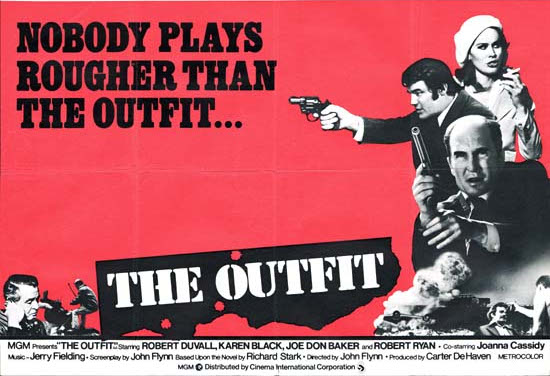
The Outfit (1973)

"You hit my brother and you came after me, that's no good. The Outfit's gonna pay me money for my trouble. I figure $250,000 to make things right."

THE OUTFIT doesn't waste time. As a 70's revenge thriller of the highest order, it sets about its premise quickly and ruthless. Nothing stylish. Nothing fancy. Motives are given and acted upon. Violence is dispensed. Vengeance is served. Characters are dispatched swiftly and brutally. Though nothing truly satisfying comes of it. For a bunch of hard cases like Macklin and Cody, a good laugh at their getaway and some extra cash in their wallet is the only highlight. Those they've hit will soon hit back.

THE OUTFIT takes place in a hard lit, low-rent world full of hustlers, drifters, con-men, and criminals. All jockeying to see what the score is. All afraid of a man like Macklin for whom revenge is the only answer, so long as he profits by it. This is not a sentimental man. He mourns his murdered brother, broods over the contract on his head, wonders if he is finished as a criminal, but never once deviates from his purpose despite having plenty of opportunities to do so. He wants payback. And he wants to get paid for it.

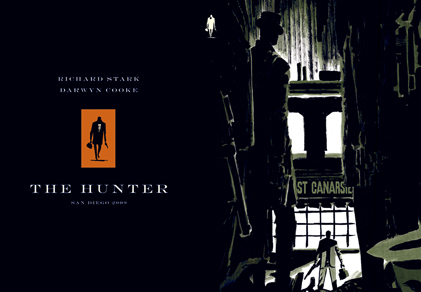
THE OUTFIT is based on the novel of the same name by Donald E. Westlake (writing as Richard Stark). It is the third novel in the infamous Parker series, which also gave us a novel called "The Hunter" which has been made into multiple movies, including POINT BLANK. It was also recently adapted as a graphic novel by Darwyn Cooke (with a version of "The Outfit" on the way).

Westlake wrote his Parker novels under a pseudonym because, compared to his other novels, they are hard-boiled to the extreme. He was also very protective of his character. In none of the film adaptations is the Parker character actually called Parker. The tone of the character is usually off too, though THE OUTFIT comes closest to bringing the amorality and cool- headedness of Parker to life through Duvall's portrayal of Macklin. The scene below, where Macklin heists a poker game, is one of my favorites...


The film also features Joe Don Baker as Cody and Karen Black as Bett. Both of whom are totally bad-ass. Baker stirs some humor in with his grit as an ex-criminal gone legit and Black gives one of her better performances as the protective gun moll whose strained relationship with her family forces her to continue along with Macklin despite many misgivings. Rounding out the cast is a veritable who's who of former film noir stars, including Jane Greer, Marie Windsor, Emily Meyer, Timothy Carey, and Elisha Cook Jr. Robert Ryan also turns up in his final film performance as Mailer, the weary mob kingpin whom Macklin keeps hassling.

THE OUTFIT has never been issued on DVD. There are bootleg copies floating around. VHS copies demand a pretty price, though the quality of the VHS print is below-average at best. I have seen streams as well, though sometimes they are of edited television broadcasts that have been recut into absurdity. Only TCM rebroadcasts the film uncut so catch it there if you can.

I was lucky enough to see THE OUTFIT at Anthology Film Archives in New York City. It was part of a great series of currently unreleased 70's thrillers, including another John Flynn film, the exploitation masterpiece ROLLING THUNDER. Both films deserve to be on DVD.

THE OUTFIT (Flynn, USA, 1973)

Thursday, July 23, 2009

The Man Who Stole the Sun (1979)

Photobucket

It starts--like more than a few Japanese films--with images of a mushroom cloud, a sight which I can only imagine is even more terrifying in Japan.

Makato Kido (Kenji Sawada) wants the police to call him “Nine,” since he can now be added to the list of eight nations who own nuclear weapons. He becomes known as “Mr. A-bomb” instead, a figure who achieves folk-hero status by holding the government ransom, threatening to detonate his homemade a-bomb if they don’t submit to his demands. To the kids at school, he’s just “Bubblegum,” a science teacher who is barely more mature than them, and who spends most of his time sleeping in class.

MSS1

Kido bores his students by teaching them about nuclear weaponry, rather than following the standard high school science text. Since they’ll never be tested on Kido’s lessons, the students tend to ignore him. And no wonder: Kido has almost no personality to speak of.

The teacher explains to his students that A-bombs are easy to make--you just need the plutonium. This is one of the strangest parts of the film: to get the plutonium necessary for his bomb, Kido breaks into a military installation (I think), which appears to be guarded by members of Devo. The action comes in a series of still frame images, portraying a suddenly James Bond-esque Kido getting his hands on the goods, all to some swell 70s music.

MSS2

Once he constructs the bomb (which we get to see, at length, in a series of montages), Kido is free to make his demands. But what is it that this terrorist demands? For starters, Kido wants to watch baseball games until the end--the TV stations always cut out after the seventh inning for the news. After that … well, he hadn’t thought that far. Enter “Zero” (Kimiko Ikegami), a local DJ who starts taking Kido’s calls on her new show. She suggests that “Mr. A-bomb” demand a Rolling Stones concert. He agrees with her and makes the demand, all to the chagrin of Detective Yamashita (Bunta Sugawara), a determined and heroic cop.

At this point, The Man Who Stole the Sun begins to look like a more run-of-the-mill cops and robbers story, except that the “good guy” is a science nerd with a nuclear weapon. The movie begins to engage in cat-and-mouse stuff, with car chases and the lot, and Kido having to be one step faster than the police. He never seems entirely aware of the severity of what’s going on--does he really have the guts to detonate the bomb? Or is it all just bluff? Kido seems more interested in constructing the bomb just to prove that he can; the power it grants him is almost an afterthought.

MSS3

Added to the cops and robbers plot is a budding romance between Kido and Zero. The disc jockey is obviously attracted to the mystique around Kido, and the element of danger involved in being with a criminal. Typical to the 70s (at least in North America), Zero has bought fully into the “us against them” attitude, considering those people who are over thirty, or in authority, as evil. Still, she’s a fairly shallow character, whose real motivation is never really felt by the audience.

Oddly enough, The Man Who Stole the Sun was written by Leonard Schrader, brother to writer/director Paul Schrader, with whom he wrote Taxi Driver. The Man Who Stole the Sun has more than a few similarities with that film--the outsider as protagonist, the dangerous loner lashing out against society in a random and homicidal fashion that still somehow encapsulates the irritation and rage of the everyday man.

MSS4

More so than in Taxi Driver, it’s not always clear in The Man Who Stole the Sun that the audience should be taking everything they see at face value. How much is actually supposed to be the events as they happen, and how much is supposed to be in Kido’s head? Does Kido really dump plutonium into a full swimming pool, or is it just something that he dreams up? While Taxi Driver seems like the more cerebral film, The Man Who Stole the Sun leaves you questioning whether or not some bigger statement is being made.

Or perhaps its just uneven. The car chases and the final battle with Detective Yamashita seem more like something out of a 70s cop show than a challenging work of art. I’m tempted to assert that this is somehow a comment on film itself, that a cops and robbers movie will always devolve into cliché and convention. Or something.

Despite its uneven nature, and its longer-than-necessary running time (147 minutes), The Man Who Stole the Sun is an intriguing film, and well worth seeking out, if only for the oddness of seeing a Western plot and story told by Japanese filmmakers.

Friday, May 22, 2009

The FALLOUT 3 Reviews: Logan's Run (1976)


In 1967, William F Nolan and George Clayton Johnston penned a novel that had the potential to be one of the most scathing critiques of humanity ever written. Sadly, it was a work that didn't really aspire to lofty heights and settled for something slightly above mediocrity.

It portrayed a world where human self-indulgence had literally made the earth uninhabitable and it drew a picture where 60's Counterculture and the Sexual Revolution had gone into overdrive and suddenly became the thing they despised the most: the establishment.

The 60's hippie mantra of "don't trust anyone over 30" became a law enforced with an iron hand and unyielding lethality.

Welcome to the world of Logan's Run.


The late 1960's to mid 1970's saw yet another boom in the lucrative Sci-Fi film market. 20 Century Fox scored big in 1968 with Planet of the Apes and rumors were that they were working on yet another large sci-fi project (which turned out to be Star Wars).

MGM decided that they needed a franchise of their own to compete at the box office so they tapped Michael Anderson to direct an abridged version of Logan's Run. The pressure was on since the summer of the previous year saw the box office titan, JAWS, hit the big screens and all of a sudden, the timeframe between the middle of May and the end of August became the focal point of a movie studio's major releases.

The Summer Blockbuster was born.

While very successful (earning an Oscar for visual effects, a Saturn for Best Film, and earned $50 million on a $9 million budget), Logan's Run was doomed to be eclipsed by the sci-fi films that followed, primarily Star Wars (1977), Close Encounters of the Third Kind (1977), and Alien (1979).

As far as the plot goes, the film never really delves all that deeply into the more satirical parts of the Logan novels and wisely sticks to telling the basic story within a fairly resonable runtime.

In this dystopia, overpopulation and war have all but destroyed the human race. Mankind now lives in domed cities where their every need (from food to plastic surgery to human companionship via "The Circuit") is provided for by the computer that runs all housekeeping and life-support functions.

Population control is given a rather ritualistic twist. In the future all births are achieved through cloning. Sexual contact is purely recreational (and encouraged) but pregnancy is outlawed.

Each clone is fitted with a gem embedded in the palm of their left hand known as a lifeclock. At the age of 30, the lifeclock turns black and the citizen must go to Carousel where they are subsequently put to death.

There is a strong belief in this new society that despite the obvious genocide taking place, some souls will actually be reused for future clones and thus everyone has a shot at immortality.

Dystopia being what it is, we outside observers know that the promise of renewal is pure bunk and so does the computer that runs everything. Therefore, the computer correctly hypothesizes that it will require some sort of security detachment to help enforce its will. That's where the Sandmen come in, and where Logan 5 (Michael York) enters the picture.

Those who try to escape their fate on Carousel are dubbed "runners," and it is a Sandman's job to terminate all runners.


Through the course of events of the film, the computer realizes that there is a small percentage of the population that remains unaccoutned for and assumes that despite its best efforts, citizens who decide to run are somehow managing to escape the confines of the domed city.

In a ruthlessly efficient response, the computer tasks Logan 5 with a secret mission. It alters Logan 5's lifeclock to make it appear as if Logan 5 is approaching his 30th birthday and then sends him out to make contact with any runner he can, so that he may follow the runner to Sanctuary (the mythical place where escaped runners have formed their own society) and destroy it.


To this end, Logan 5 enlists the aid of Jessica (Jenny Agutter), a girl that Logan 5 meets through "The Circuit" and correctly suspects has some intention to "run."

To this day, I always include the wonderful folks at the MGM wardrobe department in my bedtime prayers for putting the stunning Miss Agutter in the killer, green piece of nothing you see her draped in below.


Ahem... Anyway...

The following events see Logan and Jessica come to grips with startling realizations (primarily in the terrifying form of the insane robot, Box (Roscoe Lee Brown), and an amusing cameo from Peter Ustinov), catharsis, love, and finally in Logan's case, redemption.

You'll note that no one refers to the termination of runners or the renewal of those on Carousel as "death," and it is this philosophy along with the disturbingly utopian City of Domes that adds to the neo Genesis feel of the film with Logan and Jessica serving as our sci-fi version of Adam and Eve.

When the cost of paradise is paid with lives and individuality, then the only logical conclusion is to flee. Escaping from an Eden where nothing is as it appears to be is a very common theme in sci-fi and Logan's Run manages to put everything in a fairly entertaining package.


Watching Logan's Run in the present day has been bittersweet. The performances from the cast are acceptable enough to push the story along, but it really is a film that prefers style over substance. The story tends to drag during the parts where sleepguns aren't flashing or when Jenny Agutter isn't naked and the plot has holes large enough to drive a truck through.

I honestly think that this could've been one of those movies that might've been better than the book if it it had tried to more clearly address the society issues that the novel (and the novels that followed) only paid lip service to.

The caveat being that despite the rather average storytelling heights the novels aspired to, the basic concepts contributing to the premise were rather brave. The death age in the novels is 21, not 30, and I think that a project featuring young people (even minors) doing the same things that York and company did in this film would've never seen the light of day.

I still don't think society is ready for that sort of film, which probably explains why the oft-promised remake of Logan's Run still languishes in developmental hell. It's sort of tragic really.

In the 60's and early 70's, special effects really weren't at the stage where you could depict the changes in scenery or scope of concept in the Logan novels without spending tens of millions of dollars. The technology just wasn't there at the time.

Nowadays, the easiest thing to handle would be the special effects and it is the details of the story itself (especially in Logan's Run, where society is composed nearly entirely by teens and twenty-somethings) that would generate the most brow creasing and angst from film execs and audiences.

To this day, Logan's Run remains the semi-forgotten stepchild of the afterbirth of the Golden Age of Sci-Fi. An envelope pushing film rather than a groundbreaking one and certainly worth watching, however it certainly pales when compared to the true heavyweights of the genre that showed up when ILM changed all of the rules and Special FX became king.

Thursday, February 26, 2009

Valerie and Her Week of Wonders (1970)

VWWTit

Jaromil Jires’ Valerie and Her Week of Wonders is the type of film that most movie viewers think of when they hear the term “art house”: its foreign (and on top of that, its Czech, so it’s not even a “familiar” type of foreign); it is more concerned with the visual aspect of film than with storytelling; and it’s almost entirely inscrutable. People parodying foreign art house films might actually come up with something that is at least superficially similar to Valerie.

Do not take this description, though, to be a condemnation of the film. Indeed, the movie is far too beautiful to condemn, and too strange to dismiss. But you need to know what you’re getting yourself into.

VWW3

The plot (as much as it can be discerned) is as follows: Valerie (Jaroslava Schallerova), thirteen years old and beautiful, has just begun to menstruate. Her brother (but is he her brother? It’s never clear) breaks into the home that she shares with her grandmother and steals her earrings while she is sleeping, only to return them, explaining to her that they are magical. That same day, the carnival arrives. Among the tumblers is a man who looks a lot like Count Orlok, who Valerie sees as a monster. Her grandmother seems to recognize the man. Throughout the rest of the film, this vampiric figure is identified as a constable, a priest, and (most importantly) Valerie’s father, but it’s never clear if he’s any of them.

VWW2

And then things get weird. The stranger turns Valerie’s grandmother, willingly, into a vampire; a bunch of self-flagellating thugs chase off Valerie’s brother, at least for a while; the local priest tries to rape Valerie; etc., etc. The difficulty in following the film isn’t exactly in understanding what’s going on--there’s usually an explanation for everything, at least at some level--and you can follow the plot without causing yourself too many problems. The difficulty, such as there is, is one of interpretation. How, exactly, are you, the viewer, to interpret the events? Should they be understood as allegory (but allegory of what)? Should they be understood in some sort of psychoanalytic-symbolic sense? Is everything happening literal, and real--in the sense that the action of a horror movie, with monsters and all, is real? What are we to make of all of it?

Perhaps most worth noting, beyond its general strangeness, is the degree to which the film is saturated with sexuality. Little Valerie, having “become a woman,” finds herself desired by everyone--family especially. Her ‘brother’ is clearly sexually interested in her, as is the priest, the vampire, and her own grandmother. Not only does she become the object of desire, but she also becomes a desiring object, seemingly interested in everyone’s advances. Considering that Valerie, and the actress portraying her, is thirteen, you can add pedophilia to incest, when counting up the ways in which the film can make your skin crawl.

VWW3

I’ve said that the film’s inscrutable. So, what’s to be made of all of this? I certainly can’t claim to be familiar with the source material (a novel by Vitezslav Nezval), nor am I comfortable discussing the history or culture of Czechoslovakia in 1970. However, my basic stab at interpreting the film goes like this: Valerie, having entered womanhood, is thrust into the world of sexuality. That sex can be mysterious and horrifying, when first encountered (or when only imagined), accounts (to some extent) for both the unexplainable and the more horrifying aspects of the film. The more incestuous elements arise, I believe, from a similar confusion--as a child, a kiss from her grandmother, holding hands with a boy, etc., was only exactly what it was. Sex complicates all of that. There is sensuality everywhere, and everything that was once neutered is now, potentially, sexual. It’s a whole new world, and the film attempts to visualize that.

And it is in the visual realm that Valerie and Her Week of Wonders is most powerfully felt. Many of the film’s stills could be framed and put up on a wall, to be admired. I can scarcely think of two other films where so much time and effort has so clearly been put into making everything beautiful. Each shot is framed with the utmost care, each scene carefully composed. It’s truly wondrous to watch; that is, if you can sit through it.

Sunday, July 20, 2008

Chase Step By Step (1974)


PLOT:

A drought has hit a poor county in China and the people are suffering. Two circus performers, Tsao Wu & Ling Wing (Feng Hsu), are asked to escort a delivery of gold to the area. On the way they are attacked by everyone. Honestly. Every single person they run into tries to steal the gold, or kill them and *then* steal the gold. Eventually they reach the county and are (surprise) attacked once again. Luckily our two heroes use their significant kung-fu skills (and a few circus tricks) to smack around anyone who tries to attack them.


REVIEW:

Chase Step By Step is saddled with a bad title, but it actually has the ingredients to be a rather interesting kung-fu film. The idea of mixing circus performing (demonstrated in the opening credits) with kung-fu action would seem to be a natural mix, and the acrobatics of performers in the late 70s (and the comedy that was injected into kung-fu films of that era) might have proven this to be a precursor of that style. Unfortunately, while there are a few moments of unique action, the vast majority is slow, blandly choreographed kung-fu with some blatant undercranking meant to make the fights appear faster.

This style of kung-fu, where the opponents often don't appear to be even attempting to hit our heroes, was quite common in the mid-70s and could be looked past if the plot provided anything interesting. However, what exists of the plot is barely a skeletal structure on which to hang fight scene after fight scene. The relationship between the two leads quickly becomes irritating, with Ling Wing becoming intolerable as the film moves along. Her shrillness certainly doesn't do the film any favors.


To the film's benefit, the multitude of fight scenes at least keeps the pace moving and when the pair does use their circus-honed skills it makes for some interesting visuals. Tsao Wu uses stilts to briefly fight off some attackers, and the two walk across a tight-rope with the gold to escape some attackers. More integration of these sorts of skills might have made the material something special, but instead only serves to remind the viewer of the lost potential here.

The video quality of the film is rather abysmal at first (particularly in the opening credits, where the image is stretched horribly), but evens out to just being bad throughout a majority of the film. Occasionally the fight scenes find characters wandering in and out of frame, though this is a limitation of a 235:1 being cropped so significantly. The dubbed audio is often ludicrous, but is intelligible enough throughout most of the film.


Action packed, but tiresome kung-fu entry handicapped by some lackluster fighting that betrays the era it was made. Purely mediocre with a few memorable moments.