Tuesday, June 23, 2009

Horrors Of Malformed Men (aka Kyôfu kikei ningen: Edogawa Rampo zenshû) (1969)

Photobucket

"Banned for decades! The most notorious Japanese Horror film EVER made!" shouts the cover of Teruo Ishii's Horrors Of Malformed Men, and fans of extreme Japanese cinema could be excused for expecting something that could test the limits of even their not-delicate sensibilities. But the truth is actually much more interesting: The film was banned because back in 1969 the Japanese were still rather sensitive about how handicapped and "malformed" people were portrayed in film in the wake of the bombings of Hiroshima and Nagasaki, particularly when the characters are shown to be mentally unbalanced because of their deformities. While the film certainly has some disturbing content; touching on incest, mutilation and cannibalism; the story (which was pieced together from several stories by noted Japanese author Edogawa Rampo) is really a perverse mystery where all is revealed in the final ten minutes. It's the odd stylistic touches, particularly in the performance of Tatsumi Hijikata, that make this a special treat for fans of genre cinema.

Teruo Yoshida plays Hirosuke Hitomi, a young doctor who finds himself imprisoned with no memories of his past besides flashes in his dreams of a weird figure dancing by the beach of a strange island. After accidentally murdering someone in self defense, Hitomi escapes only to discover his rather incredible resemblance to a local man who has just passed away. Hitomi decides to impersonate the dead man in the hope of learning about a possible connection to the island from his dreams. What he actually discovers is an island full of deformed and malformed men and women, led by a strange doctor (Tatsumi Hijikata) who may actually be his father. All will be revealed on the island, but will Hitomi and his associates ever be able to leave?

Photobucket

Ironically for a film about the ugliness of man, Horrors Of Malformed Men is an often intensely beautiful film, from the spastic dancing from Hijikata to the painted female figures that litter the island, this is a stylish and attractive film, particularly in the second half. Even the opening credits, filled with extreme close-ups of spiders feeding, is grotesquely beautiful. Director Ishii's career spanned multiple genres over his long career, including some Sonny Chiba action films, but while he could make populist entertainment he wasn't afraid to make some odd and interesting choices in his filmmaking.

But it's the Butoh dancing of Tatsumi Hijikata that I take away most from the film. Butoh is more a movement than a specific style of dance, and often typically involves playful and grotesque imagery, taboo topics, extreme or absurd environments. In this film the actor is first seen moving almost crab-like among the rocks of the island, and when Hitomi finally meets him his "dance of darkness" is exciting while remaining disturbing to witness. The following gutteral, shifting performance is quite amazing, even as we discover some horrifying secrets about the island and its inhabitants.

Photobucket

Despite these unique and exciting elements, the film remains deeply flawed, particularly in its final ten minutes when Ishii feels the need to bring all of the elements - horror, mystery and tragedy- together. While the film is set up as a mystery from the beginning, with echoes of Hitchcock in its main character and his actions, I found myself losing interest in the whodunnit aspect of things by the time the cast made it to the island. Introducing a character who arrives to explain it all Scooby-Doo style undermines the tension significantly, and brings things to a rather abrupt halt. This scene is followed by a memorable but laughable scene that represents both the high and low point of the film.

Whatever flaws the film may have, the same cannot be said for the wonderful DVD from Synapse Films. The movie is presented in its original 2.35:1 aspect ratio and it looks pristine throughout, with sharp, mesmerizing colors. The film has clear and easy-to-read subtitles, a necessity in a movie that is designed to be dreamlike and confusing.

There are also some wonderful included extras which serve to put Horrors Of Malformed Men in the proper historical context while extrapolating on the history of Teruo Ishii and Edogawa Rampo. First we have a quiet, but intermittently fascinating, commentary from author Mark Schilling. I had to strain to hear the track at times, and there are long gaps of silence, but as someone who was instrumental in getting the film released it's still quite interesting to hear Schilling's perspective on the director's career.

More interesting is a featurette featuring brief interview segments with cult filmmakers Shinya Tsukamoto (Tetsuo: The Iron Man, Tokyo Fist) and Minoru Kawasaki (The Calamari Wrestler). Both men speak hightly of Ishii and his films, as well as the influence that the director has had on their own careers. Interspersed are tantalizing clips from some of Ishii's other films. Ishii in Italia is another short featurette following the director in 2003 at the Far East film festival in Udine, Italy. Clips of him introducing some of his films, including Malformed Men, are included. It's a breezy and fun segment showing a man that seemed very much alive just a few years before his death.

Finally, we also have a trailer for the film, a gallery of Ishii poster art, and brief biographies for Ishii and Edogawa Rampo.

Photobucket

Despite my reservations about the film's ending, this is a wonderful DVD that serves to both show a fascinating, and unfairly maligned, film, as well as examine the works of a director who deserves greater exposure for his large catalogue of films. Horrors Of Malformed Men is a beautiful, eerie and haunting work that has obviously influenced a generation of Japanese film-makers (you can see echoes of the film in parts of The Ring and other contemporary Japanese horror films). A truly impressive work, and well worth adding to your collection.


Monday, June 22, 2009

2LDK (2003)


Yukihiko Tsutsumi's 2LDK is the other film created for the Duel Project (mentioned in my review of Aragami (2003)).

For those not in the know, the term "2LDK" is Japanese realtor shorthand that applies to an apartment or a living space that has two multi-purpose rooms (serving as bedrooms or entertainment areas), a dining area and a kitchen.

As per the rules of the Duel Project, it is this apartment that will serve as the battleground for two of the most unlikely warriors in Japanese filmdom.


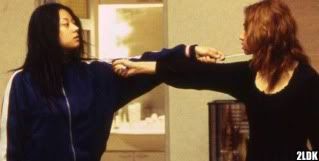
Nozomi (Eiko Koike) and Rana (Maho Nonami) are reluctant roommates and aspiring actresses.

Nozomi and Rana are also as different as night and day, and are as compatible as oil and water. Nozomi is your typical "country rube trying to make it big" story complete with additional emotional baggage while Rana is an accomplished studio whore looking for one last shot at greatness.

As it so happens, both ladies are up for the lead role in an upcoming film entitled, "Yakuza Wives."

No, I didn't just make that up.

It also turns out that the movie role isn't the only point of contention in the lives of these two women. They also share interest in the same man and as 2LDK winds along, tensions mount and eventually transform from catty verbal exchanges to all out friggin' war.

Like with any war, it's the little things that cause things to boil over. From those unsightly hairs left in the bathroom to spilt perfume to Rana using the last of Nozomi's shampoo without telling her, every minor irritation and transgression is yet another cobblestone on the road to hell.

And what a road it is. When conflict finally breaks out, it is as disturbing to behold as it is completely fucking hilarious, with action ranging from use of chainsaws, to drowining, to electrocution and yes...

Despite all of the hatred and violence, Tsutsumi finds a way to work in a scene where Rana and Nozomi kiss one another.

That's my kind of filmmaking, folks.


I found 2LDK to be a very interesting film thanks to what appeared to be Tsutsumi's remarkably keen understanding of the human psyche. Even though the hyperbole-rich 2LDK feels more like a Brothers Grimm-style terror fable than it does a microcosm of real life, it is dripping with insight into just how warped the human soul can become.

Nozomi and Rana aren't fighting because they see the other as an implacable enemy. They're doing it because they see the other as the proverbial "mirror darkly" that displays all of the loneliness, unrequited desire, and personal failure that they both desperately try to hide behind a glossy shell of either beauty or intellectual superiority.

These ladies are not terribly unlike Eihi Shiina's character in Takashi Miike's now iconic Audition (1999), masking complete batshit insanity with a near perfect public veneer of innocence and calm.

Given that glaring similarity, I'd love to sit down and chat with Tsutsumi or Miike some time and see if these respective films were created to creatively and indirectly address some greater societal ill without directly indicting Japanese culture as a whole (much in the manner that Pulse (aka Kairo) (2001) or Spirited Away (aka Sen to Chihiro no Kamikakushi) (2001) did), or if they did it just for the laughs and shock value.

2LDK certainly gets its point across, but its 70 minute runtime is too brief for my liking. While I don't think it's my place to tell an artist what his vision should be, I have to admit that I think that Tsutsumi was on the verge of creating a psychological thriller for the record books and I'm a little disappointed that it stopped just shy of that mark.

That being said, I hope that Tsutsumi will eventually return to this project and ponder over it a bit more, because there is certainly a lot more creative room to transform this from a haunting yet amusing short film into a dark epic that could put him on the worldwide cinematic map.


Friday, June 19, 2009

Godzilla: Final Wars (aka Gojira: Fainaru uôzu) (2004)

Photobucket

Has any film missed the point so spectacularly as Roland Emmerich's 1998 big-budget, CG-filled Godzilla? Fans of Gojira are a forgiving lot, having watched the King Of The Monsters go from a manifestation of post-Hiroshima nuclear paranoia in the 1950s to a kid-friendly superhero in the incredibly goofy 1970s iterations, but watching Matthew Broderick run away from Jim Henson's Godzilla babies was too much for even the most forgiving Godzilla lover. Thankfully it was only a year later that the Millennium Series of Godzilla films began with Godzilla 2000, eventually culminating in Ryuhei Kitamura's Godzilla: Final Wars, at this point the final Godzilla film that has been produced.

In many ways Kitamura has a similar objective to Emmerich in his approach towards the Godzilla mythos: to combine the elements that people love about the monster (which envelops all of his eras) with high tech special effects and an interesting science fiction story to give the big guy an appropriate (if temporary) sendoff. Of course, Kitamura has a rather distinctive (derivative) style of his own, so there's plenty of The Matrix and X-Men in here for good measure. Also there are lots and lots (and lots) of monsters. Lots of 'em.

Photobucket

Here's the line-up:
Gigan, Kumonga, Kamacuras, Rodan, King Caesar, Angurius, Hedorah, Ebirah and ZILLA (the U.S. Godzilla who Kitamura said took the "God" out of Godzilla", and is totally CGI in this film as well).

We also get the mysterious Monster X (who might have a connection to a fan favorite monster), as well as appearances by Mothra and (sigh) Minilla.

You would be forgiven for not being able to keep all of these monsters straight, and it's hardly necessary except for fans to see some of their favorites tackle with the big green one for the last time. Unfortunately for these fans, Godzilla makes short work of his foes in nearly all encounters, and some fan favorites get a bit shorted.

But what about the story? In the future Earth is protected by the Earth Defense Force who employ the M Organization, a collection of mutants with superhuman speed and strength, to protect the world against massive threats (usually in the form of giant ridiculous animals of some sort). When several of these monsters start attacking major cities at once the EDF seems to be out-matched, until a helpful group of aliens (called Xians) beam the baddies away before landing on Earth to talk of peace and friendship and all that good stuff. The End.

Or, more accurately, they are soon revealed to be EVIL, and threaten the world with monster attacks all over the place. And not only that, they also have the ability to control all of Earth's mutants (except Ozaki, our stoic hero)! Looks like we're screwed. Except Ozaki breaks the jailed, bad-ass Captain Gordon (MMA Fighter Don Frye) out of jail to help, and he comes up with a corker of an idea: Why not wake up Godzilla to take care of the monster threat? Before you know it, it's time to Destory All Monsters, and Godzilla (let by Gordon in his Atragon ship) begins trashing anything in his path. Also, Godzilla's kid gets in some wacky adventures.

Photobucket

Many Godzilla purists, if you can imagine such a thing, have taken issue with Kitamura's kitchen-sink approach to Godzilla: Final Wars, and one can easily see why. While obviously a love letter to Godzilla and its history, it's also comically flashy with modern Wire-Fu and Matrixy effects in nearly every scene. Frankly, it all sometimes seems like a bit much, particularly in a Motorcycle fight scene that manages to be even more ridiculous than the one in Mission Impossible II. It's all quite entertaining, but it takes focus away from the often meandering plotline and, even worse, from the big guy that everyone has paid to see. I give Kitamura credit for trying to beef up the human story in the film, since these scenes are often the dullest parts of earlier Godzilla films, but they sometimes feel like they've dropped out of a different film completely, and grow a bit tiresome.

The monster battles, short as they might be, are really quite impressive. The suits have been re-designed to be lighter and allow more movement, and (generally) subtle CG help helps give the creatures movement and flexibility well beyond that of their initial appearances. In one memorable fight Angurius, King Ceaser and Rodan (all previously friends of Godzilla) attack the big guy at once, Angurius rolling into a ball to attack before being used as a projectile in an impromptu soccer match. Godzilla leaves his former comrades laying in a heap (literally) in a scene reminicent of the lighter battles in the 1970s Godzilla films.

Photobucket

In fact, Kitamura seems to have trouble deciding just how lightly he wants to take the material. There are plenty of wisecracks (mostly from Frye's Captain Gordon), and nothing is taken too seriously, but the tone is inconsistent. One scene in New York city between a police officer and a pimp is eye-rollingly bad, and the acting by english-speakers as a whole is pretty incompetent. Frye seems to be trying hard, and he has a really fun part, but he's much better at looking like a bad-ass than delivering his lines. I suppose it wouldn't be a Godzilla film if there were not at least a few unintentional laughs.

The Sony DVD of Godzilla: Final Wars features the film in its original 2.35:1 aspect ratio, and the film looks absolutely terrific. Kitamura was afforded a comparatively large budget for the film, and while the effects can sometimes be a little iffy, the money is definitely up on the screen. Some mention must be made of the extremely unusual soundtrack by Keith Emerson (of Emerson, Lake & Palmer). The synth soundtrack strangely brings to mind Emerson's work for Dario Argento, and is a strange match for giant monsters, but it's still certainly interesting and only occasionally distracting. There's also a rock song by Sum-41 on the soundtrack that gets pretty primo billing in the opening credits for some reason.

Special features are unfortunately rather sparse. There are trailers for Final Fantasy VII, the 50 Years Of Godzilla collection, Steamboy, Dust To Glory, Madison, and Mirrormask. As well there's 18 minutes of Behind The Scene footage which shows a few flashes of interesting material, but is unfortunately missing any narration to put the material in context. Considering that the film was made to mark Godzilla's 50th anniversary, a bit more effort would have been appreciated.

Photobucket

A supremely goofy and overstuffed mess of a movie, Godzilla: Final Wars still succeeds by being nearly throroughly entertaining, and by showing respect for all aspects of the series' past. Not necessarily a good place to start for those wanting to get into the films for the first time, it marks a successfuly resting spot for modern Godzilla films until the inevitable next series comes along. Flashy and fun, it's certainly worth out for fans of giant monsters and destruction.

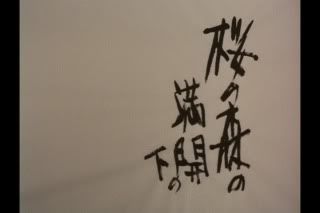
Under the Blossoming Cherry Trees (1975)

UBCC Title

PLOT:


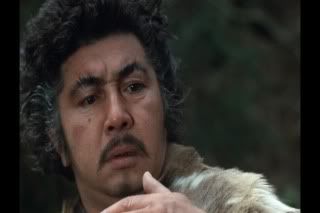
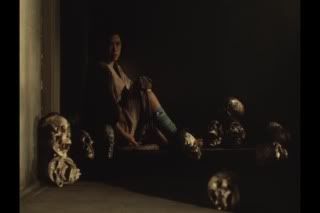
When a mountain man (Lone Wolf and Cub’s Tomisaburo Wakayama) kills a man and steals his wife (Shima Iwashita), he bites off more than he can chew. Rather than being a submissive victim, the beautiful woman soon browbeats her murderous husband into total compliance, convincing him to murder all but one member of his harem of dirty mountain women. She soon becomes his wife, and convinces him to take her (and the one girl she spared, now a maid) to the capital, where the mountain man begins his new vocation: collecting heads for his wife, who uses them as props in her own personal melodramas. Soon, Wakayama (his character has no name) becomes a feared figure in the city, and his wife’s collection of heads grows and grows. But how long can it last?

UBCC1

REVIEW:


Beauty and horror combine in equal measures in this mid-70s outing by Masahiro Shinoda. Under the Blossoming Cherry Trees begins with gorgeous images of cherry trees (you guessed it, blossoming) in a modern landscape. As people go about their day, and young voice tells us that it was once believed that those who walked under the blossoming cherry trees would lose their minds. And with that brief prelude, the film takes us back, into the past, where Wakayama attacks an entourage and takes by force the woman who will be his wife.

You can’t help but feel sorry for Wakayama, despite the fact that he plays a wild, unkempt, and murderous mountain man. In fact, there’s something cute about his rustic life, his shaggy looks, and the way his stocky little body sprints around the forest, causing mayhem. It’s a clear example of a bad character being made to look good by the presence of a truly evil character--in this case, his wife.

UBCC2

You know Wakayama is in for it almost immediately: when he tells his new wife that he’s abducting her, and taking her to his home, she makes him carry her. Surely, if he’s such a tough man, he can carry his wife up a mountain, right? And Wakayama, eager to show off his manliness, does just this, even though it entirely exhausts him. When he gets to his hovel, he introduces his new wife to six or seven others, which he’d probably accumulated in much the same way he got this new one. She asks him to kill them--all but one, to be her maid--and he does so. The mountain man clearly represents a sort of bestial, alpha male badness, but she represents something else altogether. Soon she henpecks him out of his comfort zone, forcing him to move to the capital. And then he is murdering for her, cutting off people’s heads so that his wife can put on bizarre, pornographic plays, with them as props.

Of only three main characters (the mountain man, his wife, and the maid), two are women, and they are both given strong, important roles. The maid, who has a crippled leg, is gentle, and acquiescent. She never complains, no matter how bizarre her new mistress is, and even though her sister-wives have recently been put to the sword by her former “husband.” But she is easily overshadowed by the wife, who is one of the most evil women in cinema.

UBCC3

And it’s worth commenting on her as an “evil woman,” and not just a woman who is evil, since her evil is directly tied to her gender. She entrances the mountain man with her beauty, and it is only by questioning his masculinity (and therefore acting as a woman questioning his status as a man). Once she begins collecting severed heads, it isn’t long before she incorporates them into her sex life, using them for all sorts of sexual degradations. It is her status as a woman--a beautiful, soul-sucking woman--that allows her to manipulate Wakayama as she does. So evil is she, it has to be wondered whether she’s a human at all.

Perhaps the wife is some sort of demon, or hungry ghost. It’s certainly a possibility. She seems strangely detached from the rest of the world--though she longs to leave his mountain cabin, when the mountain man takes her to the city, she remains indoors, hidden away with her grisly toys. Only the maid sees her, and perhaps her ready compliance to her mistress’s wants speaks to her awareness of her lady’s evil nature. Certainly this touch of the supernatural would not be out of place in a film where falling cherry blossoms are shown to drive people completely and utterly mad. And it is this madness, this mindless insanity, that the mountain man begins to crave, perhaps as the only escape from the trap that his wife has left him in.

Wednesday, June 17, 2009

Funeral Parade of Roses (1969)

Photobucket

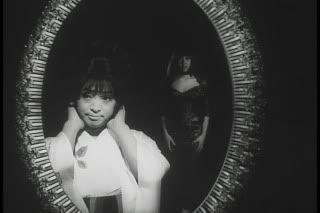
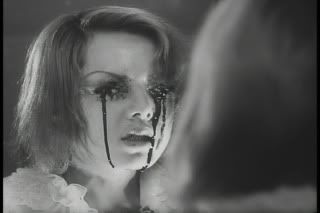
Man, the 60s were weird all over. Toshio Matsumoto’s Funeral Parade of Roses is a strange artifact of that wild decade, a bizarre experimental film which is part document of the youth counterculture, part a stylistic tale of the life of a drag queen, and part retelling of the Oedipus myth. Weird all over.

FPR1

Funeral Parade follows Eddie, a drag queen (played by Peter, who later went on to star as the fool in Kurosawa’s Ran) who works as a hostess in a gay bar and who is having an affair with the head queen’s lover. We follow Eddie as she works, loves, and plays in 60s Tokyo. Among her friends are a group of radical leftist “artists”; their leader is a man named Guevera, who wears a fake beard and mustache to look more like Che himself. I think he looks more like Jesus. Those who think of Japan as not just another country, but a whole other world, will be shocked to learn that their young leftists were just as idealistic and annoying as their US counterparts.

Eddie’s story, though, is really just there to form a narrative core to the film. Her affair, her struggles, and even her parallel to the mythical Oedipus, are all used to give some cohesiveness to the other elements of the film, which are Matsumoto’s main concern. That is to say that Funeral Parade is primarily a vehicle for Matsumoto’s experimental film making, and a way for the filmmaker to explore the 60s counterculture.

Photobucket

The film is able to cover a lot of aspects of Japanese society, and is largely able to do so by keeping those aspects in the background, or at least by dealing with them as part of the story rather than as blatant historic, non-fictional inserts. Eddie and her friends introduce us to the drag queen scene in Tokyo, which I can only imagine is a recently-outed portion of Japanese culture. As well, the filmmakers interview homosexuals in an open and honest manner, though treating them as a new and unexplored part of society. Occasionally the film features American military, reminding the viewer that this all takes place during the American occupation of Japan. Finally, through Eddie we are introduced to the aforementioned group or leftist radicals and hippies, the sort you’d expect to see in Berkley. It certainly surprised me to learn how similar to America Japan was back in 69.

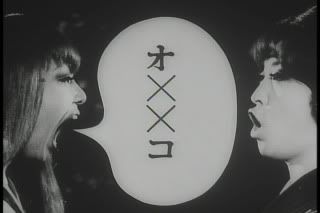
Matsumoto’s experimental film making seems especially well-suited to the film. In another context the bizarre editing and strange, symbolic inserts might seem ostentatious and out of place, but here it seems that the form of the film matches its content. Documenting a chaotic story and a chaotic era demands a chaotic form, I think, and a straight-up narrative wouldn’t deliver this. Among Matsumoto’s most striking tricks are some occasional speed-ups (think the ménage à trois scene in A Clockwork Orange) to accentuate frenetic, wild action; breaking of the fourth wall, in which the actors are interviewed, documentary-style, and in which you actually get to see the crew filming the scenes; and, perhaps most successfully, an argument between Eddie and another queen which is done manga-style, with voice bubbles instead of spoken dialogue.

Photobucket

Eureka’s “Masters of Cinema” line--a kind of Criterion Collection for Britain, I think--has released a really swell edition of Funeral Parade of Roses, and the good news is that it’s NTSC rather than PAL, so it should work in most players (at least, that’s my experience). Funeral Parade of Roses sure ain’t for everyone, and I be lying if I said that all of its experiments were successful ones; however, for Japanese movie buffs or cinephiles, the allure of the film is its place as a historical document, as a weird and wild symbol of 60s counterculture and experimentalism.

Monday, June 15, 2009

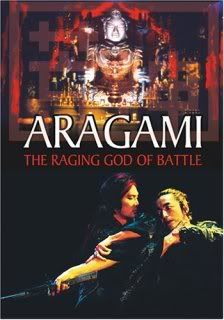
Aragami (2003)


As the story goes, Yukihiko Tsutsumi and Ryûhei Kitamura each finished their personal contributions to a short film anthology entitled Jam Films (2002) in record time.

As a result, producer Shinya Kawai threw down a punk card to both directors.

Each was create (not just writing and filming, we're talking total completion) a feature length movie in less than ten days, with the optimum time frame being a week.

The film had to feature two primary antagonists, no more than three supporting characters, a static setting, and it had to conclude with a showdown between the two key players.

The undertaking was called the Duel Project.

Yukihiko Tsutsumi's final product was the film 2LDK (2003), which I will be reviewing in the near future for the Japanese Cinema Blogathon.

Kitamura-san's idea turned out to be an engaging piece of work called Aragami.


Aragami takes place arguably sometime during the latter part of the Bakumatsu; the final years of the Edo Period that signaled the end of the Tokugawa Shogunate.

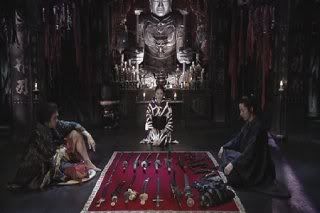
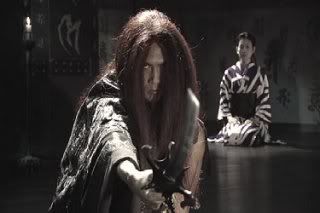
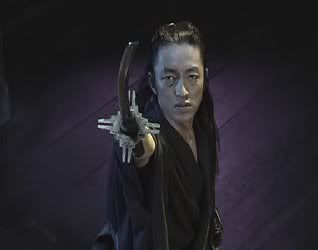
The action picks up with a badly injured samurai (Takao Osawa) and his nearly dead companion (Hideo Sakaki) finding refuge from a brutal storm inside the walls of a mysterious temple. The companion dies, but the remaining samurai is miraculously nursed back to health by a powerful swordsman (Masaya Kato) and his female companion (Kanae Uotani).

Over the course of the evening, the swordsman engages the samurai in a rather profound dialogue with topics ranging from battle tactics to reincarnation. The swordsman even claims to have been the great Miyamoto Musashi in a former life.

The samurai responds with mild amusement that gradually evolves into outright jovial disbelief.

But this is no laughing matter. The swordsman in actuality is a kami; an immortal being whose sole purpose is to hone his martial prowess far beyond that of normal men and pit his skill against the skill of other fighters. However, the one thing that centuries of existence has taught the kami is that everlasting life isn't all that it's cracked up to be.

The samurai then discovers the reason that his life has been spared. The swordsman's greatest desire is to give up his immortality and pass his mantle on to a successor. But it is not a mantle that can be freely given.

It has to be earned in a duel to the death.


Like most people, my first experience with Kitamura-san's work was the oft-maligned but ridiculously enjoyable, Versus (2000). Aragami represents a dramatic departure from the over the top heroics of Versus and Kitamura's light-hearted and bloodsoaked ninja epic, Azumi (2003).

Aragami is a surprisingly mature film. Kitamura manages not only to show his reverence for the folklore of his homeland while simultaneously poking fun at it, but also accomplishes the impressive feat of creating an ever-growing web of tension by use of one of the strangest plot devices I've ever seen.

A philosophical discussion over a cup of tea.

Even more arresting is the fact that when you do the math, this film consists of only two fights in its 79 minute runtime.

The rest is pure dialogue, yet Aragami never seems to drag.

The progressively grave tone of the conversation is like a clock of armageddon ticking down to the time when the swordsman and the samurai will draw steel against one another and find out whom fate truly favors.


It really bums me out that Midnight Meat Train (2008) (a film I reviewed on this very blog) did rise to great prominance here in the US (Up yours, Lionsgate!), because Kitamura is a man that has a lot to offer not only to Japanese film, but film as a whole.

Hopefully the lack of mainstream success will not deter him from expanding his entertaining body of work. It is also my hope that some producer will find it in his heart to call out Kitamura's creative streak once more if this is the type of finished work we can expect from such a dare.

Shock and Awe - The Grindhouse Experience #3 (06/13/2009)

Photobucket

My wife, who gamely joined me this past weekend for her first all-night Grindhouse experience with Shock & Awe #3, once asked me why I would possibly subject myself to 11 hours of films that, generally, are only notable for their rarity. Even a hardened viewer would have difficulty classifying most of the films watched as “good”, and often they often devolve into incomprehensible weirdness or sleaze in a not always pleasant way. What keeps me coming back, and why would I wear it as a badge of pride that in these three sessions I’ve yet to enjoy a moment of sleep?

I can’t really answer. Recently, Devin Faraci of Chud.com wrote an article explaining that fans of horror (and, to that end, sleaze, eurotrash, blaxploitation, etc. etc.) are really the best sort of fans. One of the reasons being that we are, at heart, prospectors. Part of the joy is discovering and uncovering things, and when you finally track down something that proves itself to be good, fun or interesting, we love to share it with anyone who might be even slightly interested. The Shock & Awe marathons are not easy. You could throw together a collection of lauded horror, cult and sleaze and it would be easier, and likely more profitable, but there would be no sense of discovery. No sense of curiosity and wonder. June 13th at the Fox Theatre in Toronto, Ontario found a lot of miners searching for something a bit special and a bit different, and we certainly received that in spades.

In my reports of the previous Shock & Awes I’ve spent some time talking about how wonderful the Fox Theatre is. Vast and beautiful with comfortable seats and a truly friendly staff, there are few places better suited to house us unwashed masses for many, many hours. In between (and during) films the concessions remained open, fueling the attendees with pizza, burritos and (for myself) a bottomless cup of soda that would be my Sunday demise. A highly recommended cinema, and one I wish I could spend more time in (particularly June 21st, where they are showing Superman/Young Frankenstein/The Good, The Bad & The Ugly/Suspiria. Jeepers!).

My own group arrived at the theatre at around 10:00, and I already felt the yawns coming on by 11:00 which isn’t a great sign. We took our seats and the films began..

Photobucket

Hells Angels On Wheels (1967)

Before Altamont brought things to a tragic and abrupt end, America seemed fascinated with the culture of bikers and, in particular, the Hell's Angels. Easy Rider was a cultural milestone for many, but the years previous featured exploitation film-makers turning to the biker subculture, sometimes even working in cooperation with some of the more infamous gangs. Roger Corman struck it big with The Wild Angels in 1966 (with Peter Fonda) and soon after came Richard Rush's (The Stunt Man) Hells Angels on Wheels which features Jack Nicholson (who also appeared in Rush's Psych-Out (1968) before hitting in big with Easy Rider).

The film is an often fascinating "true story" look at the Hells Angels in California, actually featuring the Oakland chapter and their leader Sonny Barger in a small part. Nicholson plays Poet, a disenfranchised youth who gains the biker's respect after helping them in a fight and is soon invited to pledge. We get glimpses at wild brawls, sorta-orgies and even a Hells Angels wedding (performed by a reluctant priest played by B-movie legend Bruno VeSota) before things go sour and Poet takes on Buddy (Adam Roarke), the gang's leader, in a climactic fight that features an absolutely ridiculous ending.

Padded with musical montages and scenes of the Angels just generally goofing off (Rush admitted in a recent issue of Shock Cinema that he barely referenced the original script), Hells Angels On Wheels features about ten minutes of story in its 90 minute run-time but remains fascinating as a time capsule of the period. The bikers are shown as a tight and fraternal group, though their lack of any actual bonds (and devotion to their leader) eventually becomes too stifling for Poet. It's not entirely flattering to the Angels, and even when the audience finds themselves enjoying their exploits, a quick shot of a swastika tattoo brings you back to reality. Rush generally keeps things moving and the audience seemed to really enjoy it.

Photobucket

Screams of a Winter Night (1979)

A rarely interesting low-budget anthology horror film, Screams Of A Winter Night features a few creepy moments in what is an essentially forgettable film. The framing story has a group of "students" (all of whom appear to be in their 30s) telling scary stories in an abandoned cabin. As they recount their story we're shown them in action with a number of these students playing the parts.

The first story is the familiar tale of broken down car, the guy who heads out to find gas, and the eventual "thump thump" sound on the roof which terrifies the remaining female occupant. They do add a swamp-thing looking creature for good measure, but it's probably the least of the three tales. The second is one I hadn't heard about: three college fraternity pledges who have to spend the night in a haunted house. The ending doesn't quite have the oomph that it should (scary stories, like M. Night Shyamalan films, live and die by their endings), but it has some fun humor and a creepy atmosphere. The third story is simply about a virginal college girl who goes on a murder spree after killing a would-be rapist. It's choppy and pretty silly, but has its moments.

The ending of the framing story is actually quite impressive, as the cabin itself starts to get attacked by what is apparently a vengeful spirit. There are echoes of The Evil Dead here, but it's unlikely that Screams was much of an influence since it wasn't released until The Evil Dead was in production. The film features flashes of gore in its final sequence, but is really quite tame as a whole. If the rest of the film has the same energy as the final few moments, it certainly would have been a bit easier to take.

Photobucket

The Swingin' Pussycats (1969)

Rather important in the history of Sexploitation, the German film The Swingin' Pussycats (originally titled Rat' mal, wer heut bei uns schläft...?) is a fun romp that somehow becomes entirely incomprehensible in its final thirty minutes. Whether this is because of some scenes being excised, the result of the (awful) dubbing, or my own drowsy state I can't be sure. Either way, the plot (dealing with the Filander family who are experts at giving pleasure to male visitors, thanks to the erotic properties of the local water supply) shares a points in common with Danish Pastries from the first Shock & Awe. A big hit when originally released, which opened the door for some of the classic German sex comedies of the 70s, this one features plenty of attractive females and lots of silly humor. A lot of fun, even when things eventually get confusing.

Photobucket

Mystery Film (1982)

We've been sworn to secrecy as to its identity, but after some quick technical difficulties we were treated to a very, very Canadian horror film. Filmed in Quebec and featuring both William Shatner AND Michael Ironside at his creepiest, this turns out to be a rather thoughtful slasher film that features some legitimate tension and a great lead performance. Definitely worth the initial wait, and recommended for fans of David Cronenberg's early films.

Photobucket

Mona: The Virgin Nymph (1970)

According to the IMDB, Mona was the "first American feature-length, non-documentary hardcore pornographic movie theatrically released". Yep, as per usual the audience is treated to some six A.M. hardcore porn, and as usual this one was a bit of a mind-bender to my sugar addled brain. Fifi Watson stars as the titular Mona, who has decided to remain pure until her upcoming marriage is complete but still gladly blows anyone with a heartbeat. Her behavior stems from her father, whom we see in a highly disturbing flashback, getting the young Mona (played by Watson in pigtails) to fellate him. Ick! Despite that awful, bad-taste sequence, the film as a whole is actually rather tame. Eventually Mona's fellatio fetish is discovered by her beau, who invites her sex-pals over for a final orgy.

Filled with EXTREME close-ups and some hilariously inappropriate music, Mona played well to the Shock & Awe crowd who were distributed noise-makers for when there was Mona-ing onscreen. Needless to say, inappropriate honking made some of the longer hairy buttcrack scenes bearable.

Photobucket

The Return of the Living Dead (1985)

As a kid, the VHS cover for Return of The Living Dead used to seriously freak me out. Thankfully, i've seen Dan O' Bannon's Romero homage/parody dozens of times since then, and I still absolutely love it. From the tremendous punk soundtrack (featuring The Cramps and The Damned), the great character actor performances from James Karen ("It's not a bad question, Burt"), Don Calfa, and Clu Gulager, and *sigh* (mostly) naked Linnea Quigley rushing me head-long into puberty, there's a ton to enjoy here even when the crowd have themselves been near-lobotomized by nine hours of movies. Like The Toxic Avenger and Dead/Alive (Braindead) before, RofLD was a reward for making it through the evening, and those who did ate up the treat whole-heartedly.

Once again, curator Dion Conflict gave the crowd a selection of rare and obscure films of wildly varying quality, giving brief introductions to each but letting us come to our own conclusions on their respective merit. These films come from his personal collection, and I feel lucky that he's opened up his vault to showcase some sadly (or sometimes deservingly) overlooked movies that I might not otherwise have ever checked out. The next Shock & Awe is currently scheduled for November, and like an unrepentant addict I will be there fueled by caffeine and a vague sense of accomplishment. Highly recommended to film fans of all kinds.