Saturday, July 30, 2011

Bloody Nightmares #38: Up For Rent (2006)


Hooray! Another anthology! Actually despite the overwhelmingly piss-poor selection of anthologies in the Bloody Nightmares collection, I tend to welcome their arrival. For one, the short running times of the individual segments at least prevent the material from being interminably stretched (a common problem in this set as a whole), and I - being an eternal optimist - can sustain myself through an awful segment in the hopes that the next one will be an improvement. Thankfully, in the case of Up For Rent the final segment is the best by far, though considering the quality of the other two (and the surrounding story) that's not really saying much. Still, at least by having three different directors - Derek Cole, Shane Cole and Kayla Richardson - there is a minor variation on the styles on display, and unlike some other anthologies (like, ugh,  Scarlet Fry's Junkfood Horrorfest (2007)) there seems to be some attempt at building to an eventual twist or resolution in the individual segments. It's still pretty bad, but there are worthwhile bits here.

As the title would imply, these three stories (with one wraparound segment) all focus on a particular apartment. The implication is that it's cursed, though we don't really learn that from the stories. In fact, the actual fates in the individual segments don't seem to connect to the apartment at all. It's simply that a lot of bad stuff has happened there We begin with a young couple being shown around the modest location by a renter obviously aware of its troubled history. Soon we're launched into the first story.


Push concerns Cynthia Caldwell, a young female film director (her friend compares her to Almodóvar. How cute!) pushed to the edge by a suspicion that her boyfriend is cheating on her with his secretary. Haunted by the memories of her own mother's abuse, her mind rapidly deteriorates until she ends up stabbing her dude to death. Of course the bulk of her mental anguish happens in the HAUNTED apartment. But the twist is that he was never really cheating at all! In fact, he was getting her flowers and the rest was all a big misunderstanding! What a nut! 

This first story - directed by Kayla Richardson - might actually have been fairly effective, but is sabotaged by a lead performance that seems completely disinterested. Sharon Savene as Cynthia not only looks a bit like Shelley Duvall, a definite strike against her, but completely fails at showing any of the emotional damage that her character is supposed to be experiencing. Her mental breakdown becomes completely unbelievable, and her eventual insanity becomes laughable. I'd like to believe that the director was at least attempting to make a statement about the cycle of abuse, but by hanging the entire thing on the lead it never ends up coming together. A disappointment. 


The second segment is called Eye to Eye and centers on a twisted necrophiliac serial killer (a believably unhinged Derek Plonka - who looks disturbingly like Robert Sean Leonard) who is being tracked by a pair of frustrated cops. The killer is - of course - staying in the expected apartment, murdering young women and spending his time talking to their corpses (while placing plastic bags over their heads) and just generally being a total nutball. The big reveal at the end is that there's actually a copycat killer targeting the same young ladies and using similar methods, leading to a brief skirmish that leaves one of the killers dead. Which one? Guess. 

This one ends just as things are starting to get interesting, but is a definite improvement over Push. For one, it's less reliant on acting and more focused on the various scenes of murder and the investigation of the killings. There's even a bit of comic relief where the two cops accidentally stumble upon an S&M couple doing some role-playing. Shane Cole handles the direction, and it's a bit more reliant on handheld camerawork than the static camera of the first segment. It's also, unsurprisingly, a bit more grisly. There's more blood than gore in the film, but the sexual content gives this segment a bit more edge.


Wanna-Be Deadly is the third segment of the anthology, and is by far the best thanks to a healthy dose of mostly effective humor. John (Greg Ashamalla) is an office drone who spends his days fantasizing about being a memorable serial killer (these fantasy sequences take the form of a newscast where co-workers talk about how mysterious and effective he is), while his actual murders feature general disdain from the pursuing Detective Smith and being labeled as The Plastic Killer (as opposed to his preferred moniker of The Micron Murderer). This time the twist is that Detective Smith has also been killing people, and has intercepted evidence from John that suggests that some of the killings he's been accused of were committed by someone else.

Ashamalla does a terrific job as the psycho who just wants a little respect, while Ed Cole as Detective Smith brings the proper amount of smarm and dickishness to his part. Even the direction (by Derek Cole) and editing are a step above the other two entries, with small flourishes (like John's inner monologue actually being played by a second actor) working quite well. The humor skirts the line of bad taste but it works, and even the fake newscast (a thorn in my side in this collection) is a bit more palatable when presented as one of John's bizarre fantasies.

The framing story ends with the couple (having rented the apartment) fighting over possible infidelity (just like in Push!) with one contemplating a knife before the closing credits roll. Will the accursed apartment take another victim for some reason? Eh. Who cares?


As with most of the films from the mid-2000s featured in the Bloody Nightmares collection, Up For Rent looks absolutely fine in its full-screen presentation, but features the usual video glitches now common in most of the featured transfers. Much more distracting are consistent audio drop-outs throughout the entire running time of the film, which was particularly noticeable since the sound quality is otherwise quite good with most dialogue being perfectly intelligible. It doesn't kill the entire thing, but proves to be rather irritating once you start noticing their frequency. The soundtrack is all over the place, with moody ambient pieces (by Peter Stone) mixing with industrial music from the bands Bile and Exorcist.

As with all of the films in the Bloody Nightmares collection, we unfortunately are not even treated to chapter stops (which would be particularly useful in an anthology film like this), and there are no special features.


Once again the anthology format proves tough to crack as a majority of Up For Rent, despite moments of inspiration, is simply a waste of time. The creators never really sell the theme appropriately, and the first segment is so terrible it would turn away all but the most patient viewers. Wanna-Be Deadly is the gem here, but even it falls victim to sound issues despite its unique stabs (ha!) at humor and some impressive performances. Inconsistency is simply a reality of this format and while this anthology is better than some in the collection, it simply never hits the mark. Not worth your time.


Friday, July 29, 2011

Capsule Review: The Phantom Carriage (1921)

Despite some shaky melodrama and some last-minute moralizing that can't help but come off as trite, Victor Sjöström's The Phantom Carriage is a beautiful and haunting film featuring a collection of unforgettable images. Utilizing a narrative that travels seamlessly into a series of flashbacks (and even flashbacks within flashbacks), the film theorizes that when a person dies at the stroke of midnight on New Year's Eve they are conscripted to spend the year picking up the souls of the dead and placing them in a phantom carriage. David Holm, a real drunken bastard, is killed in a fight immediately after telling this story, and is visited by his friend who died the previous year at the same moment - and has spent the year wielding the scythe. We're then treated to flashbacks of Holm's awful behavior, the dissolution of his marriage, and the Salvation Army nurse who was committed to saving him. Based on the novel Thy Soul Shall Bear Wit­ness! by Swedish author Selma Lagerlöf, The Phantom Carriage is best known for its groundbreaking special effects, which are eerily effective despite their simplistic nature. An obvious influence on the films of Ingmar Bergman, The Phantom Carriage is not only an essential piece of Swedish cinema history, with its impressive cross-cutting, flashback structure and effects, but equally important to the development of film as a whole.

Tuesday, July 26, 2011

Capsule Review: Inglourious Basterds (2009)

Audiences can be forgiven for not quite knowing what to expect from Quentin Tarantino's Inglourious Basterds upon its release in 2009. Perhaps shaken by the lukewarm (and in some cases hostile) response to his (along with Robert Rodriguez) Grindhouse double feature, Tarantino decided to revist one of his most anticipated scripts - ostensibly another genre mash-up in the vein of Kill Bill- but this time taking place near the end of World War II. The (reasonable) anticipation was that this would be a remake of Enzo G. Castellari's film The Inglorious Bastards (it's not), or perhaps a tribute to the "men on a mission" films released after the success of The Dirty Dozen (not really). These mixed expectations certainly contributed to a disasterous Cannes showing, but somehow despite the possible confusion - and a hasty re-edit - it ended up being Tarantino's most successful film, as well as leading to numerous award nominations. Somehow it manages to feel just like a Tarantino film - long, self indulgent scenes of dialogue, bravura camera work, pop-culture references, close-ups of feet - but with hints of a filmmaker ready to jump to an entire other level. As usual he pairs his dialogue with scenes of cathartic extreme violence, but these scenes absolutely crackle with tension - particularly the opening sequence and an attempted meeting at a bar that goes awry. Some audacious choices near the end may have confused some, but this may very well be Tarantino's most wholly satisfying film - thanks in no small part to a collection of wonderful, international performers.

Sunday, July 17, 2011

Rolling Thunder (1977)


After the critical and commercial success of Taxi Driver (1976), the door was suddenly swung open for filmed tales of damaged Vietnam veterans trying and failing to reintegrate back into American society. While The Exterminator (1980) and First Blood (1982) (as well as dozens of knock-offs) were later able to mine this material for less cerebral thrills, writer Paul Schrader (Taxi Driver, Raging Bull) and no-nonsense director John Flynn paired the subject with that of the popular revenge thrillers of the time to create an entirely new kind of entertainment. Praised by a slew of directors – chief among them Quentin Tarantino, who named his short-lived distribution company after the film – it has remained underappreciated due to not being easily available since its release, but remains ripe for rediscovery by genre fans.

Major Charles Rane (a steely William Devane) returns home from a Vietnamese prison camp to find a San Antonio that he can barely recognize. While the city treats him like a hero, his wife has moved on to another man and his son barely remember him. His nights are plagued by memories of the torture he received, and he can barely contain his distaste for the world he’s now forced to live in. It’s only after a brutal attack that leaves his family dead and his arm mutilated in a garbage disposal that his life finally regains purpose as he methodically hunts down and kills the men who’ve wronged him, with the help of fellow POW Johnny Vohden (Tommy Lee Jones) and barmaid Linda Forchet (Linda Haynes). The final confrontation in an El Paso whorehouse is rightfully legendary, featuring sudden, intense violence that maintains its ability to shock.


What is most surprising about Rolling Thunder as a revenge story is how deliberately slow it is in getting to its retribution The first half hour plays as a nuanced character study with little hint of the violence that is ahead. These scenes are bravely anchored on the performance by Devane, and he’s fabulous in a role that requires intense restraint with trauma lurking just behind his eyes. This is a man who has learned to embrace the violence and pain of his imprisonment, demonstrated in a telling conversation with his wife’s new beau where he states “That's how you beat people who torture you. You learn to love 'em”. He’s not visibly broken, but his mental state is in shambles.

The eventual attack occurs entirely without warning – Major Rane comes home to find a group of thugs waiting to extort the recent gift of silver dollars that he received from the city – and their attack is brutal. Rane, used to brutal treatment, is completely silent, but his returning family seal their fate by walking in on the violence. Director John Flynn (The Jerusalem File (1972), Defiance (1980)) is wisely restrained during this scene, though it’s still a vicious and disturbing assault. The attackers are a quite a wonderfully sleazy collection, including James Best (best known as Rosco P. Coltrane from The Dukes of Hazzard) as Tex, and the wonderful character actor Luke Askew as the memorably named Automatic Slim.


After a long hospital stay where his wrist is fitted with a hook, Rane begins his bloody search for revenge in Mexico. Linda Haynes as his “groupie” and love interest doesn’t really provide much, but she is a necessary part of his plan for tracking down the assailants. These scenes are notable for their air of menace before sudden punctuations of violence as the Major gets closer to his targets. Discovering that they’ve settled in El Paso, Rane gets together with fellow POW and friend Johnny Vohden – who is more visibly affected by his experiences during the war - who jumps at the opportunity to be part of the assault. Tommy Lee Jones looks shockingly young here, but the scenes of him obviously failing to adjust to his new family life are a highlight. He also gets perhaps the best line when asked by a prostitute what he’s planning after Rane turns the whorehouse (which contains Automatic Slim and the rest of his gang) into a shooting gallery: “I'm gonna kill a bunch of people.”


The film ends suddenly, violently. There is no relief here. No exhale and no victory. You get the feeling that these men simply have no existence outside of the violence they’ve caused. No future to look forward to. Their mission complete, the credits simply roll and we’re left to ponder what years of intense violence can do to the minds of men. Many films featuring traumatized vets were to follow, but few carry the weight and intensity (or, it must be admitted, thrills) of this lost classic. One of the great revenge films, and highly recommended.


The Timeslip (2011)

Confirming much of the potential hinted at in their earlier no-budget zombie epic The Veil, Richard and Jonathan Chance get an opportunity to show off their impressive directing and acting chops in their intriguingly existential science-fiction short film The Timeslip. A visibly shaken and confused "modern man" (played by Richard Chance) finds himself randomly whisked from the busy streets of London - courtesy of the titular timeslip - and placed in a seemingly endless forest where he soon finds himself pursued by a collection of tribesman. Working again from minimal resources, the brothers show admirable confidence in their choice to use nearly no spoken dialogue and instead rely entirely on a wonderful (and diverse) soundtrack and their visual acumen. Tension wrung from early scenes builds to a formidable chase through the woods, eventually dumping the lead quite unceremoniously where he began. Editing is tight and builds to a surprisingly exciting climax, a rarity in any low-budget production. An original and fascinating piece.

Monday, July 11, 2011

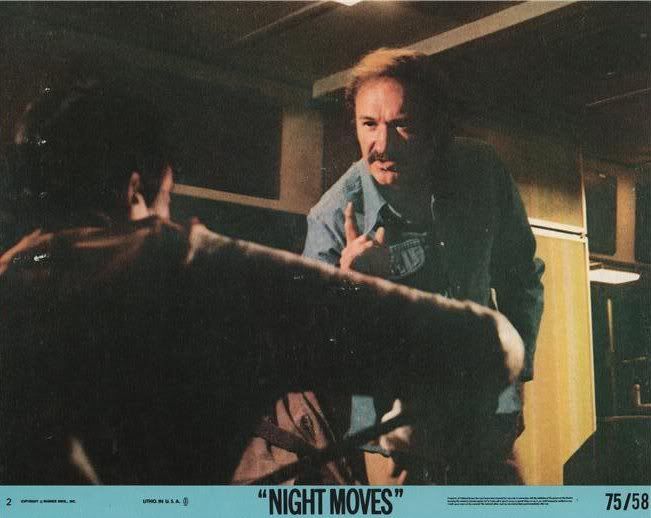
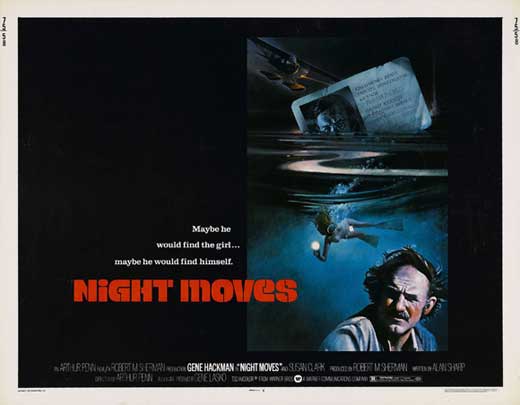
Night Moves (1975)

"You mind if I ask you what the set-up is?"

NIGHT MOVES rests almost entirely on the character of Harry Moseby, a retired football player turned cut-rate private eye who stumbles into a complex smuggling operation while tracking a missing girl. Gene Hackman plays Moseby with a weary eye and wounded pride. He's an average operator, often behind on the score. He trades on his lingering sports fame and a kind of blustery toughness to make easy cases. Harry Moseby is no hero. He's too tired, too depressed, and too slow on the uptake to be of any real use to anyone, including his wife and the client he's trying to find.

That we buy into Moseby's character is essential because the plot of the film is deliberately misleading, hiding and revealing in equal amounts to leave both character and audience in the dark: there's a missing girl, some shady stuntmen, sailors, and mechanics, a boozed out mother with a bad history, and a wary ex-stripper whose motivations are suspect only because it seems Harry can't trust a woman regardless of her intentions. These characters revolve around each other in a sort of pointless circling centered around Harry and his inability to make heads-or-tails out of their greater relationship. When the final piece of the puzzle is revealed, the result is only more enigmatic, bleak, and disheartening. There's no answer for Harry, nothing to solve. As he himself stated, Harry Moseby doesn't so much solve cases as stumble into their resolution. In that sense, it's almost classically noir, in that he did a lot of work but little good. Almost everyone involved is dead and Harry's got nothing to show for it except a wounded leg.

Arthur Penn directed NIGHT MOVES as a meditation through genre on the existential ennui of the post-Watergate era. And as an ambitious experiment in that direction, it fails to deliver. A straight forward, slightly nuanced noir would've worked better in keeping the pace and setting out the detail. Instead, NIGHT MOVES feels waterlogged. A sub-plot involving Moseby and his wife starts promising on the thrill of adultery but settles into a mawkish exploration of Moseby's childhood abandonment issues and his resultant false bravado in the face of emotion. This really sidetracks the main premise and undermines the nuanced work that Hackman was doing with the character. All the layering was already there, in his face and movement and terseness. Hackman nailed the character, no explication necessary.

Another fault is Penn's overall direction and cinematic vision. The film is visually unengaging. Aside from a thrilling stunt and some beautiful shots at the finish, the composition, framing, and editing are all sub-standard (even by 70's thriller standards). You'd never guess that such an acclaimed director was at the helm. The entire films looks and feels flat. If it weren't for Hackman's magnetism and profound abilities as an actor, NIGHT MOVES really wouldn't be worth watching. For all it's acclaim, I was left wanting, intrigued more by the squandered potential than by what was actually delivered.

One thing I did like about the film is that it proves that not all noir films need dark alleys and deepening shadows to bring across their brooding cynicism and despair. NIGHT MOVES is so sun-drenched as to be bleached out. There's no room for romance, hope, and optimism under such a bright and unrelenting sky.

NIGHT MOVES (Penn, USA, 1975)

Monday, June 27, 2011

Bloody Nightmares #37: Bloodsucking Babes from Burbank (2006)


When pondering these Bloody Nightmares films, I often start to wonder about the motivations that led to them coming into existence. It takes a lot of passion, sweat and teamwork to make a film - not to mention generally (hopefully?) a modicum of talent - so when I see so much obvious work go into something so terrible, it makes me truly curious about the thought process behind it. I know well how the development of a movie can change from the initial writing to the actual production (and post-production), and how you're often at the mercy of factors beyond your control. These issues are amplified when dealing with low (or no) budgets and inexperienced actors and crew. In the end you simply want something you can be proud of, something that hopefully can provide status for everyone involved, and maybe, just maybe, make a little money off of the proceedings. Bloodsucking Babes from Burbank seems to have fairly modest goals - blood and boobs with a few laughs thrown in is a time-tested tradition - but somewhere between conception to birth something clearly went off the rails.

I mentioned some of the issues regarding working with low budgets, and here it appears the filmmakers had to deal with a nightmare situation: a lead actor leaving the production before it was finished. I'm only guessing on this as I haven't read anything confirming it, but when a seemingly major character dies half way through the movie in a scene which makes little sense in context - and the director just happens to hide her face throughout - it's not difficult to work out what occurred. I'll give director Kirk Bowman credit for at least trying to piece things together - another character is quickly introduced and given lines almost certainly meant for the original actress - but it makes an already shaky production nearly incoherent. Even worse, it makes it look unprofessional. It would be neglectful to not mention that the "replacement" actress also bares her breasts, which may have been a contributing factor.


For a film with such seemingly simplistic motivations, the actual plot is baffling, which isn't helped by the massive number of characters introduced at the beginning. We start with the lovely Samantha (Heidi Brucker, who acquits herself well and really deserves better), an archaeology student who finds herself joining a team searching for an ancient jewel-box in the mountains of Burbank. Supposedly the jewels are cursed - a theory quickly confirmed when two of the students wander off before almost literally tripping over them. The gal opens up the box which leads her to immediately strip down to her underwear, rubbing the jewels all over herself and growing some (really terribly looking) plastic fangs. She eats her male companion, while the rest of the party ignores their disappearance and head home.

However, Samantha's dickish boyfriend Gary (Danny Kitz) has (somehow) smuggled the jewels back in the hopes of trading them for some heavy petting. Samantha - offended - runs off in a huff, leading Gary to go to a competing archaeology group who are only too happy to accept the artifact, which rapidly leads two of them to turn into the titular bloodsucking babes. They strip down and eat the gardener, which is displayed in some jaw-droppingly awful special FX. Seriously. Check out this screen shot.


But that's not all! During all of this Chelsea (Christina Caporale), the head of the first archaeology group, is accosted by mountain man Zack (Danilo Mancinelli) - who had been spying on the group and knows how quickly the awful curse can spread. Discovering that Gary has the jewels, the two try to track him down but their efforts are quickly thwarted when - wait for it - Chelsea (or someone that looks an awful lot like her) is randomly stabbed to death in a parking lot. All seems lost, until Zack's friend Felicity shows up and somehow fills exactly the role that Chelsea's death left empty. What luck!

Samantha, searching for Gary, wanders in on the competing group chowing down on their gardener and attempts to call Chelsea for help. But Chelsea is really, really dead (are there no police in Burbank?) so she reaches Zack and fake Chelsea instead, who come to her rescue and explain to her that the jewels (and curse) can only be destroyed by throwing them into the ocean. This bit of exposition comes with the three characters just hanging out at the beach, even though they KNOW that Gary has the jewels. Somehow, a few random characters also dig up a few of the jewels out of the sand - this part is particularly confusing -  which leads to a few more rubber body parts being spread around.

After that there's some exposition, and Gary shows up at a bar with the jewel box leading to MORE people getting eaten. Thankfully, Samantha tracks him down and - after Zack and Felicity have a shag session - the whole bunch get together and toss the jewels into the ocean. But wait! Before all that we get a cameo from the director as someone from the "archaeological society", who proves to actually be an actor hired by the competing archaeological group in an attempt to steal the jewel box. Bowman actually does really well in his brief role before being chased off when our intrepid heroes discover his true motivation. Foes vanquished, the box gets tossed into the ocean - making use of the worst hammer throw ever caught on film - and everyone lives happily ever after.

Actually, there's an eye rolling "trick" ending before all is said and done. Let's never speak of it again.


Bloodsucking Babes from Burbank wants to be something that it's not - namely, a legitimately funny and gory thrill-ride with smatterings of cheesecake nudity. Unfortunately the comedy is almost wholly unsuccessful, and the gore is generally pathetic with a few notably awful "special effects" scenes which look to have been assembled in MS Paint. There are lots of indistinguishable women prancing around in their underwear (and gamely nibbling at rubbery limbs), but there's nothing titillating about the amount of needless padding and confusing exposition shoe-horned into many scenes. There are also some obvious continuity issues - once scene has a character come out of a shower only to have dry hair as she rounds a corner - and sound recording issues plague many scenes, making the whole production seem rough and unfinished.

It's not a total waste, however. While the acting is inconsistent, at least most of the cast give a strong effort, with Heidi Brucker (as Samantha) and Danilo Mancinelli (as Zack) doing an excellent job under the circumstances. The music seems to be a mix of original material (by a number of different artists) and library material, but it's introduced well and punctuates a few scenes impressively. It's also shot in a number of attractive locations throughout Burbank, and the choice to film most scenes in the daytime at least helps avoid many of the lighting issues which affect many low-budget productions.


Bloodsucking Babes from Burbank is presented in its original 1.78 : 1 aspect ratio, though the transfer is surprisingly rough considering it's a comparatively recent film. Obviously shot on digital video, there is constant haloing throughout and the usual glitches and skipped frames that have appeared in a number of these productions. It's important to remember that by attempting to fit four films on a single DVD, the Bloody Nightmares collection doesn't present most of them at near optimum image quality. It's watchable, but unimpressive. There are some significant sound issues in a few scenes with background noise and poor recording making dialogue difficult to hear, but if you've watched up to that point it's unlikely to be the thing that tips you over the edge to stop actually watching.

It's part of the Bloody Nightmares collection, so don't go expecting chapter stops or bonus features. Would actually be quite interested to hear some behind-the-scenes dirt on this one. Guess I'll just have to stalk Kirk Bowman on Twitter instead.


An ambitious, though unsuccessful, attempt at horror comedy, Bloodsucking Babes from Burbank wears its intentions on its sleeve, but is neither funny enough - nor scary enough - to be anything but a confusing mish-mash of genres. While rarely boring, production issues are distracting enough to keep most audience members away, and the story is confusing and rarely engaging. While there are flickers of talent from the cast and director, this one is best left dead and buried.