Thursday, August 7, 2008

Spirits Of Bruce Lee (1973)


PLOT:

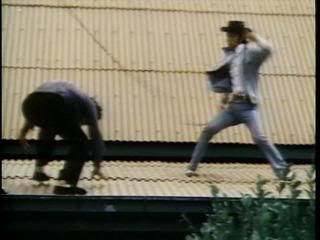
Chang Chen-Wai (Wai-Man Chan) travels to Thailand to find his brother, a jade dealer who vanished the year before. While searching for information on his brothers disappearance, Chang Chen-Wai befriends a Chinese family who own a restaurant, and who reveal that his brother was found murdered nearby. Filled with rage, he takes his revenge on local criminals while tracking down information on who was responsible for his brother's death. He also meets a police officer named Li Pai-Yu who is working undercover to take down the gangster Ming Pan-Tin. The whole thing culminates in a big ol' fight, where two Japanese guys (one with a WHIP!) show up for no good reason.

REVIEW:

When Bruce Lee died in 1973, the search for his successor began almost immediately. However, for some enterprising kung fu movie producers, Lee's name (or, a close facsimile) would continue to have value for years to come. The Bruceploitation genre of films was soon born, starring Bruce clones like Bruce Li, Bruce Le and Dragon Lee; many of whom were talented in their own right but lacked the charisma or ability of the man they were imitating. These films duped many a unsuspecting kung-fu fan, particularly as the films often referenced Bruce Lee's more famous work (The Dragon Lives, The Chinese Connection 2), or pretended to be biography (The Bruce Lee Story, The Secret Of Bruce Lee). Some of these films are entertaining and many have their own exploitive charm.

I mention the Bruceploitation genre because Spirits Of Bruce Lee is the worst sort of Bruceploitation film: one that neither has a Bruce Lee imitator, nor attempts to recreate a Bruce Lee classic or document his life story. The only mention of Bruce Lee you will find here is in the title, as the lead has no particular resemblence and makes no attempt to ape his fighting style (a.k.a. he doesn't howl with every punch). I'm guessing the title was just a cash-in attempt following Lee's death.

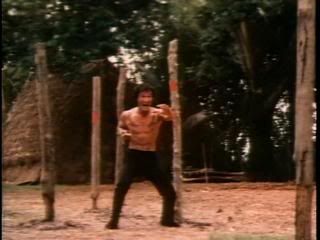
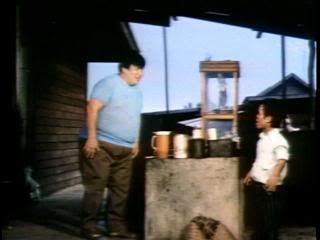
The movie itself is a slow moving affair, with infrequent bursts of badly choreographed kung-fu before going back to a murky revenge story. We get the requisite love interest, an abbreviated training scene, and a fat guy doing some bizarre comic relief. There's also a short (ha!) appearance by a midget that brightened my spirits briefly, but sadly he soon vanished and I had to pay attention to the plot again.


Wai-Man Chan is reasonably charismatic in the lead, but the actor playing the Thai police officer seems to have stronger charisma and fighting skills. That being said, there are opportunities for both men to show off their abilities, particularly in an early fight scene where the two fight off some would-be rapists.

The Thai location could actually be an interesting setting for a kung-fu film, but this is a long way from Ong Bak. There are a few flashes of interesting Thai fighting styles from the Thai stuntmen, but they move so slowly compared to the Chinese actors that it's jarring to see them. The late appearance by two Japanese fighters is bizarre, but actually offered a bit of color to what was generally a very bland film.

The photography is awfully dark, and night scenes become very difficult to follow (particularly the opening scene). The dubbing is absolutely atrocious, and there are a few scenes where characters fall into awkward silence as the dubbing actor runs out of dialogue. The full frame presentation is ugly, but mostly watchable.


A confusing plot, combined with lackluster martial arts, means that Spirits Of Bruce Lee is best avoided. An interesting location, and some talented actors, can't make up for the bland stew of nothingness that ends up on screen.


Monday, August 4, 2008

Renaissance (2006)


Whether it be the outrageously proportioned women in the 1981 geek love classic, Heavy Metal, or the breathtaking mother of all anime, AKIRA, I think that it is pretty much understood that not all cartoons are for kids these days. I find it refreshing that a generation always manages to drag the trappings they feel most comfortable with along with it as it progresses, despite the insistance of the previous generation that such trappings are "childish."

I find it equally refreshing that when this occurs, it means that said generation hasn't forgotten the importance of having fun.

For my parents, those trappings were board games and soul music. For me, it is cartoons and video games.


When I first heard about the film, Renaissance, about a year ago, I was immediately excited. Not only was this a cutting edge animated film, but it featured the voice of Daniel Craig (Layer Cake, Casino Royale) and drew some rather blatant parallels to one of my all time favorite dystopian science fiction movies, Blade Runner.

Then I heard that this was made by the French... Yikes....

Or not, since one of the greatest treasures that the France has given to the world was neither Statue of Liberty nor the Eiffel Tower.

It was a man by the name of Luc Besson..

Hell, either Cyril Raffaelli, David Belle, or Jean Reno could single handedly redeem the entire French population, so my initial fears that French involvement could ruin this production were put to rest for the time being.


Renaissance takes place in Paris, France in the year 2054 and follows French-Algerian detective, Barthélémy Karas (Craig), as he investigates the kidnapping of a beautiful and brilliant geneticist named Ilona Tasuiev (Romola Garai). In the course of the investigation, our intrepid hero naturally runs afoul of evil corporate dickhead, Paul Dellenbach (Jonathan Pryce), and eventually hooks up with Bislane Tasuiev (Catherine McCormack), the sister of the kidnapped scientist.

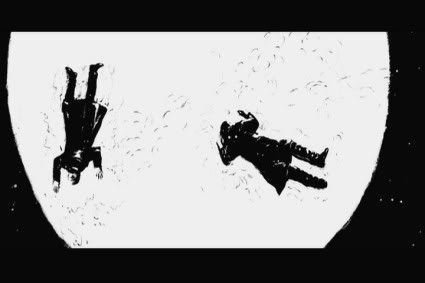
Rather predictably, Renaissance attempts to run the gambit between noirish action and moral relevance much like her predecessor, Blade Runner, did over two decades ago but was much better at it. The odd thing about this production is that even though the everything is done in black and white, the visuals are still very stark.

The Paris of 2054 worked better than I expected it to as far as dystopian settings go. It reminded me quite a bit of (what I assumed to be) the future London of Terry Gilliam's, Brazil: a city where you can't help but marvel at the complexity and still feel a chill run down your spine because you knew that somewhere, someplace... evil was hard at work..


What ultimately disheartens me about Renaissance is that it is a film that has only learned part of the lessons taught by similarly themed works.

Like Brazil or Blade Runner, the film relies heavily on visuals that bring big dividends. The film's innovative rotoscopy techniques and stylized illustration keep your attention fairly effortlessly. Renaissance accomplishes quite a bit through mere pacing and action, and does a great job of convincing you that the black and white lens through which you view this world is just as important to the story as the plot itself.

I would argue that if there is a project that really does successfully capture that intangible, surreal touch we all expect in comic book films these days then this is the one, even though Renaissance isn't based on any past or present illustrated hard copy.

As you watch this, you really get the sense that you're actually settling down with your favorite graphic novel, or kicking back with your ancient stack of Heavy Metal or Epic Illustrated magazines and losing yourself in those sci-fi alternities that Juan Giménez, Masamune Shirow, and Moebius created so long ago where women were hot and problems were solved properly via liberal use of small arms fire from cool looking automatic weapons.

I enjoyed savoring the irony of Renaissance as it presented a dysfuntional place where the lens of the world literally registers black and white, yet the spectrum of morality dwells in familiar shades of grey. Renaissance gives you a glimpse into a backdrop where absolute power does indeed corrupt absolutely, where purity and honor are ideals to be admired even if they do seem like liabilities, and where sometimes you have to do a terrible thing in order to preserve the greater good.

However unlike Brazil, Blade Runner, or even AKIRA, Renaissance does not take the time to build a foreboding sense of dread. The villains are acceptably threatening but Karas is such a badass that you're certain that he'll will eventually triumph over the sinister mega-corporate forces that dare to play God with the rest of humanity. For a dystopian work, Renaissance is hardly subtle.

There are a couple of very clever plot twists, but not enough tangible menace to fill a viewer's heart with any doubt that good will win in the end. That is a cardinal sin when it comes to dystopian literature.

In a despotic future society where things aren't as they seem, the worst thing you can inject into the plot is a feeling of positive surety. Whether it be the insurmountable bureaucratic power of Big Brother found in in Orwell's 1984 or Terry Gilliam's Brazil or the state-sanctioned mind control used by The Grammaton in the 2002 woefully underloved cinematic offering, Equilibrium, there always has to be something overwhelming and malevolent lurking just beyond the mind's eye that tests the protagonist's perseverance to the breaking point, if it doesn't grind him into dust first.

Overcoming nearly impossible odds is what makes dystopian plotlines so interesting in my opinion. The amount of hardship the hero has to overcome is so monumental that it makes even the most mundane victories memorable, and makes complete triumph truly remarkable.

Director Christian Volckman doesn't keep the narrative as tight as he should nor does he seem to trust the story enough to let the plot do its work. This disappointed me a bit because I've seen this movie twice now and after every viewing, I always get the feeling that something wonderous will literally jump out of the screen and force its way into my subconcious.

There is a film for the ages somewhere in the script of Christian Volckman's Renaissance, but sadly you will just have to settle for a popcorn muncher that is a tad too smart for its own good.


Monday, July 28, 2008

Ninja Champion (1985)


PLOT:

Ok. This might get messy. So, at heart it's a basic revenge movie in the vein of I Spit On Your Grave. A woman is raped by three thugs wearing make-up, and after getting out of hospital she tracks them down and kills them one by one. Meanwhile, an ex-lover/Interpol agent who abandoned her after the rape and remarried (awfully quickly) comes back into her life, and she also accepts the help of a bald, muscle-bound retarded guy. Oh, and she's involved in diamond smuggling in some way. OH! And we find out she has a twin sister who is also involved in the revenge scheme.

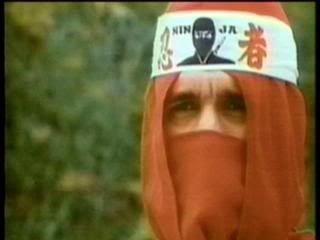
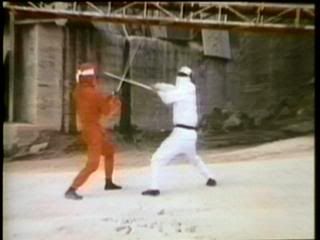
But, forget all of that. You might be wondering about the title: Ninja Champion. Where are the ninjas, goober? Well, there are ninjas here. We know they are ninjas because they dress up in bright red and blue pajamas, and sometimes have the word NINJA on their headbands. These scenes are actually entertaining in a silly way, but have absolutely no relationship to the revenge film outside of some dialogue that comically tries to tie things together. The film culminates in a DUAL TO THE DEATH between the white (good guy) and red (bad guy) ninja that apparently takes place on a playground. After some baffling exposition, red-guy gets stabbed on the monkey bars. Rough way to go.


REVIEW:

Oh yeah. This is what bad is like. You may remember the name Godfrey Ho from my review of The Shaolin Drunk Monkey. In the mid-80s, our man Godfrey came up with a tremendous money-making idea. Ninjas were huge, so he purchased the rights to not-quite-complete films, sprinkled in some new scenes featuring rainbow colored masked ninjas, and then re-dubbed the whole thing and gave it a title like Rage Of Ninja, or Full Metal Ninja (Actual Titles!).

These low-budget titles were regular features in video stores in the 80s, and for anyone unlucky enough to see more than one a pattern soon began to develop. Ho would re-use footage constantly, commonly sticking his American actors in multiple films, though the footage was obviously all shot at once. It must have been his effort to corner the crucial Michael Dudikoff market.

For instance, the ninja star of this film (named.. Donald) is played by Bruce Baron. In 1986, Bruce Baron "starred" in The Ultimate Ninja, Ninja Destroyer and Challenge Of The Ninja. Take a wild guess who directed those three. It's a particularly creative form of hackery, and a ballsy one at that, since these films make almost no sense at all. On top of that, Ho takes full directing credit despite often not being involved with a majority of the footage actually on-screen! And that is how a director gets over 100(!!) directing credits in just under 30 years.

An even more egregious example is a minute long scene featuring Richard Harrison (who was a well regarded actor in Italy) who was in no less than 18(!!!) films with the word Ninja in the title. Almost all directed by Godfrey Ho, and almost always playing a character called Gordon since the footage for all of these films came from one session of filming.

But what about Ninja Champion? Obviously two separate films stuck together with chewing gum and spit, it's actually probably best to review them seperately.

The female revenge flick is bland, pedestrian stuff. In one scene the female protagonist is captured in a car and asks for a chance to put on make-up before her capturer (and former rapist) kills her. His response? "Don't do it too well, or I may want to rape you again before I kill you!". You stay classy, Godfrey Ho.

Oddly, there's actually a bit of kung-fu in the film, and it's not at all bad. My favorite bit is when the boyfriend/interpol agent jumps into the air and vanishes completely, leaving his attackers dumb-founded. If only he taught his lady-friend this teleportation trick!

But the film is limp and uninteresting. There's a bizarre early scene where Rose (our unfortunate female lead) visits a diamond smuggler and drops her top, revealing.. um.. shininess. Or a heavenly glow. Or something. It's quite bizarre, particularly since we get a gratuitous nipple shot about five minutes later.


Most of Rose's revenge attempts involve poison, so we're not treated to any I Spit On Your Grave penis-cuttings (Spoiler!), and it's frankly a little difficult to understand the motivations behind her rape even after several long-winded explanations. The man-child who enters the film in the final scene seems to be missing an entire back story, likely excised to make room for more ninja action!

Speaking of the ninja action.. It's not bad. I mean, it's only likely ten minutes of the running time, but it includes some nice acrobatics and swordplay and isn't particularly offensive outside the fact that:
  • The ninjas are dressed in bright rainbow colors.
  • The ninjas are clearly marked as such, which must hurt subterfuge.
  • The fights are often preceded with some nifty circus tricks, including one spry ninja literally jumping through (small) hoops to make us happy.
  • The male American leads are.. weird looking. I can't really explain it, but they just are.


Video quality is bad, but watchable. The dubbing is terrible.

There is really no reason to ever watch this film. The revenge story is confusing and slow, and the ninja footage is probably repeated in some other, possibly better, Godfrey Ho film. Any interesting parts from Ninja Champion (including the blatant Star Wars rip-off music right off the bat) are right here:

Friday, July 25, 2008

Zipang! (1990)

Photobucket

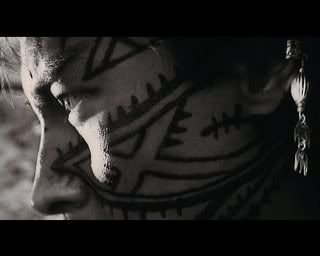
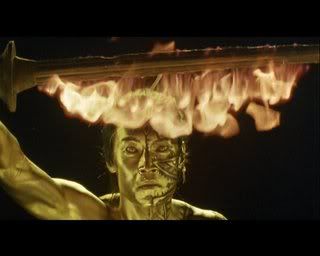
OK, so, Kaizo Hayashi’s 1990 action flick Zipang features an unstoppable samurai, an immortal ancient warrior, a ninja with advanced technology and weapons hidden inside his bones, secret worlds, and all sorts of crazy crap that I don’t have the space to get into here. It’s a bizarre funhouse of a film, and your enjoyment of it will hinge entirely on how much zaniness you can take in one sitting.

Photobucket

So what’s the plot to Zipang? Well, it goes something like this: a group of bounty hunters, including Yuri the Pistol (a female fighter played by Narumi Yasuda and armed with--that’s right--a pistol), set out to capture a ronin named Jigoku (which means “Hell,” I think). Jigoku (Masahiro Takashima) is, of course, a super samurai, who numbers his various swords like they’re golf clubs. He yells out a number to one of his followers who, like a caddy, makes sure he gets the requested tool.

The battle between the bounty hunters and Jigoku is a long one, played with little blood and lots of comedy. In the process of dispatching his foes, Jigoku runs afoul the familiar chambara characters Zatoichi and Tange Sazen--and also a Muskateer, I think (or maybe its Cyrano de Bergerac--Jigoku doesn’t mince words with him). Apparently they’re after the bounty as well. Jigoku defeats them all. He’s just that slick.

Photobucket

Historically, “Zipang” is the name Marco Polo used to identify Japan. Or so I'm told. In the film, however, Zipang is some other dimension. Somehow, Jigoku and his band of merry followers get caught up in the search for Zipang, a mystical and hidden land of gold. To get there, one must wield a golden sword, which Jigoku locates in short order. Unfortunately, there are others searching for the gold, including the ninja Hanzo, and an ancient warrior--an ancient warrior who was killed before the film’s opening credits, only to rise again.

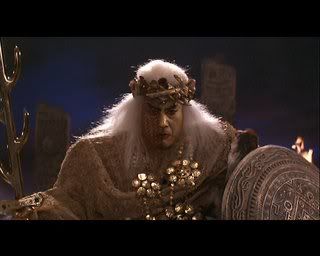
While all of this is going on, Jigoku falls for Yuri the Pistol, who ends up being transported to Zipang, along with Hanzo, both of whom become prisoners of the King of Zipang, who’s kind of a dick. Jigoku sets off to save her. Because he's just that kind of guy.

Photobucket

While Zipang is certainly zany, with its comical characters and its spoofing of the genre, I wouldn’t go so far as to call it a comedy. While the fighting is light-hearted, it is still thrilling, action-y stuff. You’re meant to enjoy the fighting in it the same way you’d enjoy a fight in, say, the Zatoichi series. Zipang seems to represent the samurai film laid bare as a genre, with all of the elements used in a self-conscious fashion--as well as some flights of fantasy added. One guy can kill a whole army? Sure! Even if they have rocket launchers? Why not!

Photobucket

Pagan Films, a UK-based distributor, has produced a fairly bare-bones DVD for Zipang, but if you want to see the film, it’s all there is, so there’s no point complaining. The film probably wouldn’t work if it weren’t for Hayashi’s eye for style. He switches from a monochromatic opening to a film filled with vibrant colour, and later has no problems about playing around with the film to add to the unreal quality of the story. The film is visually quite interesting, despite a few cheap looking costumers (Hanzo’s ninja outfit looks like it’s made out of garbage bags) and some rather static matte-painted backgrounds. On the whole, though, it’s the look of the film that really draws you to it.

Wednesday, July 23, 2008

The Deadly Duo (1978) (aka The Two Great Cavaliers)


PLOT:

Ah Cheng (John Liu) has decided to get out of this silly kung-fu business and retire with his new girlfriend. Unfortunately, everyone is out to kill him, and one of the killers has been using his trademark knives to frame him! D'oh! Meanwhile his friends (who have turned on him because of his unwillingness to help a poisoned ally with his acupuncture skill) meet up with a mysterious swordsmen who is not what he seems. Lots of people die and switch sides, and things wrap up with the ailing Ka Yan (Leung Kar-Yan) being cured and all of his allies attacking the big baddy, who has a powerful (blue) fist.


REVIEW:

First things first. Despite the plot description on the DVD, and a lot of the information out there, this is not Chang Cheh's classic Shaw Brothers film from 1971. The Deadly Duo is more well known as The Two Great Cavaliers and, though worthwhile in its own right, shouldn't be confused with Cheh's film.

Instead, we have a very confusing plot that is kept afloat by the able abilities of the cast. John Liu shows some amazing kicking abilities in the lead, and he's given many opportunities to demonstrate his impressive speed and accuracy. The great Angela Mao (Enter The Dragon) is the female lead, and she shows off her impressive kung-fu skills in between bouts of pouting and being turned on by allies. The third male lead I didn't recognize, though his sword skills are impressive and add a bit of variety to the fighting on display.

And though he doesn't get to show off many of his skills, it's always nice to see
Leung Kar-Yan (The Victim) show off his beard.


Aside from the fighting, the plot doesn't provide many interesting moments or surprises. At least until we get to the final twenty minutes and find a group of bad guys attempt to sneak into the trapped location where Ka Yan is being held. Not having been taught the different phoenix stances that work as a key, the baddies are dispatched in various grisly ways. The most impressive being an explosive charge that blows a dummy all to hell, and provided me with my most enjoyable moment while watching.

Once again we have to deal with a lousy, full-screen, dubbed print of a film that would greatly benefit from being shown in its original form. In fact, this film has been released in a letterboxed version that is commonly available through Crash Cinema and might be worthwhile to pick up for fans of Angela Mao. The image here is fuzzy but watchable, but the dubbing is wretched and only helps to confuse an already muddled plot.


While the plot is mostly incomprehensible, the film itself is never boring and the fights are inventive, acrobatic and very fast paced. One of the better kung-fu films in this collection, and features some amazing fighting from John Liu and Angela Mao.

Sunday, July 20, 2008

Chase Step By Step (1974)


PLOT:

A drought has hit a poor county in China and the people are suffering. Two circus performers, Tsao Wu & Ling Wing (Feng Hsu), are asked to escort a delivery of gold to the area. On the way they are attacked by everyone. Honestly. Every single person they run into tries to steal the gold, or kill them and *then* steal the gold. Eventually they reach the county and are (surprise) attacked once again. Luckily our two heroes use their significant kung-fu skills (and a few circus tricks) to smack around anyone who tries to attack them.


REVIEW:

Chase Step By Step is saddled with a bad title, but it actually has the ingredients to be a rather interesting kung-fu film. The idea of mixing circus performing (demonstrated in the opening credits) with kung-fu action would seem to be a natural mix, and the acrobatics of performers in the late 70s (and the comedy that was injected into kung-fu films of that era) might have proven this to be a precursor of that style. Unfortunately, while there are a few moments of unique action, the vast majority is slow, blandly choreographed kung-fu with some blatant undercranking meant to make the fights appear faster.

This style of kung-fu, where the opponents often don't appear to be even attempting to hit our heroes, was quite common in the mid-70s and could be looked past if the plot provided anything interesting. However, what exists of the plot is barely a skeletal structure on which to hang fight scene after fight scene. The relationship between the two leads quickly becomes irritating, with Ling Wing becoming intolerable as the film moves along. Her shrillness certainly doesn't do the film any favors.


To the film's benefit, the multitude of fight scenes at least keeps the pace moving and when the pair does use their circus-honed skills it makes for some interesting visuals. Tsao Wu uses stilts to briefly fight off some attackers, and the two walk across a tight-rope with the gold to escape some attackers. More integration of these sorts of skills might have made the material something special, but instead only serves to remind the viewer of the lost potential here.

The video quality of the film is rather abysmal at first (particularly in the opening credits, where the image is stretched horribly), but evens out to just being bad throughout a majority of the film. Occasionally the fight scenes find characters wandering in and out of frame, though this is a limitation of a 235:1 being cropped so significantly. The dubbed audio is often ludicrous, but is intelligible enough throughout most of the film.


Action packed, but tiresome kung-fu entry handicapped by some lackluster fighting that betrays the era it was made. Purely mediocre with a few memorable moments.

Friday, July 18, 2008

Mother Joan of the Angels (1960)

MJtitle

Eight demons possess Mother Joan of the Angels: Behemoth, Ballam, Isaacaron, Gresil, Amon, Asmadeus, Leviathan, and Clootie. How can one man, her exorcist, Father Joseph Surin, hope to save her?

Polish director Jerzy Kawalerowicz’s Mother Joan of the Angels (Matka Joanna od aniolow), like Ken Russell’s The Devils (1971) is loosely based on the 1634 case of the Loudon nuns. In Loudon, France, a group of Ursuline nuns were supposedly possessed, due to the actions of Father Urbain Grandier, who was eventually burned at the stake for witchcraft. While the nuns remained ‘possessed,’ a group of expert exorcists--the Jesuit Jean-Joseph Surin among them--attempted to cleanse them in a series of public exorcism, which reportedly gathered groups of up to 7,000 people. The possessed nuns became something of a tourist attraction.

MJ1

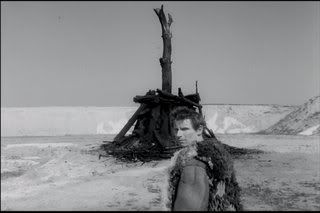
Kawalerowicz’s Mother Joan of the Angels begins with Father Surin (Mieczyslaw Voit) prostrating himself before the crucifix. He has just arrived, and he is uncertain that he is up to the task. The villagers, oddly enough, don’t seem to take the possession very seriously--it’s more-or-less a good source for rumours. It’s explained that the priests allow the common people to see the possessed nuns, since proof of demon possession, paradoxically, acts as proof of God’s existence.

When Surin meets Mother Joan (Lucyna Winnicka), he finds that she is very forthcoming about her possession. It all stems from Father Grandier, she explains, and now the evil is within her.

MJ2

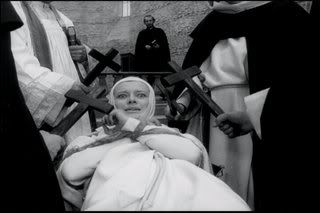
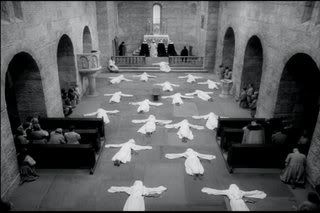
The actions of the possessed nuns seems rather tame by today’s standards. Most of the lesser nuns--never named--flounce about in a rather un-nunly fashion, but most of the blasphemies are left for Mother Joan. Sadly, you’ll never hear her shout anything like “Your mother sucks cocks in hell!”, and so hers is a lesser possession in the annals of filmdom. Still, she does do a lot of her own tumbling, and a few awkward contortions, which are enough to convince Father Surin that the possession is sincere. Still, it’s unclear to me if Mother Joan’s relatively sedate possession is due to constraints of the time and place, or if Kawalerowicz intended to cast reasonable doubt on the nature of Mother Joan’s complaint.

Surin, a self-flagellator, is deeply affected by Mother Joan’s actions. It makes him doubt his own skills, and possibly his own religion. He also seems weirdly attracted to Joan’s sins. In one scene, both of them are shown in the same room, and, though separated, both simultaneously flog their own bare backs in acts of contrition. Both are naked, from the waste up, and both are performing a strictly physical act. This works as Mother Joan of the Angel’s sex scene, I think.

MJ3

As Surin begins to doubt more and more, he seeks out the advice of a Rabbi. The Rabbi makes a series of ominous statements, which Surin doesn’t seem to understand: that the presence of demons might only be the absence of angels; that all things, good or wicked, are based on love; that Father Surin and the Rabbi are one and the same. And, indeed, the Rabbi is Father Surin, in as much as it is obviously Voit playing him as well. But what do all these things mean? And how does it help Surin?

MJ4

Mother Joan of the Angels is beautifully shot on black and white film. I haven’t seen as much Bergman as I probably should, but I was reminded of The Seventh Seal, at least visually, while watching this. The film is very stark, and the two leads, Voit and Winnicka, seem to have been chosen as much for their acting as for their piercing eyes. Many of the shots are expertly composed, and aside from some jump-edits (which might be the DVD, for all I know) the film is well-executed.

The DVD by Polart is, simply put, one of the worst I’ve ever seen. The features are slim (a write-up on the director and the leads, as well as advertising for other Polart DVDs), but most importantly the quality of the film image is terrible. On top of that, the subtitles are down-right laughable. Hardly a line goes by without some glaring issue of spelling or grammar, and occasionally a line is just missing. Still, this didn’t stop me from enjoying the film.