Showing posts with label Exorcism. Show all posts

Saturday, January 24, 2009

The Devils (1971)

DVtit

PLOT:


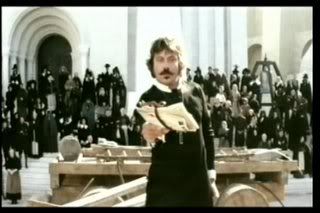
When Cardinal Richelieu’s plans to control the country are thwarted by the willful Father Urbain Grandier (Oliver Reed), the head priest of the fortified town of Loudun, the esteemed religious leader of France decides that the best course of action is to remove Grandier by any means necessary. Grandier is an unwitting ally in his own downfall--his womanizing ways (doubly inappropriate for a priest) have left him with few allies, and there are many who would wish to see him wrestled from power. Still, it is Sister Jeanne (Vanessa Redgrave) who holds the key to Grandier’s ultimate destruction; the deformed nun has become sexually obsessed with the priest, and when she discovers that he’s been secretly wed, she accuses Grandier of witchcraft and demonic possession.

Using the charges of witchcraft as a pretense, Baron de Laubardemont, Father Mignon, and Father Pierre Barre (a professional witch hunter) coerce the rest of Jeanne’s convent into playing the part of possessed nuns, and blaming Grandier for the condition. The antics of the “possessed” nuns are so over-the-top and extreme that they attract large audiences (and are so sacrilegious that the film has often been censored, and remains unreleased on DVD, in North America, to this day). When Father Grandier returns to Loudun from having met with the King, he discovers that his town is in an uproar, and that he’s at the centre of it.
DV1

REVIEW:


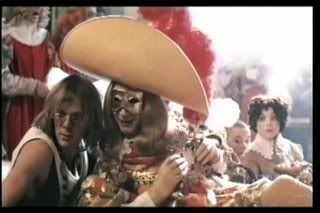
Ken Russell’s The Devils, based on a book by Aldous Huxley, is a hell of a show. Those who seek out the film based solely on the controversy surrounding it won’t be disappointed: there is nudity, the sexual assault of a statute of the crucified Christ, simulated masturbation (with a large candl)e, forced enemas, immolation--most of which involves nuns. However, those drawn to the film for its apparent sleaziness may be shocked to discover an incredibly well-made film, with some fine performances by Reed and Redgrave, and brilliant production design by Derek Jarman.
DV2

In fact, those who are not so sensitive to religious taboos might find the film to be a bit of a disappointment in the filth department. The actions of the “possessed” nuns might be over-the-top, but they’re never really uncalled for or excessive, considering that you know they are being forced to play the part. You might actually think of their actions in largely symbolic terms--the literal rape of Christ brings attention to the fact that the Church has been metaphorically doing just that, as far as the film is concerned.

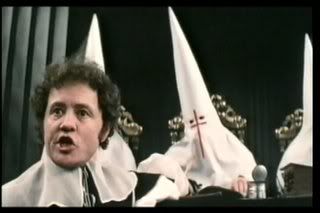
Russell’s zany take on the historical event actually brings to mind the work of Terry Gilliam, or the Monty Python period pieces. Some care has been taken to make the clothing, the accouterments, the material things of the film seem authentic to the period, but everything is also slightly off, over-stylized or in some way made strange, so that our perception of the action seems somewhat fevered.
DV3

The Devils is a horror film, if only to the extent that the true horror of the film is not the “demonic possession,” which is completely fictitious, but the horror of a lone rational man, Grandier. Confronted with all the irrationality of religion, the passions of the mob, and the hunger for power of the highest levels of society, Grandier knows that he is doomed. He cannot compete against the overwhelming insanity and irrationality of all the forces leveled against him. What makes the film all the more successful is the fact that Grandier is not held up as some sort of ideal man, and thus made into a martyr; rather, Grandier is a mortal man with some serious character flaws. If he was entirely innocent, the film would lack any real punch. That Grandier contributes to his own downfall makes his ending all the more tragic.

Ken Russell’s The Devils really does deserve its own DVD, with a good transfer (unlike the bootleg I had to watch) and some extra features explaining the difficulty the movie experienced after its release. More people need to see this film--not just because of its controversial status, but because it’s a damn good film.

Friday, July 18, 2008

Mother Joan of the Angels (1960)

MJtitle

Eight demons possess Mother Joan of the Angels: Behemoth, Ballam, Isaacaron, Gresil, Amon, Asmadeus, Leviathan, and Clootie. How can one man, her exorcist, Father Joseph Surin, hope to save her?

Polish director Jerzy Kawalerowicz’s Mother Joan of the Angels (Matka Joanna od aniolow), like Ken Russell’s The Devils (1971) is loosely based on the 1634 case of the Loudon nuns. In Loudon, France, a group of Ursuline nuns were supposedly possessed, due to the actions of Father Urbain Grandier, who was eventually burned at the stake for witchcraft. While the nuns remained ‘possessed,’ a group of expert exorcists--the Jesuit Jean-Joseph Surin among them--attempted to cleanse them in a series of public exorcism, which reportedly gathered groups of up to 7,000 people. The possessed nuns became something of a tourist attraction.

MJ1

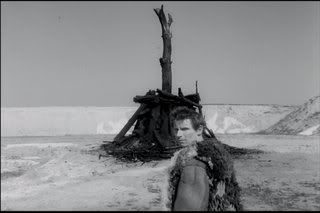
Kawalerowicz’s Mother Joan of the Angels begins with Father Surin (Mieczyslaw Voit) prostrating himself before the crucifix. He has just arrived, and he is uncertain that he is up to the task. The villagers, oddly enough, don’t seem to take the possession very seriously--it’s more-or-less a good source for rumours. It’s explained that the priests allow the common people to see the possessed nuns, since proof of demon possession, paradoxically, acts as proof of God’s existence.

When Surin meets Mother Joan (Lucyna Winnicka), he finds that she is very forthcoming about her possession. It all stems from Father Grandier, she explains, and now the evil is within her.

MJ2

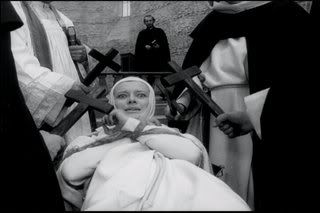
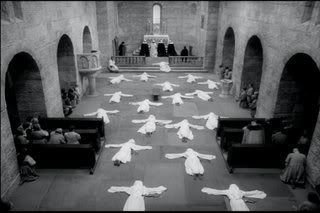
The actions of the possessed nuns seems rather tame by today’s standards. Most of the lesser nuns--never named--flounce about in a rather un-nunly fashion, but most of the blasphemies are left for Mother Joan. Sadly, you’ll never hear her shout anything like “Your mother sucks cocks in hell!”, and so hers is a lesser possession in the annals of filmdom. Still, she does do a lot of her own tumbling, and a few awkward contortions, which are enough to convince Father Surin that the possession is sincere. Still, it’s unclear to me if Mother Joan’s relatively sedate possession is due to constraints of the time and place, or if Kawalerowicz intended to cast reasonable doubt on the nature of Mother Joan’s complaint.

Surin, a self-flagellator, is deeply affected by Mother Joan’s actions. It makes him doubt his own skills, and possibly his own religion. He also seems weirdly attracted to Joan’s sins. In one scene, both of them are shown in the same room, and, though separated, both simultaneously flog their own bare backs in acts of contrition. Both are naked, from the waste up, and both are performing a strictly physical act. This works as Mother Joan of the Angel’s sex scene, I think.

MJ3

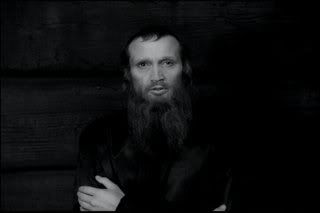
As Surin begins to doubt more and more, he seeks out the advice of a Rabbi. The Rabbi makes a series of ominous statements, which Surin doesn’t seem to understand: that the presence of demons might only be the absence of angels; that all things, good or wicked, are based on love; that Father Surin and the Rabbi are one and the same. And, indeed, the Rabbi is Father Surin, in as much as it is obviously Voit playing him as well. But what do all these things mean? And how does it help Surin?

MJ4

Mother Joan of the Angels is beautifully shot on black and white film. I haven’t seen as much Bergman as I probably should, but I was reminded of The Seventh Seal, at least visually, while watching this. The film is very stark, and the two leads, Voit and Winnicka, seem to have been chosen as much for their acting as for their piercing eyes. Many of the shots are expertly composed, and aside from some jump-edits (which might be the DVD, for all I know) the film is well-executed.

The DVD by Polart is, simply put, one of the worst I’ve ever seen. The features are slim (a write-up on the director and the leads, as well as advertising for other Polart DVDs), but most importantly the quality of the film image is terrible. On top of that, the subtitles are down-right laughable. Hardly a line goes by without some glaring issue of spelling or grammar, and occasionally a line is just missing. Still, this didn’t stop me from enjoying the film.