Wednesday, July 16, 2008

The War Game /Culloden (1965-64)

The War Game

WGTitle

What happens to a city, to its people, when an atomic bomb detonates in the atmosphere above it? In the 1960s, this question probably seemed pretty pressing. Peter Watkins, fresh off the success of Culloden, convinced the BBC that he should be allowed to shoot a nuclear war film, one that would show the effects of a nuclear attack on British soil. When he handed in the final film, the channel refused to broadcast it--but, Watkins claims, only after secretly showing it “to senior members of the Home Office, the Ministry of Defence, the Post Office (in charge of telecommunications), a representative of the Military Chiefs of Staff, and Sir Burke Trend, Secretary to Harold Wilson’s Cabinet.”

Using documented evidence about the effects of bombing on Hiroshima, Nagasaki, Dresden, and other European towns firebombed during the War, Watkins was able to create an extremely realistic film detailing the violent effects of a nuclear attack on British soil. Like most of his work, it’s shot like a documentary, filled with amateur actors and realistic effects. The War Game shows many things that the BBC thought people weren’t ready to see: blinded children; the degrading effects of radiation poisoning; terminal patients executed by police officers, in what is both an act of charity and necessity; food riots; suffering; gruesome death.

WG1

At first, The War Game seems too much a document of its time. The fear of nuclear war has, thankfully, abated, and the black and white footage and dour narration makes the film seem almost campy. Once you get past that, though, it’s remarkable how much detail Watkins goes into. While certainly he dwells on the grizzly physical aspects of the attack, just as much (or more) time is spent on the moral problems, most of which are caused by logistics. In the case of an attack, we learn, the British government simply lacks the resources to relocate such a large part of its population; after the attack, they lack the capacity to treat and feed the survivors.

Obviously Watkins is a pacifist, and the point of his movie is to scare the living hell out of his audience. And it is scary, since every instance that Watkins depicts in his faux-documentary had already happened in one of the Axis cities bombed during the War. His reliance on facts, then, makes the film all the more terrifying, and stops him from making a simple and derivatively alarmist piece. The War Game won the Academy Award for Best Documentary Feature in 1966.

Culloden

CulTitle

Project X, the Canadian distributors who (with New Yorker Films) have made a mission of making Watkins’ work available in North America, saw fit to release The War Game with Culloden, Watkins’ first major work. Combined, the two films run only two hours, and so the pairing is sensible--even if the way they’ve positioned the two films out of sequence seems somewhat illogical.

The 1746 Battle of Culloden was the last battle of the Jacobite uprising, in which the British army smashed the Highlanders and chased Bonnie Prince Charlie off of their land. We learn (if we didn’t know already--my Scottish history is rusty, but fortunately I've read Waverly) that the battle was an extremely bloody affair, with the Highlanders losing 25 men for each slain British soldier. Culloden first documents the poor planning and suicidal incompetence of the Highland leaders before turning to the cold-bloodedness of their British rivals.

Cul1

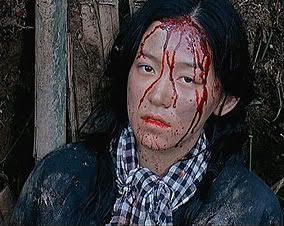
In what became Watkins’ trademark style, Culloden is shot as a documentary. Some viewers may find this hard to grasp--Watkins doesn’t portray the battle as a recreation, but simply acts as though there was a documentary film crew present at the battle. Nothing is done to explain things any further. Watkins used non-actors to fill the speaking roles, just as he would later do in The War Game and Punishment Park. The lower-class Highlanders even speak in Gaelic, while Bonnie Prince Charlie has a French accent.

Using the documentary style, Watkins is able to interview the personalities involved, and to try to give the viewer some idea about how the actual battle went down. On Watkins’ website, he says “This was the 1960s, and the US army was ‘pacifying’ the Vietnam highlands. I wanted to draw a parallel between these events and what had happened in our own UK Highlands two centuries earlier, including because our knowledge of what took place after ‘Culloden’ was basically limited to an exotic image of ‘Bonnie Prince Charlie’ on the label of a Drambuie whiskey bottle.” He does this by portraying the battle as realistically as possible, and by focusing on the grim realities of the War, stripping away all the romantic nonsense that historic battles always end up wearing.

After the Highlanders are slaughtered, the British heroically bayonet all the wounded, and have the survivors either executed (usually hanged, and then drawn and quartered) or sent to Barbados as indentured servants (read: slaves). Hardly the high water-mark for English compassion.

The Project X/New Yorker release is nothing special, but it contains both films and commentaries, though not (unfortunately) from Watkins himself. Watkins really did produce films unlike any you've seen before, so film fans should check it out.

Black Cobra 3 (1990)


PLOT:

Robert "Bob" Malone (Fred "The Hammer" Williamson) is brought to the Philippines by Interpol agent Greg Duncan, the son of an old friend, to help investigate the theft of American weapons. Partnered with C.I.A. agent Tracy Rogers (Debra Ward), the trio find themselves constantly thwarted in their investigations, leading them to suspect they might have a mole amongst them. The film climaxes with the three infiltrating a base and blowing everything (and everyone) away.


REVIEW:

Once again having no direct connection to any previous film in the series, this time we're in pure Commando/Missing In Action/Delta Force territory as Malone goes behind enemy lines so he can mow down dozens of unlucky Filipinos with various weaponry. But don't worry! He also gets plenty of opportunities to show off his hand-to-hand skills, and throws plenty of his trademark goofy kicks. This is the part where I make sure to mention that i'm certainly not making fun of Fred "The Hammer" Williamson as I imagine, even at the age of 70, that he could beat my sorry ass all day without breaking a sweat.

Unfortunately Nicholas Hammond doesn't return for this sequel, so instead Williamson is partnered with bland pretty-boy (and really awful actor) Forry Smith who obviously has never played Spider-Man in a short-lived late-70s television show. However, a quick peek at his IMDB profile shows that Smith did play The Green Hornet briefly in Dragon: The Bruce Lee Story so I guess i'll cut him some slack. Smith takes on the brunt of the running, jumping and machine-gun firing in the film. Debra Ward is expected to stand around (success) and look pretty (fail), but I applaud the writer for not saddling Malone with another tired love interest.


We're still definitely in low-budget territory, but the action is ramped up considerably and there's hardly a ten minutes stretch where someone isn't getting punched or kicked. The final act has plenty of gunfire and explosions, and the film benefits when it stays away from the lame dialogue and focuses instead on blowing things up. Production values are slightly better than the previous two films as well.

Image quality is slightly better than Black Cobra 2, though still only at VHS level. There is lots of dubbing still on display, but it's generally not as atrocious as the previous film, nor as prevalent as the first. Unfortunately we're no longer treated to the rockin' soundtrack from the second film as the music is generic action fare.


The best of the three Black Cobra films I have available (there is a fourth, but i've heard WIlliamson only appears in stock footage, and it's helmed by the always uneven Umberto Lenzi), Black Cobra 3: The Manilla Connection is a servicable action film with a cookie cutter plot and a reveal at the end that would be a surprise to only the dullest of viewers. The second film still trumps all in terms of unintentional comedy, but there are a few fun moments here for undiscriminating action fans.

Recommended to fans of The Hammer. Everyone else might want to stay away from all three.

Tuesday, July 15, 2008

Black Cobra 2 (1988)


PLOT:

After one too many displays of excessive force (this time involving blowing the head off of a hostage-taking biker), Lieutenant Rob Malone (Fred "The Hammer" Williamson) is sent from Chicago (what happened to New York?) to The Philippines in one of those ever-so-common police exchange programs. Once there, he's paired with buttoned-down do-gooder Lt. Kevin McCall (Nicholas Hammond from the 70s TV version of SPIDER-MAN!!!!!) and after the requisite amount of distaste they slowly begin to warm to each other after a search for Malone's stolen wallet ends with them discovering a dead body. It turns out the wallet thief stole some microfilm from Iranian terrorists, and Malone and McCall have to crack this motherfucker WIDE open. Oh, and afterward the Iranians try to blow up a building (containing McCall's kid), and the two have to spend 15 minutes climbing up an elevator shaft so Williamson can smash through some glass and blow the bad guys to smithereens. Wait a sec! He didn't learn anything! The film ends with Malone on his way back to Chicago, having taught McCall that extreme violence is the only proper response to terrorism.


REVIEW:

Black Cobra 2 is a better film than Black Cobra. It just is. Part of this is because a bad Lethal Weapon rip-off is slightly more interesting to me than a bad Dirty Harry rip-off, but it also throws in more elements that exploitation fans can enjoy. It's more violent, more profane, and the unintentional hilarity is much more pronounced. Aside from some bloody moments, and a lot of naughty language, this would have been prime MST3K fodder. And it has Spider-Man!

WARNING: Scene may not appear in actual film.

Fred Williamson is back as Robert Malone, and despite (for some reason) now being stationed in Chicago, the early scenes are once again obviously filmed in Italy. The opening action sequence, a great deal of which is on foot, really puts the 50-year old Williamson to the test as he crawls around a parking garage, running after the motorcycle assailant. Obviously feeling some old injuries, you can't help but feel bad for him as he sucks wind. But, he gives it the old college try and he at least seems game to some.. um.. interesting physical challenges. He's also not dubbed this time around, which makes his performance a lot more tolerable.

Malone is given a love interest in lounge singer Peggy Mallory (Emma Hoagland), who is not only incredibly bland and built like a 14 year old boy, but also spouts some ridiculous dialogue as their relationship heats up for no reason in particular. She gets an off screen bullet in the head in what can only be called a mercy killing.


Nicholas Hammond is Spider-Man. McCall and Malone don't really have any chemistry, but the buddy-cop dynamic doesn't grow too stale, and his over-the-top response to his son being kidnapped (with a requisite call to his terrified wife promising to get their boy back while he applies camouflage grease paint) make for some fun moments. The rest of the cast is nondescript and/or terribly dubbed. Particularly McCall's kid who speaks with the voice of an adult woman, which is actually a bit creepy.

It's also a bit jarring whenever a non-dubbed character speaks to a dubbed character, as the sound levels don't match well. An improvement over the ADR in the first film, but still quite rough.

The action is much more bloody this time around, with nice juicy squibs on display whenever Malone decides to shoot a terrorist in the chest with a shotgun (which is quite often). The action scenes are still inept, but Williamson's odd-looking Kung-fu kicks are certainly a sight to behold. It's also considerably more profane than the previous film with a surprising number of "fucks" and "shits" being thrown around. I was most amused by Peter Parker telling a severely beaten Iranian to "Shut the FUCK up!", but your amusement at such things may vary.


Image quality is about the same as the first film, meaning pretty rough. Luckily, the audio is a bit less muffled this time around, and the editing is less hatchet-y. We're also treated to a rockin' 80s musical score which nicely compliments the 80s fashions (skinny ties! Members only jackets!) and hairstyles on display.

A slight improvement on the original, but still a pretty awful zero budget Italian action knock-off. My Spidey sense says to avoid it, but at least we're moving in the right direction for *sigh* Black Cobra 3.

Monday, July 14, 2008

R-Point (2004)


War is hell. One of the world's most brutal truisms that ranks up there with "the only two things certain in the world are death and taxes." That being said, you'd think that any war as a backdrop for a horror movie would work quite well, especially the usual yōkai films we've seen flooding North American shores.

After all, if yōkai films convey anything it is that there are some fates that are worse than death. In such a film with any war as the setting, those that died would probably be the fortunate ones.


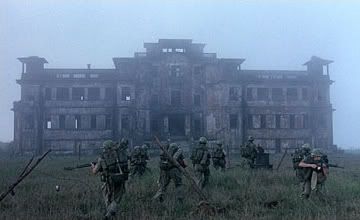
R-Point is a Korean film that tells the story of an ill-fated Korean commando unit during the tail end of the Vietnam War. Hardened vet Lt. Choi Tae-in (Gam Wu-seong) leads his platoon leads his troops to an area 150 kilometers south of Saigon in search of another platoon that patrolled the area six months prior to the events of this movie.

Naturally, the first platoon never made it back but Choi's platoon is hand picked to investigate a cryptic radio message from the first platoon that was presumed to be killed in action.


In all respects, this movie out Blair Witches the rather unscary Blair Witch Project, as it succeeds where Blair Witch failed. R-Point effectively conveys just how fragile the human will really is when subjected to a dual assault from the forces of nature and the realm of the supernatural.


R-Point teaches us that war is not hell, because war is not eternal. There are some things that are indeed worse than death.

If your taste for A-Horror is wearing thing these days, go pick this up.


Saturday, July 12, 2008

Black Cobra (1987)


PLOT:

Detective Robert Malone (Fred "The Hammer" Williamson) is a hard boiled, take-no-prisoners, loose cannon cop. Between randomly blowing street scum away, Malone protects a fashion photographer (Eva Grimaldi) who witnesses a biker gang's brutal assault. And that's pretty much it. Oh! And Malone has a partner (Vassili Karis) who helps him out before the gang sends him a message by kidnapping his daughter. This leads to this wonderful bit of dialogue from Williamson: "I'm not doing it for you. I'm just doing it. I would do it even if it were Santa Claus' daughter."

Well said.


REVIEW:

I'm sure it's just a coincidence that the Sylvester Stallone film Cobra was released in 1986, while the following year we find the first (of FOUR!) films shot in Italy featuring a similar no-nonsese cop called Black Cobra. It's not like the Italian film industry is in the habit of making cheap rip offs of American flicks, right? (Except for the dozens of Italian Exorcist, Dawn Of The Dead, Mad Max, Jaws, Saturday Night Fever, etc. etc. etc. etc. knock offs)

Though in all fairness, Cobra wasn't a huge blockbuster, and the film owes as much (if not more) to Dirty Harry than the Stallone Vehicle. One other thing Black Cobra has going for it is the presence of Fred THE HAMMER Williamson as Detective Robert Malone. Williamson was nearing 50 when this film came out, but the man still bleeds bad-ass, and isn't afraid to get his hands dirty. Though it's comical in action, there's a gunfight in Black Cobra where Williamson swings from a wire, knocking over an assailant. While the actual "tackle" consists almost solely of Williamson ramming his ass against the shoulder of the attacker, I give points for effort. particularly in a film of this ilk.

Speaking of films of this ilk, this is certainly *not* a martial arts film. There's quite a bit of gun play, and Williamson tosses around grenades for good measure, but hand to hand combat is minimal. This is an action movie in the 80s American sense of the word, though filtered through an Italian eye (and budget).


The film itself is blandly (though competently) directed, but the print is really terrible (obviously mastered from a VHS tape) and dark, and the audio is muddy and can be difficult to make out. This is particularly hurtful since the actors (as is often the case in Italian productions) are dubbed, with Williamson apparently being one of the few that provide their own voice. This also appears to be an edited version of the film, as there are some obvious moments of carnage that have been excised (sometimes leaving a few frames behind, making it seem like the film was hacked up with rusty scissors). There is a single breast on display, which was gratuitous but at least woke me up at a particularly slow section of the film.

The plot itself is terribly thin, though Williamson gets a few (mostly unintentionally) funny lines. What's really missing from the film is a sense of fun, particularly considering that we get such a bland group of villains whose motives are anyone's guess. Without a reasonable threat (or suitably maniacal bad guy), we are left with a hard nosed cop being generally dickish for no apparent reason. That can be fun for a while, but wears very thin over 90 minutes.

I better get used to it, though.. I have two more of Black Cobra films coming up in the set.

This one isn't worth your time, particularly with this shoddy image and audio quality.


Monday, July 7, 2008

In Bruges (2008)

Photobucket

Full disclosure: I’ve always disliked Colin Farrell. His resume is filled with bad movies, and when he somehow ends up in a good film he’s usually the worst part in it. However, this film has changed my outlook completely. Colin Farrell is so astonishingly good, so impeccably cast, that I actually look forward to the next Colin Farrell film. Martin McDonagh’s In Bruges is just that good.

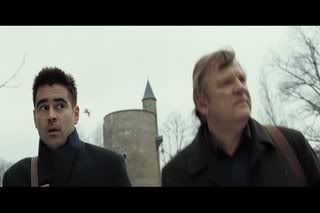
Ken (Brendan Gleeson) and Ray (Farrell) are both hit men. I’m pretty sure that this is an occupation that only exists in the movies, but whatever. What makes them different from most hit men, however, is the fact that they seem like fairly ordinary people--kind of like Jules and Vincent in Pulp Fiction, rather than the elite killers found in such films as Assassins. Ray, especially, acts like you think a criminal actually might act. It’s rather refreshing.

Photobucket

Having finished their last job, their boss, Harry Waters (Ralph Fiennes) sends them--sentences them, if you will--to Bruges, a medieval town in Belgium. Ken, the older of the two, is able to make the best out of it, and turns it into a site-seeing trip. Ray, on the other hand, thinks Bruges is purgatory.

Ray is a real shit. He acts somewhat like a child with ADD, and, as I said, it’s Farrell’s best performance. I hesitate to suggest that this might be because Farrell is more like Ray than, say, Alexander the Great. But who knows. In Bruges, he finds only two things that interest him--the chance for sex (which he finds with Chloe, a native of the area) and gawking at a dwarf who’s in town for a film (“They’re filming midgets!” Ray says). When he isn’t around Chloe or Jimmy (the midget), he’s generally pouting or getting himself into trouble. We do learn, however, that there is a reason for his attitude--everything did not go smoothly during Ray’s last mission, and his conscience weighs heavily on him. His petulant attitude, perhaps, disguises the turmoil inside.

Photobucket

Farrel isn't the only great character, though. Brendan Gleeson is always reliable, and plays Ray's grown-up partner with just the right amount of seriousness, while Ralph Fiennes (seemingly on a break from dour period pieces) is suitably intimidating and brutish as their boss, Harry.

Most of the humour in In Bruges comes from Ray, and hits its mark. There’s a great scene--unfortunately spoiled in the trailer--where he tries to tell some obese American tourists that they should avoid the narrow, winding stairs that lead to the top of the medieval church. His lack of subtlety (and the Americans’ lack of good sense) lead to an altercation that should make anyone laugh heartily (except, perhaps, uptight and overweight Americans). All of the humour makes the graphic violence near the end of the film all the more shocking.

Photobucket

In Bruges isn’t without its flaws, though. The ending is a little too perfect, and sometimes that humour falls flat. When going for laughs, McDonagh’s film swings for the fences, and so when it misses, the silence is deafening. While Ray’s obsession with midgets, for instance, is humorous, said midget’s obsession with an oncoming racial war seems tacked on, like McDonagh needed something zany to add to fill space, and it was the best he could come up with.

The Focus Features DVD presents In Bruges in its original 2.35:1 aspect ratio, and comes with a few featurettes. Most notably among these is “Fucking Bruges,” a compilation of all the swears in the film. This is good for a quick chuckle, and also draws attention to the fact that In Bruges must be one of the most expletive-filled films out there. I’d highly recommend checking it out.

Friday, July 4, 2008

Shaolin Deadly Kicks (1977) (aka Tai ji ba jiao/The Flash Legs)


PLOT:

After a botched robbery, eight criminals (known as the eight dragons) decide to split a treasure map between themselves and reconvene in three years to claim their reward. Years later two policemen are catching up with the members, and after one's death, Fong Yee (Tao-liang Tan) declares war on the rest of the dragons and starts tracking them down one at a time and collecting their pieces of the map. After saving a young woman from her arranged marriage to a dwarf, Yee soon discovers that her uncle is one of the last of the dragons, leading to an explosive finish as Yee battles the Scarred Dragon (Lieh Lo from Five Fingers Of Death) with his furious array of kicks.


REVIEW:

This is more like it. While once again dealing with a pan & scan job that cuts off a great deal of the action (and i'd guess there's at least a couple of minutes missing from the plot), this remains a worthwhile kung-fu effort and keeps the kung-fu coming at an impressive pace . Tao-liang Tan doesn't make for a charismatic lead, but the star of the film is his ability to kick, and his skill is shown off in a number of nicely choreographed battles. The plot gives a reasonable framework to deliver the fights, and though most take place in grassy fields, there is enough variety in the action to keep the audience's attention. The ending is sudden (as is often the case in old-school kung fu films), and the climactic fight between the two leads (along with the lady-friend, played well by Doris Lung) doesn't stack up to some of the earlier fights, but there's enough here for an easy recommendation.

Not a classic by any stretch of the imagination, but a solid kung-fu entry. And it has a dwarf.