Showing posts with label Bruce McDonald. Show all posts

Saturday, September 25, 2010

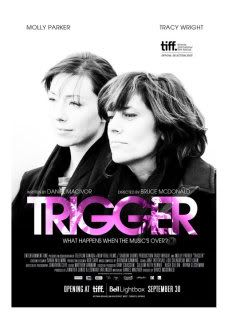
Trigger (2010)

The 30th Atlantic Film Festival


Photobucket


Bruce McDonald is one of Canada's best working directors, second only, in my mind, to David Cronenberg; right now, Cronenberg gets to hold onto that spot due more to his record than his current output. McDonald is sort of like Canada's answer to Robert Rodriguez, in that he makes interesting movies quick and on the cheap; the major difference is that McDonald's movie are almost always great. Rodriguez is an expert at making B-movie pastiche; McDonald is capable of making touching and even subtle films regarding punk music, teenage angst, and infected words that turn people into mindless zombies. Advantage: McDonald.

TRIGGER is one of two new movies by McDonald, both of which played the festival. I opted out of catching THIS MOVIE IS BROKEN, despite it's interesting premise, since I'm not a fan of Broken Social Scene. Still, the fact that the man has two new movies playing simultaneously shows you his work ethic.

In many ways, TRIGGER is the spiritual sequel to McDonald's best-known film, HARD CORE LOGO. And that's not surprising; Daniel MacIvor, the screenwriter, was asked by McDonald to produce a MY DINNER WITH ANDRE-style script which would feature Joe Dick and Billy Tallent, the main protagonists of McDonald's earlier punk masterpiece. When Hugh Dillon (the man who was Dick) wasn't able to fix his schedule for the shoot, McDonald and MacIvor decided to re-write the script for two female leads.

So what you get with TRIGGER is the story of Kat (Molly Parker) and Vic (the late Tracy Wright), the main ingredients behind the eponymous band Trigger, which broke up a dozen years before the movie takes place. Kat and Vic reunite for a "Women in Rock" festival, or some such thing, and in doing so set to reminiscing and airing their grievances. Both are addicts: Vic escaped death-by-heroin years ago, and keeps things straight, while Kat is a recovering alcoholic. Both have taken completely different paths in life: Kat, who remains shockingly youthful, is some sort of big-whig consultant, while Vic is putting together a solo album of acoustic work and is just happy to still be alive.

What makes TRIGGER work so well is that their history is instantly believable. From the moment the two characters begin to talk, you can feel all that history. You can even believe that they're both ex-punk rockers (despite the fact that the one concert scene clearly displays that neither actor can actually play their instruments). While Molly Parker is great, as always (I'll always think of her as Alma Garret from "Deadwood"), it's Wright who just owns every fucking second of this movie. Her Vic is a strong woman who has lived a hard, hard life, and shows every minute of her struggles on her face. She is toughened by the life she's lived, but she's also struggling just to keep it all together.

At one point, around half way through the film, Vic begins a monologue that lasts, I'm guessing, at least five minutes, and probably more. The scene is an extreme close-up of her face, and there are no cuts. It's just one, incredibly long monologue, reminiscent in many ways of Harry Dean Stanton's lengthy monologue in PARIS, TEXAS. It's just incredible to watch. You just keep wondering: why wasn't Wright in more things? Why wasn't she lauded, celebrated? Why isn't there a fucking statue in her honour.

So, long story short, go see TRIGGER, if you get the chance. It's better than that shit you were gonna watch anyway.

Thursday, July 30, 2009

Pontypool (2009)

PP Title

Canada is not a country known for its filmmakers, and so it’s with a small amount of pride that I declare two of my favourite working directors to be Canadian. The first, David Cronenberg, is internationally renowned, so he hardly needs any extra word of mouth. The second, Bruce McDonald, is certainly less well-known. Cronenberg wears his influences on his sleeve; the effect of Marshall McLuhan and Philip K. Dick is relatively clear, especially on his earlier work, and the fact that he’s translated Burroughs to the screen gives some indication of his interests. However--and though taking a different tact--McDonald seems to have similar interests, and in his last few films has similarly tried to get across the idea that “the medium is the message.” This is evident in his use of the documentary form in Hard Core Logo and his deconstruction of the image (and linear time) in The Tracey Fragments. Now, in Pontypool, McDonald turns his focus to language itself. And he does so with zombies. Bravo.

PP1

OK, so perhaps that might give the indication that McDonald is an overly cerebral director. He isn’t (at least, not in any pejorative sense). HCL, The Tracey Fragments, and Pontypool are all very accessible films--perhaps more accessible than all but the latest of Cronenberg’s films--and one of the major detracting factors surrounding Pontypool is the fact that every reviewer feels the need to talk about how “smart” it is. Rather, the film is “clever”; you don’t actually learn anything about language, and names like Barthes are bandied about without any weight put behind them. The premise is far more interesting than most zombie films, though, and so sets the film apart.

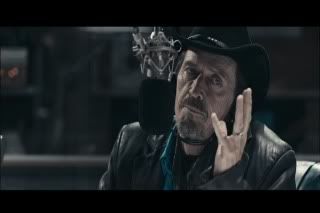
But I’m getting ahead of myself. Pontypool is the story of morning DJ Grant Mazzy (Stephen McHattie), a grizzled veteran DJ who apparently lost his job in the big city for being too controversial (I think) and so has been banished to the sticks (in this case, the small, unincorporated Ontario village of Pontypool). Stuck with Mazzy in the bunker-like basement of the abandoned church--Pontypool’s makeshift radio station--are his producer, Sydney Briar (Lisa Houle) and their technician, Laurel Ann (Georgina Reilly), recently returned from Afghanistan. The film never leaves these three characters, and cameras remain--almost exclusively--within the radio station for the duration of the film.

PP2

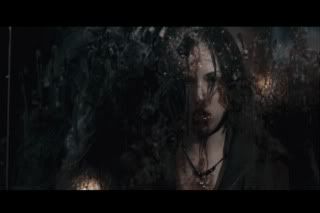
On this particular cold morning, the denizens of Pontypool have begun, without warning, to turn upon each other. Moving with typically zombie-ish, shambling steps, and (typically) hungering for human flesh, the people of Pontypool have seemingly entered the realm of the undead. Not so, instructs McDonald. These are not zombies. These are “conversationalists.” We, the viewers, soon learn that everyone has been infected by a sort of virus, not unlike the unfortunate people in the 28 Days Later films. This virus is not airborne, however, nor is it an infection of the blood; no, in Pontypool, language itself has become infected.

The victim of the language-virus suffers a few short symptoms before going full-blown zombie. Primarily, the victim begins to stumble on, and repeat, a word, a specific word. Repeating it over and over again, the victim finally becomes enraged, and lashes out. Since the virus passes through language, Mazzy (and his radio show) are quite probably the Typhoid Marys of the village.

PP3

Pontypool is low-budget filmmaking the best sense of the word; that is to say, the film in no way looks cheap, and the acting (save for one actor--you’ll know who when you see it) is all pretty great, especially McHattie, who’s always on the ball. No, Pontypool is low-budget in that it has only a handful of a cast and only one real location. Rather than being strapped by these limitations, McDonald is able to ramp up the claustrophobia. Indeed, about half of the films 90-minute running time has passed before we even see one of the zombies. McDonald keeps our interest by giving us repeated radio-updates from people outside--in particular the weather man, Ken Loney, who is the first on the scene--and by letting us share in the unease of the radio station employees, rather than dazzling us with special effects or jump-type scares. In this way the viewer feels a building sense of dread--one that, sadly, begins to ebb as soon as the outside world finally does come into the radio station.

Pontypool is a great little film, and while it has its share of weaknesses, it stands as one of the better horror films of recent years, and a nice change from the recent zombie-fair we’ve been fed. It’s definitely worth a watch, for fans of the genre, and it’s enough to keep me interested in McDonald’s two upcoming sequels.