Showing posts with label samurai. Show all posts

Friday, January 1, 2010

Fighting Mad (1978) (aka Death Force)


Photobucket

Cirio H. Santiago directed or produced a number of blaxploitation/kung-fu hybrid films in the mid-1970s (including TNT Jackson and Bamboo Gods and Iron Men) - usually made in the Philippines - but the genre mashing only held so much potential, so during the tail end of the decade he brought together the equally odd pairing of blaxploitation elements with samurai films in his film Fighting Mad (originally titled Death Force). Santiago had a rather keen eye for bringing together disparate elements into something entertaining despite working with low budgets - this one often looks even cheaper than his earlier efforts - and despite taking a little time to get going, Fighting Mad is no exception.

It's actually a rather imaginative concept: Three soldiers return from Vietnam with a slew of smuggled gold bricks. Doug Russell (James Iglehart) dreams of returning to his wife and newly born child, but his partners (including Penitentiary's Leon Isaac) are more interested in running a criminal empire, so on the boat ride back to the States they slit his throat and throw him overboard. Doug washes up on an island inhabited only by two WWII Japanese soldiers who refuse to believe that the war has ended, but grudgingly accept him and - after the usual period of humbling - train him in the art of the Samurai. After hitching a ride back to the U.S. with some visiting soldiers (who don't seem too concerned about being attacked by Doug and his Japanese pal), Russell tracks down his wife (Jayne Kennedy) before taking on the mafia with only his wits and razor sharp samurai sword. Expect a surprising number of decapitations before everyone lives happily ever after.


Photobucket

Cited by Quentin Tarantino as a major influence, Santiago is an exploitation film legend and films like Fighting Mad go a long way to confirming his talents. Far from high art, the film still delivers a great deal of high energy, popcorn fun with the requisite squeaky clean heroes, dastardly villains, and smatterings of gore and/or nudity with the trademark international elements unique to his productions. The Philippines is not always the most convincing double for California, but production values are generally quite high and some strong casting - particularly James Iglehart, who really did make a terrific, charismatic leading man - goes a long way towards keeping things from getting bogged down. While the actual martial arts action doesn't compare to the Chinese or Japanese efforts of the time, it has its own sloppy charm that is certainly never boring.


Santiago doesn't bring much visual flair to the proceedings, but once Phillips arrives on the island - and the film begins cross-cutting between his samurai education and the rise of his criminal antagonists - the pace picks up as well, speeding up considerably once Doug reaches the U.S. and starts taking care of business. A fight between Doug and a hired goon in a barber shop, in particular, shows off some fine orchestrated destruction that is a lot of fun because of its lack of polish, and the finale get appropriately bloody once Doug's family are (of course) kidnapped and he has to go to Mexico to get them back.

Photobucket


Leon Isaac is appropriately dickish as the main baddie, though it's a tad uncomfortable to watch him beat and attempt to rape Jayne Kennedy, his future wife. Jayne gets to sing a few songs (which slow things to a halt), but doesn't have a lot to do here. The two Japanese soldiers are quite good, adding a few moments of (fairly stereotypical) comic relief - particularly in a conversation regarding the term "mother humpers" - and an air of legitimacy once the three bond and start seriously training. Strangely, the entire film is rather badly dubbed, though it appears that most of the actors are speaking with their actual voices. I don't recall the dubbing being quite so obvious in some of Santiago's earlier films.

Sex and violence and surprisingly subdued for much of the film, besides some messy gun-fights, but things break out in the last ten minutes as Phillips starts lopping off heads left and right - with appropriately messy arterial spray included. There's a brief sex scene - as well as the mentioned attempted rape - but no nudity, and certainly nothing quite as obviously wonderfully exploitive as the topless fight scene in TNT Jackson. Music is by genre mainstay Jaime Mendoza-Nava (The Town That Dreaded Sundown, Vampire Hookers), but is fairly forgettable.

Photobucket


Part of the Millcreek 50 Kung-Fu film collection, Fighting Mad is presented in a muddy, full-frame transfer that is likely comparable to the film's (many) VHS releases. Somehow a number of Santiago's films fell into the public domain, so it's unfortunately unlikely that we will see a cleaned up version of the movie in its original aspect ratio any time soon. The few night scenes are a little dark and murky, but things are generally soft, but quite watchable.

As per usual in this collection, all we get is four chapter stops. Fun!

Photobucket

A silly but fun revenge action film, Fighting Mad holds up its end of the bargain by delivering all the promised amounts of action and bloodshed, and doesn't overstay its welcome. A novel concept, strong performances, and a director with a strong grasp of what his audience wants - and a willingness to deliver - makes this one a pleasant surprise, and definitely worth checking out.

In fact, why not do that right now?


Monday, June 15, 2009

Bandits vs Samurai Squadron (Kumokiri Nizaemon) (1978)

BSS Title

PLOT:


Wronged samurai turned crime boss Kumokiri Nizaemon (Tatsuya Nakadai) has assembled his rather large group of men for one final job, with which to cap off ten years of ruthless banditry: the hoodwinking and robbery of the district’s largest kimono wholesaler, Kichibei (Tetsuro Tamba). Unfortunately for Kumokiri and his band of thieves, they are being hotly hunted by an elite samurai squadron, led by Shikubu Abe (Shogoro Ichikawa), who are honour-bound to thwart them. Burglary, blood vendettas, and assassinations, all culminate in the sort of bloody showdown 70s samurai cinema is known for.

BSS1

REVIEW:


Prepare to be confused for at least 50 minutes. Hideo Gosha’s nearly 3 hour chambara starts with a bloody nighttime raid, without bothering to introduce the situation first. Who’s being raided? Who’s doing the raiding? These are the sort of questions that don’t get answered until nearly an hour has passed, at which point Kumokiri addresses his assembled bandits and explains what their last mission is going to be. This is first time it’s actually clear who, out of the film's many characters, are “bandits”--and it’s most of them. Suddenly the actions of these characters are a little easier to suss out. This scene is followed by another expository scene, in which a blind masseur (Jo Shishido) explains Kumokiri’s identity to Abe, telling him (and us) what we probably suspect: that Kumokiri isn’t just some schmuck thief, but a disgraced samurai. After those scenes, everything else falls into place. However, they’re a long time coming, and I can see a few people giving up in frustration around the 30 or 40 minute mark, when important things are clearly happening, yet you still don’t have enough information to process them.

If you're a fan of Gosha, or the genre, though, I'd suggest you struggle through. It really isn't as bad as I may make it sound, and it's worth sitting through it to see Kumokiri's plan unfold.

BSS2

Anyway, anyone familiar with Gosha’s other movies should realize that, in a movie pitting bandit against samurai squadron, the director’s sympathies are going to be on the side of the bandits. Gosha doesn’t truck with samurai--at least, not the bushido-backing, honour-loving kind. Gosha’s (and the viewer’s) interest is clearly in Kumokiri and his band of merry men; however, the movie really fails to make a connection between the characters and the viewer. Part of it is because there are just so damn many characters; each one is only able to get a bit of screen time, making it difficult to develop a relationship with them. Even the character whom the movie is named after, Kumokiri, is fairly bland, but at least he’s played by Nakadai, so there’s something going on.

On top of all of that, the actual plot that Kumokiri and his men have hatched isn’t particularly interesting. Fans of heist films are going to be sorely disappointed that the big scheme merely involves one of the female bandits tricking Kichibei, the kimono merchant, into marrying her; once she’s done this, she need only locate his vaults and his keys, and the rest should be easy. Not exactly cloak and dagger stuff, but it is suitable enough to set up some late night raiding and some bloody sword fights, which is what you really want from the film in the first place.

BSS3

That said, I’d hate to sound like I was ragging on the film, which I thoroughly enjoyed, despite it’s obvious weaknesses. I’m a sucker for bloody samurai action, and Bandits vs Samurai Squadron delivers that in spades. In fact, I should be clear: if you want a bloody sword fight movie, this is probably one of the best. The violence starts with the opening raid, and then the film is punctuated by action throughout, easing the viewer through its lengthy duration. Gosha has always been a good action director, and here it really comes through. The fights are quite visceral, with lots of physical damage being done to the surrounding environment. Geysers of violent red blood erupt out of those unlucky warriors who find themselves on the business end of a katana.

I’d be lying if I said that the acting was also top notch, but you get good, genre-style stuff. Nakadai is a great as always, and while he’s not cinema’s strongest swordsmen he’s still a guy that knows how to make a fight look interesting. It’s a pleasure to see chubby-cheeked Jo Shishido as well, even if his part is underdeveloped and brief. The women of Bandits vs Samurai Squadron are largely there to be pretty, and often topless, though they do get a chance to show off their acting chops. 70s era Gosha is a lot closer to grindhouse cinema than his 60s incarnation.

BSS4

Bandits vs Samurai Squadron is a hell of a lot of fun, if you know what you’re getting yourself into. If you’re willing to sit back and wait for the film to start making sense, you’ll be treated to some great action scenes, my favourite being a rice-paddy duel between Kumokiri and the Samurai Squadron’s strongest swordsman. You’ll also be introduced (if you haven’t been already) to Gosha’s trademark pessimism--it isn’t much of a spoiler to say that no one is going to be riding happily off into the sunset in this one. Gosha would never allow it.

Wednesday, June 3, 2009

Incident At Blood Pass (aka Machibuse) (1970)

Photobucket

As the 1960s closed, The Japanese film industry was in shambles. American films had already begun to dominate the Japanese box office, and less and less people were seeing locally made productions. The studios. desperate to drum up interest, began packing their films full of stars to bring in crowds, a technique that was a short term solution but burned audiences out in the long rum. Two of the biggest stars of the time, particularly in regards to Samurai films, were Toshirô Mifune who became a worldwide star from the success of Akira Kurosawa's films like Yojimbo and The Seven Samurai, and Shintarô Katsu, the star of the Zatôichi films (as well as the producer of the Lone Wolf and Cub series), and combining their own particular talents seemed like a tremendous opportunity to draw in major crowds. In fact, in 1970 these two actors starred together twice; first in Zatôichi to Yôjinbô (Zatôichi Meets Yojimbo) which was produced by Katsu and then in Machibuse (Incident At Blood Pass) which was produced by Mifune.

And Mifune and Katsu were not the only draws. Director Hiroshi Inagaki had worked with Mifune before on his famous Samurai Trilogy (for which he won the best Foreign Film Oscar), and female lead Ruriko Asaoka was a major star at the time, starring in 121 films between 1955 and 1967. The supporting players, including Yûjirô Ishihara (Washi to taka, Man Who Causes a Storm) and Kinnosuke Nakamura (who later would play Ogami Itto in the Lone Wolf And Cub television series) were also name actors, making this truly a star studded film. With a pedigree this impressive, it would be expected that audiences would have high expectations.

Photobucket

Mifune plays an obvious variation on his Yojimbo ("bodyguard") character from the Kurosawa films, a nameless Ronin roving from city to city. After revealing a cryptic clue from his employer, he travels to Sanshuu pass where he's told "something" will occur if he waits there. On his way, he rescues Okuni (Ruriko Asaoka) from her abusive husband and agrees to let her accompany him, eventually dropping her at the Minoya Inn where she quickly finds employment. There they meet an array of characters; the young gambler Yataro (Yûjirô Ishihara), the passionate policeman Ibuki (Kinnosuke Nakamura), a group of drummers, some pissed off gangsters, and Gentetsu (Shintarô Katsu), a former doctor who lives in a barn behind the inn. When the Ronin discovers his true purpose, the robbery of Shogunate gold, his loyalties are soon tested as characters are crossed and double-crossed before the final, bloody climax.

Photobucket

Taking place almost entirely on the snowy banks by the inn, Incident At Blood Pass provides some fairly unique visuals, particularly during some of the swordplay featured in the later parts of the film. But this wouldn't be mistaken for an action film, as instead the vast majority takes place inside the inn as we witness the development of the various relationships between the characters. In fact, much of the film resembles a play more than a Samurai epic, and even an experienced viewer can be forgiven for getting a little impatient waiting for some significant action to occur over its nearly two hour run-time. The film's greatest flaw is that it simply doesn't tell a very interesting story, and no amount of onscreen or behind-the-scenes talent can really save a boring film.

But they certainly try. Mifune is on familiar ground playing a resourceful Ronin, and he's fun to watch whether verbally sparring with Yataro, barely fighting off the advances of Okuni, or when he finally gets some face (and, too briefly, sword) time with Gentetsu. After his working relationship with Kurosawa ended, Mifune went on to make films of varying quality, but he's obviously working hard here. However, it's Shintarô Katsu who really bares his teeth playing a character very different than his blind masseuse and obviously relishing the opportunity to be such an unlikeable bastard. His sword skills are as impressive as ever, and he even manages to wring some surprising sympathy by the film's end (though, not as much as the filmmakers seem to think, as he's still rather despicable).

Photobucket

While all of the supporting players do a good job (though Kinnosuke Nakamura hams it up a little as Ibuki), they are all saddled with various back-stories which serve to slow the pace rather than distinguish their characters. When Yataro's history is revealed (along with his relationship with one of the other characters in the inn), it seems shoehorned in to give his character a little more to do. This unfortunate padding leads to the film's big reveal not occurring till quite late in the movie, leaving the final confrontation feeling rushed and confusing. In all, the whole thing feels more like a pilot for a television series featuring Mifune's Ronin traveling from town to town rather than a complete work.

Surprisingly, it's also not a very attractive film. Inagaki may not deserve blame, as this is quite a weak DVD transfer, but the scenery feels dull and muted with some impressive scenery shots being the only break from the rather muddy surroundings of the inn. There are some terrific scenes, particularly one where the Ronin and Yataro save Ibuki from being murdered by gangsters posing as officers, but things just drag on too long to sustain interest. As mentioned, the later scenes contain some impressive swordplay, though an early fistfight between Mifune and Yataro is embarrassing.

Photobucket

The ANIMEIGO DVD of Incident At Blood Pass is a bit of a disappointment compared to many of the companies other releases of Samurai films. The film is presented in its original 2.35:1 aspect ratio, but the image is soft and dull. It's certainly watchable, but a better transfer may have shown more respect for Inagaki's compositions. Luckily, the film sounds quite good, and the soundtrack by Masaru Satô (Yojimbo) is striking and memorable. Subtitles are available in both Full and Limited english, and seem to be quite well translated.

Special features are limited, though there are trailers for Incident At Blood Pass, Samurai Assassin (also starring Mifune), Lone Wolf and Cub - White Heaven In Hell, Zatoichi the Outlaw, Zatoichi Meets The One-Armed Swordsman (with Jimmy Wang Yu) and Lady Snowblood. Also included are brief filmographies, character biographies and some impressive Program Notes which explains some of the historical background of the film. However, these 48(!) pages of notes can be a little difficult to read, so i'd recommend just checking them out on the Animeigo website.

Photobucket

Occasionally interesting but frequently uneventful, Incident At Blood Pass wastes a great cast on a talky script that provides little in the way of interesting plot developments. The scenes with Mifune and Katsu facing off are electric, but the climax fizzles out and is confusing, and the picture never manages to build up any momentum. Disappointing considering the talent involved.

Saturday, February 21, 2009

Shura (1971)

PanTit

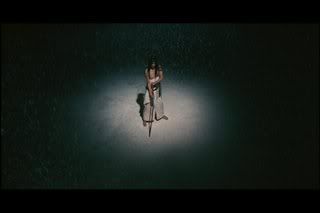
Shura begins with the setting of the sun. It is the last time color, or the light of day, will enter into the world of the film. Only darkness remains.

Certainly Toshio Matsumoto’s Shura is a dark film. In fact, that’s an understatement; in Shura, light has ceased to exist. Darkness encloses the actors, and the sets. Each and every shot seems to be crafted in such a way that the screen is almost 50% black. This striking visual scheme certainly fits the mood, which is one of utter desolation and despair.

Pan1

Gengo (Katsuo Nakamura) is a broke ronin, living with one loyal retainer in a Spartan house with bare walls. He’s sold everything he owns, except his sword, seemingly to “keep” a woman, a low-level geisha named Koman (Yasuko Sanjo) with whom he has fallen in love. In actuality, he is a samurai named Soemon, who needs all the money he can get to pay off a 100 ryo debt. In doing so, he can return to favor with his lord and join 47 other ronin--the 47 samurai (or loyal ronin) of Japan’s national legend.

The catalyst which causes the ensuing tragedy comes when the ronin’s retainer, Hachiemon, arrives with the 100 ryo Gengo needs to buy his way back into the honorable vendetta. It's always money, isn't it? Sango (Juro Kara), a beneficiary of Gengo’s patronage, shows up immediately after this, explaining that Koman is going to be sold to another samurai. Her cost? 100 ryo.

To get to the point: Gengo, after much prodding, spends the 100 ryo he so desperately needs, in order to save Koman, who agrees to marry him. But, there’s a problem. Koman can't be married, at least, not again. Sango is actually Koman’s husband. The two of them have played Gengo, and in doing so have stripped him of his love, his money, and his honor.

Gengo doesn’t take this well.

Pan2

Though he’s initially ruined by the revelation, Gengo soon comes to realize the extent of the dishonor that's been done to him. The rest of the film details Gengo’s all-consuming quest for vengeance, and it does so with bleak, powerful visuals that seem to bring into clear focus the true horror of violence.

To the average viewer of samurai cinema, Gengo’s initial actions hardly seem beyond the pale. He is, after all, a samurai, a member of a cast distinguished by its two swords and its exclusive franchise on violence. That he chooses to wield his swords against those who wronged him seems quite in keeping with the cinematic samurai tradition.

Not so fast, says Matsumoto. Violence is not a clean, sanitized event, and vengeance can never truly be justified. As Gengo becomes consumed by his fury, he becomes less and less a man, and more a demon. When people die by his sword, they die terribly, and the graphic and intense depictions of their deaths only reinforces the brutality of Gengo’s “justice.”

Pan3

Matsumoto is primarily an experimental filmmaker, with the vast majority of his work done in the genre of the short film. Only four times, to my knowledge, did he make full length features. He’s probably most well known (this is a relative term) as the director of Funeral Parade of Roses, the film that (supposedly) inspired Stanley Kubrick when he made A Clockwork Orange. While Shura is a very straightforward story, elements of Matsumoto’s background in experimental film seem to find their way in. The film is certainly shot by someone who is just as concerned with the visual look as he is with the story itself.

While Shura never dips off into total surrealism, the film remains oneiric throughout. The viewer is never absolutely sure that what he is seeing is actually taking place, or if it is actually a dream. After all, the film starts with a precognitive dream, and more than once the film depicts the contents of Gengo’s mind--how he hopes things might play out--as though they were real. Finally, it’s never really certain if Gengo is becoming “demon-like” with his actions, or if it should be understood like a horror movie, in that Gengo is actually becoming a monster. In a sense, it hardly matters; the evil wrought by Gengo is the evil wrought by man, and the evils against him (there are plenty) are certainly human as well.

To date, Shura doesn’t have a DVD release (that I know of) outside of Asia. It’s a shame, really. Hopefully Masters of Cinema, who released Funeral Parade of Roses in Britain, might look into this one in the future. It would certainly be worth it.

Friday, July 25, 2008

Zipang! (1990)

Photobucket

OK, so, Kaizo Hayashi’s 1990 action flick Zipang features an unstoppable samurai, an immortal ancient warrior, a ninja with advanced technology and weapons hidden inside his bones, secret worlds, and all sorts of crazy crap that I don’t have the space to get into here. It’s a bizarre funhouse of a film, and your enjoyment of it will hinge entirely on how much zaniness you can take in one sitting.

Photobucket

So what’s the plot to Zipang? Well, it goes something like this: a group of bounty hunters, including Yuri the Pistol (a female fighter played by Narumi Yasuda and armed with--that’s right--a pistol), set out to capture a ronin named Jigoku (which means “Hell,” I think). Jigoku (Masahiro Takashima) is, of course, a super samurai, who numbers his various swords like they’re golf clubs. He yells out a number to one of his followers who, like a caddy, makes sure he gets the requested tool.

The battle between the bounty hunters and Jigoku is a long one, played with little blood and lots of comedy. In the process of dispatching his foes, Jigoku runs afoul the familiar chambara characters Zatoichi and Tange Sazen--and also a Muskateer, I think (or maybe its Cyrano de Bergerac--Jigoku doesn’t mince words with him). Apparently they’re after the bounty as well. Jigoku defeats them all. He’s just that slick.

Photobucket

Historically, “Zipang” is the name Marco Polo used to identify Japan. Or so I'm told. In the film, however, Zipang is some other dimension. Somehow, Jigoku and his band of merry followers get caught up in the search for Zipang, a mystical and hidden land of gold. To get there, one must wield a golden sword, which Jigoku locates in short order. Unfortunately, there are others searching for the gold, including the ninja Hanzo, and an ancient warrior--an ancient warrior who was killed before the film’s opening credits, only to rise again.

While all of this is going on, Jigoku falls for Yuri the Pistol, who ends up being transported to Zipang, along with Hanzo, both of whom become prisoners of the King of Zipang, who’s kind of a dick. Jigoku sets off to save her. Because he's just that kind of guy.

Photobucket

While Zipang is certainly zany, with its comical characters and its spoofing of the genre, I wouldn’t go so far as to call it a comedy. While the fighting is light-hearted, it is still thrilling, action-y stuff. You’re meant to enjoy the fighting in it the same way you’d enjoy a fight in, say, the Zatoichi series. Zipang seems to represent the samurai film laid bare as a genre, with all of the elements used in a self-conscious fashion--as well as some flights of fantasy added. One guy can kill a whole army? Sure! Even if they have rocket launchers? Why not!

Photobucket

Pagan Films, a UK-based distributor, has produced a fairly bare-bones DVD for Zipang, but if you want to see the film, it’s all there is, so there’s no point complaining. The film probably wouldn’t work if it weren’t for Hayashi’s eye for style. He switches from a monochromatic opening to a film filled with vibrant colour, and later has no problems about playing around with the film to add to the unreal quality of the story. The film is visually quite interesting, despite a few cheap looking costumers (Hanzo’s ninja outfit looks like it’s made out of garbage bags) and some rather static matte-painted backgrounds. On the whole, though, it’s the look of the film that really draws you to it.

Wednesday, June 18, 2008

Hunter in the Dark (1979)

HD1

You can’t go wrong centering a your film on a one-eyed assassin. It helps when said assassin, Yataro Tanigawa, is played by someone like Yoshio Harada, who excels at looking both grizzled and dangerous (and not much else). Hunter in the Dark, a late 70s yakuza flick by Hideo Gosha, follows Tanigawa’s entrance into the service of Boss Gomyo Kiyoemon (Gosha’s main man Tatsuya Nakadai), a canny and tired crime lord who wants, above all, to retire someplace nice. Most viewers won’t be surprised to find out that this isn’t an easy goal for a yakuza boss to accomplish.

Like Goyokin and Tenchu! before it, Hunter in the Dark is a deeply cynical film, one in which the samurai idea of honour is largely felt only by its absence. In those earlier films, samurai clans are responsible for the evils that the main characters suffer; in Hunter in the Dark, the samurai (embodied in Samon Shimoguni, played by Sonny Chiba) are the villains, and the side of good, if it exists at all, can be found in the ranks of the yakuza.

HD2

Seen alongside these two other films, one can trace Gosha’s increasing nihilism. Gosha seems incredibly skeptical about the entire idea behind the samurai, and also seems to point towards the degenerative powers of violence. Of course, this can lead to a bit of a mixed message, since Hunter in the Dark might be Gosha’s best action film, while it simultaneously sends a message that violence begets more violence, and eventually overcomes everything.

But I’m getting ahead of myself. As mentioned, Hunter in the Dark primarily follows Tanigawa, the one-eyed assassin, who also turns out to be an amnesiac. He comes into the employ of Gomyo, who uses him as a bodyguard--an important position, when one works exclusively in the underworld. Tanigawa and Gomyo both get caught up with Samon in a complex bit of political intrigue that involves Tanigawa’s mysterious past and lots and lots of violence.

HD3

Hunter in the Dark sees Gosha begin to incorporate women more and more into the story. This is something that he continues throughout the rest of his films--Onimasa, his next film, features an actress in the leading role, and after that films like The Geisha and the Yakuza Wives are focused entirely on women. Here, while you do get one example of a loyal and loving woman, Oriwa (Ayumi Ishida), the majority are included for the purpose of a bath house knife fight. Not that I’m complaining.

HD4

At the end of the day, the plot of Hunter in the Dark primarily serves to allow Gosha to film some of his best action sequences. This isn’t to say that there’s nothing to the plot (it’s substantial) or that the characters are unimportant (they aren’t). Nevertheless, the film is driven by action. Whether it’s the action of the narrative--including the political machinations, or the revenge schemes, or what have you--or the actual, physical action scenes, Hunter in the Dark remains an action movie. And the action found in it is great. The story allows Gosha to produce a what could be described as action set-pieces, like the bloody fight in the tea house, or the bath house knife-fight, or the battle in the blazing temple. All of them are thrilling, and Gosha is really able to go all out.

Photobucket

To the best of my knowledge, there’s currently no official Region 1 release of Hunter in the Dark. That means anyone interested in tracking down the film has to enter bootleg territory. That being said, if you can track it down, and you’re the type of person who would track it down, then I think you’re in for a rewarding experience. The weaknesses of the script (slightly convoluted plot, fairly weak characters) and the fairly pedestrian acting (Nakadai is wasted in his role) are more than compensated for by Gosha’s excellent filmmaking. Hunter in the Dark might not be a classic, but maybe it should be.

Tuesday, June 17, 2008

Tenchu! (Hitokiri) (1969)

Photobucket

Hideo Gosha’s second release of 1969 is perhaps on par with the excellent Goyokin, and seems to work in tandem with the earlier film to act as a criticism of the samurai way of life. The film is very closely centered on Shintaro Katsu, who plays Okada Izo. This character will be familiar to anyone who watched Takeshi Miike’s IZO, a movie about the same character existing throughout time, and acting not as a person, but as a symbol of the ever-present violence of the system…or something. Gosha’s film, on the other hand, is a character study of the assassin during his lifetime, and Katsu brings a depth of humanity to the character entirely missing from Miike’s later work.

Photobucket

We first meet Izo as an out of work and miserable ronin. Izo is so down on his luck that he even offers to sell his armour, but finds that the price simply isn’t worth it. In desperation, he turns to Hampeita Takechi, played by Gosha’s long-time collaborator Tatsuya Nakadai. Takechi is the head of the Tosa Clan, a group of Loyalists intent on overthrowing the Shogunate and returning the Emperor to power. Takechi offers Izo a job as an assassin, and the rumpled and pathetic Izo accepts. Flashing forward, the viewer discovers that Izo has rapidly gained in power and rank, and is known as a nearly unstoppable killer.

Indeed, Izo is shown to be a victim of his success. As he gains more and more fame for his skills as a killer, he becomes more and more enamoured with himself. He is often drunk, and always loud and abrasive. Izo likes nothing more than his fame, and takes any compliment from Takechi like a dog accepting a bone. His rise to decadence makes up a large portion of the first part of the film, but its accompanied by the sense, in the viewer, that it cannot last.

Photobucket

And, of course, it cannot. Eventually, Izo angers Takechi, and when he’s rebuked he feels that he’s become too important to follow Takechi’s orders. He soon discovers, though, that his great renown as a killer offers him no real job opportunities, and that only outcome of turning on his master is the possibility that he’ll return to where the viewer first found him--alone and penniless, on the verge of starvation.

Tenchu! is more infamous than it is famous, due largely to the presence of the poet and playwright Yukio Mishima, in the role of Shimbei Tanaka, another “unstoppable” assassin. In an eerie foreshadowing of things to come, a scene in Tenchu! Depicts Shimbei Tanaka committing seppuku, only a year before the poet himself did the real thing.

Photobucket

While Tenchu! Certainly offers its fair share of action, most of this is frontloaded into the first half of the film. The rest painstakingly details the fall of Okada Izo. Here, Katsu is at his best. His deep, expressive eyes are able to make plain the depths of the anguish and turmoil Izo feels inside. The ruthless samurai not only has to come to terms with his own place in the world, but he is soon forced to confront and interrogate the very notions of the samurai way of life, of clan loyalty and fealty, and even of the use of violence itself. Many viewers may find this second half of the film far less entertaining than the first, but it is this portion of the film that truly separates it from the flock of samurai films that were prevalent at the time. The emotional depth of the film is no doubt due to its writer, Shinobu Hashimoto, whose writing credits include Kurosawa’s The Seven Samurai and Throne of Blood, as well as Kobayashi’s Harakiri and Samurai Rebellion.

Currently, there’s no North America release of Tenchu!, as is the case with most of Gosha’s films. The French release, by Wild Side, is a great, two DVD offering, featuring great video quality. Oddly, though, despite being a two-disc set, it only offers a handful of extras, such as interviews and a photo gallery. The original trailer seems to have been lost. Unfortunately, there are no English subs, so if you want to own a copy of the DVD, be prepared to wait (or starting learning French).

Photobucket

It’s crazy to think that Gosha was able to release both Goyokin and Tenchu! in the same year. In some circles, both films are considered classics of the genre. Don’t let that fool you, though; both are radically different films. While Goyokin is an exciting action/adventure, Tenchu! is a more cold and introspective film. That doesn’t mean that it doesn’t contain some great action--it does--but if that’s what you’re looking for, Tenchu! might not be for you. Here’s hoping an English language release is on the way.

Monday, June 16, 2008

Goyokin (1969)

Photobucket

The samurai known as Magobei is an intimidating figure. From his very introduction, we can immediately deduce that he is intense, mysterious, and (of course) a master swordsmen. Played by the always-excellent Tatsuya Nakadai, Magobei is one of those samurai characters--like Wakayama’s Ogami Itto or Mifune’s Sanjuro--who, once seen, comes to epitomize the very figure of the samurai in film. Hideo Gosha’s Goyokin relies on his strong central performance, and Nakadai doesn’t disappoint, resulting in one of the more fun and exciting action movies of the 60s.

Hideo Gosha (1929-1992) was primarily a genre director, and this genre was action. He was a hell of a stylist, with a real eye for composition, and an obvious talent for filming action sequences. You could compare him to Kenji Misumi, since they seem to share a love of bloodshed, and since both produce highly stylized works, but where Misumi seems to bring out the inner comic book of his films, Gosha seems better at producing strong action scenes in a more realistic context. Most of Gosha’s films from the 60s are concerned with samurai, while his work from the 70s onward turns towards the yakuza.

Director Gosha and actor Nakadai had a long and fruitful partnership. While it’s a fairly common conceit to compare the relationship (and talent) of Akira Kurosawa and Toshiro Mifune to John Ford and John Wayne, one might also make a similar comparison between the duo of Gosha and Nakadai to the team of Sergio Leone and Clint Eastwood. Nakadai brings some real acting chops to Gosha’s movies, which helps to compliment Gosha’s professionalism as a filmmaker.

Photobucket

The plot of Goyokin only comes to the surface slowly. Magobei’s brother-in-law, Tatewaki (Tetsuro Tamba), is the head of the Sabai Clan, of which Magobei was also a vassal. Long ago, when Japan’s version of “the ship of gold” sunk just outside of a small village, Tatewaki came up with a fiendish plan: by taking the gold, he could replenish the coffers of the impoverished Sabai Clan, and the Shogunate would only need to know that the ship has sunk, its treasure lost. The problem, though, is that the inhabitants of that small village would be witnesses. So Tatewaki did what all samurai do best: he killed them all. Since the true perpetrators of the slaughter are never known to the general population, a legend develops, spreading the idea that the deaths were somehow the result of evil spirits or witchcraft.

Magobei was understandably upset by the slaughter. Out of loyalty to the Sabai, he agreed to stay quiet, since the truth would destroy them, but, unable to live with the murderers, he quit the clan and became a wondering ronin.

When the movie begins, the Sabai are once again in dire straights, and Tatewaki concocts a scheme to intentionally sink the next ship bearing ‘goyokin’ (official gold) and, once again, kill all the witnesses. Fearing that Magobei will find out about the scheme and attempt to stop it, one of the Sabai samurai sends off a couple of killers to get rid of Magobei before he can become a nuisance. Of course, they fail, and Magobei, now wise to the scheme, sets off to Sabai, to stop Tatewaki before he can kill again.

Photobucket

Goyokin is a strong movie in all regards, but it succeeds as well as it does because of Nakadai’s performance in the leading role. His Magobei is absolutely driven, and almost entirely devoid of emotion. It helps, too, that Gosha is able to craft some exciting action scenes for him, and Nakadai is up to the challenge, nearly as good at the physical stuff as he is in the rest of his performance. Luckily, though, his character is backed-up by fine performances from Tanba, Kinnosuke Nakamura (who plays a maniacal swordsmen with mysterious motives) and Ruriko Asaoka, who plays Oriha, the only villager to survive the original slaughter.

Photobucket

Like many of the samurai films of the late 60s and 70s, Goyokin presents a very calloused view of the samurai way of life. The Sabai, who are not shown to be atypical samurai, are hypocrites who truly care nothing about honour, and certainly not the common people below them. Magobei, a ronin, can hardly be counted as an answer to them; far from being an ideal samurai, he has turned his back on bushido. He may be out to help the next of Tatewaki’s victims, but it’s obvious that his personal vendetta is the true driving force.

Photobucket

Perhaps it’s best to call Goyokin an adventure movie. Magobei’s journey involves a battle between samurai and yakuza, an escape from a burning building, cliff-climbing, and a silent duel on a snowy plain. Gosha doesn’t really allow for a dull moment, while at the same time managing enough down time for the characters to be suitably developed. A lot of credit should go to Gosha’s writing partner, Kei Tasaka, since many of Gosha’s other films lack such an even mix of character and action.

Goyokin is available in North America from Media Blaster’s “Tokyo Shock” label, and in Europe (French only) from Wild Side. The Tokyo Shock DVD is a decent release, about on par with the Animeigo releases of Lone Wolf and Cub. I know that Wild Side has some pretty tip-top releases, so I’d be willing to bet that that’s the better option for anyone who can read French. Everyone else need not worry, though, because the Tokyo Shock DVD really has everything you need.

Saturday, June 7, 2008

Mute Samurai - Vol 1 (1973)

Photobucket

Kiichi Hogan has a reason to be angry: as a young man, an expert fencer named Gonzales slaughtered his family and slit his throat, leaving him mute. 18 years later, Hogan (Wakayama Tomisaburo) is a bounty hunter, searching all over Japan for the devilish Spaniard. It’s a pretty standard, yet classic set up for a revenge story, one that has the potential for an interesting and varied tale.

Outside of a few Kurosawa features, the most popular samurai (or, more specifically, chambara) films in the West certainly seem to be either the Lone Wolf and Cub or Zatoichi film series. The former stars Wakayama, while the majority of the films in the series are directed by Kenji Misumi; the latter stars Shintaro Katsu (Wakayama’s brother), one of Japan’s biggest names. So, fans of samurai films should be delighted to learn that Misumi, Wakayama, and Katsu (along with genre director Hideo Gosha) are all involved in Mute Samurai in one way or another.

Photobucket

The first episode of the series, “The Man Who Lost His Ability To Sing,” introduces the character of Hogan, our hero for the duration. There’s a notable early appearance by Katsu--who also directs--but most of the episode is dominated by Wakayama. We learn about Hogan’s past, and it isn’t long before he’s fallen in with a bad crowd, led by a rogue Catholic priest. The priest thinks he can use Hogan’s sword skills, and lets the bounty hunter in on his drug-trafficking conspiracy. Bad idea. The virtuous Hogan wants none of it. We get to see a display of Wakayama’s familiar and excellent swordplay when Hogan manages to kill every last one of those evil doers.

Episode two, “A Silent Prayer For a Little Boy,” properly introduces the character of ‘Manji,’ played by Katsu in larger, more fleshed-out performance. Manji (the word for the Buddhist swastika) is a mysterious warrior on the side of justice, and that, combined with the fact that it’s Zatoichi himself, should make the character pretty cool. Unfortunately, they put this on him:
Photobucket

“A Silent Prayer For a Little Boy” finds Hogan confronting some foreigners head-on. These Spaniards are up to no good, and Hogan hopes he can find Gonzales among them. Unfortunately, the nefarious fencer is long gone, though Hogan is able to do some good. Some of the local police are involved with the evil foreigners, and these traitors get mowed down in an onslaught of Spanish firepower at the end. Hogan survives, and is able to help a little boy who lost his father in the process.

It’s hard to judge Mute Samurai, or any TV show, from its first two episodes. Since I’ve never seen any other Japanese TV shows from the 70s, I don’t really have anything to compare it to. It is similar, in tone, to the Lone Wolf and Cub series, and obviously Wakayama’s presence makes the comparison evident. The violence, of course, isn’t as explosive or bloody as in that film series, since this is meant for television, and the video quality, likewise, is much less vibrant. The thing that sticks out the most about the series, though, is the rear view mirror in Hogan’s hat:
Photobucket

Up until that, the show seems fairly serious. The rear view mirror really throws me for a loop.

What strikes me, in the first two episodes of Mute Samurai, is the show’s anti-foreigner slant. This isn’t just due to the fact that Gonzales, the absent villain of the show, is Spanish--it’s in the fact that the villain of the first episode is a Catholic priest, and in the focus on the guns that are used to shoot down the samurai at the end of episode two. A nostalgic or even protectionist point of view is fairly common in the samurai genre, but in these early episodes Mute Samurai seems to be hinting at some outright jingoism. Still, time and distance take the edge off of it, making it seem quaint or campy.

Since Mute Samurai doesn’t have an official release in North America, it’s up to the hard core samurai fans to track it down. If the names Wakayama, Katsu, Misumi, and Gosha mean anything to you (and they should!) then you’re going to want to track this down, if only for curiosity’s sake. I found it a bit of a let-down in the action department, but I think as the series finds its footing there’s the potential to do better.

Sunday, May 25, 2008

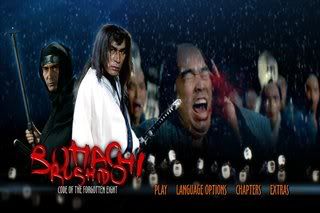
Bohachi Bushido: Code of the Forgotten Eight (1973)

Remember back, if you will, to the days before Wikipedia, before the internet had so thoroughly saturated every part of our lives. Back then, we were blissfully unaware of furries, of slash fiction, and of things like “pinky violence,” a sleazy and popular Japanese genre, whose basic ingredients are graphic nudity, graphic sex, and graphic death. O, we were almost virginal in our ignorance then…

Teruo Ishii was (apparently) a virtuoso of pinky violence--or, more specifically, the ero guro ("erotic-grotesque") subgenre (trust me, I had to look this up). One of his films, Bohachi Bushido: Code of the Forgotten Eight, based on a comic by Kazuo Koike (Hanzo the Razor), has just found itself released in North America, packed with extras and some easy-to-read subtitles, thus making pinky violence accessible to all.

So, here’s the deal: Shino Ashita (Tetsuro Tamba) is your standard Super Samurai. In the film’s opening moments, he takes on a plethora of armed guards, and kills them all in gruesome fashion, without even breaking a sweat. He declares “To die is hell, but to live, is also hell.” Dude has issues.

Shino is taken in by the Bohachi clan, a group of lowlifes and scumbags who run the prostitution biz in Yoshiwara. In order to become a member of the Bohachi, you have to abandon the “eight human virtues.” What are these virtues, you ask? Well, I’ll tell you:

1. Godliness
2. Obedience and fidelity towards elders
3. Loyalty towards friends
4. Trusting your allies
5. Modesty
6. Justice
7. Conscience
8. Shame

…all of this explained by a voice-over, accompanied by a montage of naked women be tortured, for the purpose of turning them into Bohachi women.

Here’s the thing: Shino, as low and deplorable as he is, seems incapable of banishing all eight of the human virtues, and so is kicked out of the clan. Luckily, though, a clan elder recognizes his unmatched capacity for violence, and keeps him on as a guest. Shino takes up a new occupation--to safeguard the Bohachi’s monopoly on drugs and prostitution, he becomes a hitman, killing every john who sleeps with a whore outside of Yoshiwara.

In this way, Bohachi Bushido tries to have its cake and eat it too. Officially divorced from the Bohachi, the viewer doesn’t have to feel bad cheering for Shino, who now viciously kills the scum of the land. The Bohachi women also turn out, remarkably, to be just as evil as their pimps, and so the viewer isn’t supposed to feel bad for seeing them victimized. Plus, you just know that Shino will eventually turn on the Bohachi, making their evil somehow more acceptable for the duration. The extent to which the film succeeds with this moral switcheroo depends on how willing the viewer is to let it get away with it; and, certainly, if you’ve come to see sex and violence, the film delivers in spades, and so perhaps you’re willing to give it some leeway with its extremely flawed morals.

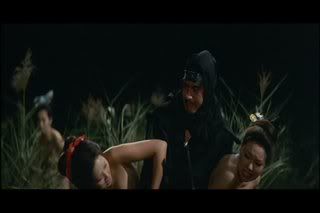
Bohachi Bushido is at its best when its at its most comical. Prostitutes don fireproof kimonos and roll in flames to put out a grease-fire; when those same prostitutes encounter a ninja some moments later, they inevitably engage in a naked wrestling match with their stealthy assailant. Shino continually gets into bloody swordfights, where limbs fly through the air and his opponents are reduced to blood-filled piñatas. Ishii makes no claims towards realism, and uses coloured spotlights and strange filters to exaggerate the comic book quality of the action. He’s like a poor man’s Kenji Misumi. Tetsuro Tamba (who you may recognize from his role as Tiger Tanaka in James Bond’s You Only Live Twice) plays his standard role: stoic, weather-beaten samurai guy, the same one he plays in countless samurai films.

The Discotek DVD sports a fair amount of extras, including an interview with the female lead Yuriko Hishima and a discussion with pinky violence “expert” J-Taro Sugisaku (who explains that the women in pinky violence films “use their sexy violence to entice the hero to win the battle.”) You also get a few pages from the original manga and a couple of write-ups about the film. All in all, it’s more than you would expect for a film of this, er, genre.

There’s really no point in recommending this film or not. If the idea of unrelenting violence and nudity appeals to you--and hey, who could blame you for that?--then Bohachi Bushido is the movie for you. If you find the entire concept of the film deplorable--and hey, who could blame you for that?--then it’d be best to steer clear.