Showing posts with label ASSASSINATION. Show all posts

Thursday, April 30, 2009

A Bullet for the General (1966)

BFGTitle

PLOT:


Set during the Mexican Revolution, Damiano Damiani’s A Bullet for the General follows the bandit leader El Chucho (Gian Maria Volonte, best known as the bad guy from a couple of Leone Westerns) and his gang of thieves, as they raid trains and government facilities for guns and ammunition to sell to General Elias, who is either a Zapatista rebel or a stand-in for Zapata himself (I’m not sure which). Chucho allows a gringo named Bill Tate (whom Chucho dubs “Niño”) to join the gang, unaware that Tate is actually an assassin hired by the Mexican government to take out General Elias with a golden bullet.

BFG1

REVIEW:


Without meaning to be reductive, the most important parts of a film are probably the beginning and the end. If you can catch people’s attention at the start, and wow them at the finish, you’ve probably got a good movie on your hands, unless you really duff it in the middle. Damiani’s political Western A Bullet for the General has one of the best first 20 minutes in film history.

It begins with four men, in close up, walking along a plain white wall. They are outside, and seem to be in a bit of a hurry. They stop, and two of them hug. And then the camera cuts away, revealing that these four are bracketed by soldiers, and that a row of men are aiming their rifles. It’s an execution by firing squad, and as Tate (Lou Castel) looks on, the four are gunned down. Tate is obviously out of place--he is pale and fair-haired, clean and well-dressed. He doesn’t belong.

Unfazed by the execution, Tate walks over to the train station to buy a ticket. A small Mexican boy asks him if he’s an American, and then asks him if he likes Mexico.

“Not very much,” Tate responds.

BFG2

The film jumps straight into the action when the train is attacked by Chucho’s gang. The setup is clever: they’ve basically crucified a captain of the army, placing him on the tracks. When the train stops, unwilling to crush the still-living officer, the bandits attack. A lieutenant on the train shouts at the captain, asking for orders. The captain lets it be known that the train should just move forward. The lieutenant, unwilling to let the captain die by his command, instead drops down between the tracks and tries to crawl up to the officer, hoping to free him without bloodshed. Chucho shoots the lieutenant in the guts. Then the train rolls forward, crushing the captain.

Tate, seeing his opportunity, kills the engineer, stopping the train for the bandits. He tells Chucho that he’s an outlaw, and that he was being extradited to the US to face trial. He asks if he can join Chucho’s band. Chucho agrees, giving Tate a new name, Niño (“boy”).

The opening scenes, then, go a long way to set up the movie in a concise and powerful manner. Chucho and Niño are obviously both ruthless individuals; they share a love of money and of violence that unites them, even though they are completely dissimilar in every other way. It’s clearly not going to be a story about heroes.

Photobucket

Now a part of the gang--including Chucho’s obsessively religious brother, El Santo (Klaus Kinski) and the charming bandita Adelita (Martine Beswick)--Niño aids the bandits as they raid government buildings in search of guns. Niño is willing to help, but he’s impatient, always pestering Chucho about meeting the General. Chucho, not the brightest bandito around, seems to take it in stride, and is only angered when Niño convinces the other men to abandon Chucho and his brother when the two of them are more interested in helping poor villagers than making money. Still, Chucho’s noble streak doesn’t last long--he, too, is in it for the pesos--and soon the gang is back together again, in time for the film’s climax.

Volonte’s Chucho is fascinating to watch; he’s wild and charismatic, and defies easy explanation, probably because Chucho himself is quite a conflicted character. There’s something inside of him--probably his background as a poor peasant--that connects him with the people, but any sort of kindness or generosity of his character is often obfuscated by his greed and rude manners. He distrusts wealth and learning and yet clearly envies it. He has to tell his brother Santo that they are giving the guns to General Elias, too embarrassed to admit that he’s selling them. That Niño is an assassin should be obvious to Chucho, and so it’s easy not to feel sorry for him, but his genuine humanity, no matter how disfigured, makes you side with the bandit against the cold, professional gringo.

Against the expectations of the genre, A Bullet for the General features a couple of strong female characters. Little is made of the fact that the first of these, Adelita, fights side-by-side with the rest of the bandits, just as though she were a man. She is clearly attracted to Niño, but her relationship with one of the other bandits keeps them apart, for a time. Adelita makes it known that she has suffered at the hands of the government and the wealthy landowners; she, more than any of the other bandits, is motivated by hatred.

Photobucket

The role of Rosario is much smaller, but is a vital part of the story. When the bandits and a handful of poor, angry townsfolk come to the home of the wealthy landowner Don Feliciano, it is his wife, Rosario (Carla Gravina) who tries to deal with the situation. We watch, uncomfortably, as she tries to reason with bandits, and then moves on to threats, before breaking down completely when it’s clear that her husband will be killed. While Chucho and his men have hardly been forgiving of their military targets, this is the first time that they victimize the unarmed and the helpless. Our sympathy for Chucho is tested when he even agrees to let his men rape Rosario--an action which Niño puts a stop to.

The man who adapted the screenplay for A Bullet for the General, Franco Solinas, was a politically-interested writer with leftist sympathies. This is obviously most evident in his interest in the Mexican Revolution, which is not a neutral setting for the story, but an integral one. Clearly this is a man who sides with the Revolution. Though quick to show the ugliness of the bandits and revolutionaries, he and the director are at their most heavy-handed with the repeated use of gold as a symbol for capital and wealth. It is not a simple affectation, that Niño must shoot the General with a golden bullet--but at least that bit of imagery is acceptable. Harder to swallow is the existence, and importance, of a golden machine gun, a mechanized weapon capable of unlimited slaughter and linked to wealth and privilege by its ostentatious decoration. Even if there were some historic truth to it--even if there is documentation proving the existence of a golden machine gun during the Revolution--it’s simply too hard to swallow as a practical or realistic detail. It takes you out of the film, smacking you in the face with its inauthenticity.

That said, A Bullet for the General is one of the best Westerns I’ve ever seen, a real gem, and I’d encourage anyone to track it down and give it a try. While I’m not familiar with Damiani’s other films, this one certainly gives Leone a run for his money.

Monday, July 7, 2008

In Bruges (2008)

Photobucket

Full disclosure: I’ve always disliked Colin Farrell. His resume is filled with bad movies, and when he somehow ends up in a good film he’s usually the worst part in it. However, this film has changed my outlook completely. Colin Farrell is so astonishingly good, so impeccably cast, that I actually look forward to the next Colin Farrell film. Martin McDonagh’s In Bruges is just that good.

Ken (Brendan Gleeson) and Ray (Farrell) are both hit men. I’m pretty sure that this is an occupation that only exists in the movies, but whatever. What makes them different from most hit men, however, is the fact that they seem like fairly ordinary people--kind of like Jules and Vincent in Pulp Fiction, rather than the elite killers found in such films as Assassins. Ray, especially, acts like you think a criminal actually might act. It’s rather refreshing.

Photobucket

Having finished their last job, their boss, Harry Waters (Ralph Fiennes) sends them--sentences them, if you will--to Bruges, a medieval town in Belgium. Ken, the older of the two, is able to make the best out of it, and turns it into a site-seeing trip. Ray, on the other hand, thinks Bruges is purgatory.

Ray is a real shit. He acts somewhat like a child with ADD, and, as I said, it’s Farrell’s best performance. I hesitate to suggest that this might be because Farrell is more like Ray than, say, Alexander the Great. But who knows. In Bruges, he finds only two things that interest him--the chance for sex (which he finds with Chloe, a native of the area) and gawking at a dwarf who’s in town for a film (“They’re filming midgets!” Ray says). When he isn’t around Chloe or Jimmy (the midget), he’s generally pouting or getting himself into trouble. We do learn, however, that there is a reason for his attitude--everything did not go smoothly during Ray’s last mission, and his conscience weighs heavily on him. His petulant attitude, perhaps, disguises the turmoil inside.

Photobucket

Farrel isn't the only great character, though. Brendan Gleeson is always reliable, and plays Ray's grown-up partner with just the right amount of seriousness, while Ralph Fiennes (seemingly on a break from dour period pieces) is suitably intimidating and brutish as their boss, Harry.

Most of the humour in In Bruges comes from Ray, and hits its mark. There’s a great scene--unfortunately spoiled in the trailer--where he tries to tell some obese American tourists that they should avoid the narrow, winding stairs that lead to the top of the medieval church. His lack of subtlety (and the Americans’ lack of good sense) lead to an altercation that should make anyone laugh heartily (except, perhaps, uptight and overweight Americans). All of the humour makes the graphic violence near the end of the film all the more shocking.

Photobucket

In Bruges isn’t without its flaws, though. The ending is a little too perfect, and sometimes that humour falls flat. When going for laughs, McDonagh’s film swings for the fences, and so when it misses, the silence is deafening. While Ray’s obsession with midgets, for instance, is humorous, said midget’s obsession with an oncoming racial war seems tacked on, like McDonagh needed something zany to add to fill space, and it was the best he could come up with.

The Focus Features DVD presents In Bruges in its original 2.35:1 aspect ratio, and comes with a few featurettes. Most notably among these is “Fucking Bruges,” a compilation of all the swears in the film. This is good for a quick chuckle, and also draws attention to the fact that In Bruges must be one of the most expletive-filled films out there. I’d highly recommend checking it out.

Tuesday, June 17, 2008

Tenchu! (Hitokiri) (1969)

Photobucket

Hideo Gosha’s second release of 1969 is perhaps on par with the excellent Goyokin, and seems to work in tandem with the earlier film to act as a criticism of the samurai way of life. The film is very closely centered on Shintaro Katsu, who plays Okada Izo. This character will be familiar to anyone who watched Takeshi Miike’s IZO, a movie about the same character existing throughout time, and acting not as a person, but as a symbol of the ever-present violence of the system…or something. Gosha’s film, on the other hand, is a character study of the assassin during his lifetime, and Katsu brings a depth of humanity to the character entirely missing from Miike’s later work.

Photobucket

We first meet Izo as an out of work and miserable ronin. Izo is so down on his luck that he even offers to sell his armour, but finds that the price simply isn’t worth it. In desperation, he turns to Hampeita Takechi, played by Gosha’s long-time collaborator Tatsuya Nakadai. Takechi is the head of the Tosa Clan, a group of Loyalists intent on overthrowing the Shogunate and returning the Emperor to power. Takechi offers Izo a job as an assassin, and the rumpled and pathetic Izo accepts. Flashing forward, the viewer discovers that Izo has rapidly gained in power and rank, and is known as a nearly unstoppable killer.

Indeed, Izo is shown to be a victim of his success. As he gains more and more fame for his skills as a killer, he becomes more and more enamoured with himself. He is often drunk, and always loud and abrasive. Izo likes nothing more than his fame, and takes any compliment from Takechi like a dog accepting a bone. His rise to decadence makes up a large portion of the first part of the film, but its accompanied by the sense, in the viewer, that it cannot last.

Photobucket

And, of course, it cannot. Eventually, Izo angers Takechi, and when he’s rebuked he feels that he’s become too important to follow Takechi’s orders. He soon discovers, though, that his great renown as a killer offers him no real job opportunities, and that only outcome of turning on his master is the possibility that he’ll return to where the viewer first found him--alone and penniless, on the verge of starvation.

Tenchu! is more infamous than it is famous, due largely to the presence of the poet and playwright Yukio Mishima, in the role of Shimbei Tanaka, another “unstoppable” assassin. In an eerie foreshadowing of things to come, a scene in Tenchu! Depicts Shimbei Tanaka committing seppuku, only a year before the poet himself did the real thing.

Photobucket

While Tenchu! Certainly offers its fair share of action, most of this is frontloaded into the first half of the film. The rest painstakingly details the fall of Okada Izo. Here, Katsu is at his best. His deep, expressive eyes are able to make plain the depths of the anguish and turmoil Izo feels inside. The ruthless samurai not only has to come to terms with his own place in the world, but he is soon forced to confront and interrogate the very notions of the samurai way of life, of clan loyalty and fealty, and even of the use of violence itself. Many viewers may find this second half of the film far less entertaining than the first, but it is this portion of the film that truly separates it from the flock of samurai films that were prevalent at the time. The emotional depth of the film is no doubt due to its writer, Shinobu Hashimoto, whose writing credits include Kurosawa’s The Seven Samurai and Throne of Blood, as well as Kobayashi’s Harakiri and Samurai Rebellion.

Currently, there’s no North America release of Tenchu!, as is the case with most of Gosha’s films. The French release, by Wild Side, is a great, two DVD offering, featuring great video quality. Oddly, though, despite being a two-disc set, it only offers a handful of extras, such as interviews and a photo gallery. The original trailer seems to have been lost. Unfortunately, there are no English subs, so if you want to own a copy of the DVD, be prepared to wait (or starting learning French).

Photobucket

It’s crazy to think that Gosha was able to release both Goyokin and Tenchu! in the same year. In some circles, both films are considered classics of the genre. Don’t let that fool you, though; both are radically different films. While Goyokin is an exciting action/adventure, Tenchu! is a more cold and introspective film. That doesn’t mean that it doesn’t contain some great action--it does--but if that’s what you’re looking for, Tenchu! might not be for you. Here’s hoping an English language release is on the way.

Wednesday, June 4, 2008

The Big Hit (1998)


My one pet peeve when it comes to movie reviews (or anything in general for that matter) is the logic of disliking something because it isn't something else. I really don't think that Kirk Wong's assassin movie / comedy, The Big Hit, ever aspired to be anything more than a breezy, enjoyable film that just happened to contain lots of gunfire. However the internet being what it is, you'll find plenty of negative reviews whose only premise is that this film is lacking because it is not a Leon: The Professional or a Grosse Point Blank or a Ghost Dog.

I happen to love all three of those films but I am also smart enough to know that all film isn't created equal, nor do I necessarily have to enjoy one assassin-themed movie for the same reasons that I enjoy another.

Our film centers on the misadventures of hapless hitman Melvin Smiley (Mark Wahlberg) as he navigates through a maze of self-loathing, a money hoarding mistress (Lela Rochon), a clueless Jewish fiancee (Christina Applegate), and the eventual double and triple crosses that occur in any proper theatrical portrayal of life in organized crime.


Melvin is in the employ of the mysterious Mr. Paris (played to the hilt by a scenery chewing Avery Brooks) and works in conjuction with three other paid killers: the self-proclaimed leader, Cisco (Lou Diamond Phillips), Vince (Antonio Sabato Jr.) and Crunch (Bokeem Woodbine). Any self-respecting action movie buff should grin with glee at that casting. Kirk Wong has done you the favor of casting a hunk or two so that the protests from your female significant other for watching this gem instead of Steel Magnolias again won't sting so much.

The teamwork of our gang of four leaves a lot to be desired. Melvin faces all of the real danger while his partners reap the benefits of his efficiency and bravado. As a matter of fact, Melvin's problem in life is that nearly everyone he knows rides roughshot over him because Melvin is deathly afraid of disappointing the people closest to him. Melvin is an assassin that wants to be liked but as Cisco humorously points out, assassins tend not to be well received in society.

Especially by the families of the people they've killed.


Eventually our intrepid assassins pursue an avenue they shouldn't and decide to earn extra money by kidnapping Keiko Nishi (the achingly cute, China Chow), the daughter of a recently bankrupted electronics mogul. Melvin naturally falls for Keiko in short order and it is only a matter of time before all hell breaks loose during the implausibly hysterical twist of fate and plot.

Everything is revealed all in due course and usually just in time for a kick-ass exchange of small calibre weapons fire.


If anything has hurt repeated viewing over the years, it is the fact that this movie is heavily laden with 90's references. Wahlberg engages in some precursor of the Gunkata from the film, Equilibrium, as his pistols seem to be the most effective while he is in the midsts of some breakdancing routine (I kid you not) and kids these days will probably not get the Spice Girls joke or the subplot concerning Melvin's overdue video rental.

Even so, this movie is absolutely worth your time.

Thursday, May 22, 2008

The President's Last Bang (2005)


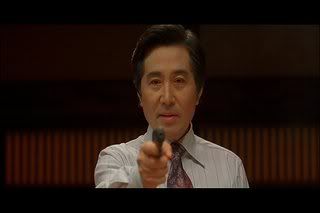
On October 26th, 1979, South Korea's President, Park Chung-hee, was assassinated by the Director of the Korean Central Intelligence Agency (KCIA), Kim Jaegyu. The President's Last Bang by Im Sang-Soo focuses on the immediate lead-up to the assassination, and the chaotic hours that directly followed.

Park Chung-hee had come to power in 1961 through a military coup. Despite these dubious beginnings, Park managed to strengthen South Korea's flagging economy, by implementing five year plans and normalizing relations with Japan. Unfortunately, the longer he stayed in office, the more despotic his rule was. Park became withdrawn, and his government more repressive. Apparently (or, at least, according to Wikipedia), when on trial for Park's assassination, Kim Jaegyu stated "I did that for democracy of this country. Nothing more, nothing less."


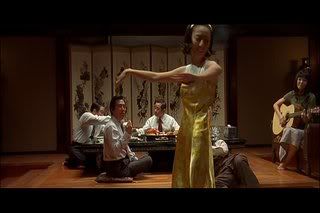
The President's Last Bang doesn't make Kim's motivations so clear. Im portrays Kim (played by Suk-kyu Han) as a burned out and frazzled bureaucrat, suffering from constipation and chronic halitosis. His decision to murder Park seems almost spur-of-the-moment, and primarily inspired by his dislike for Park's bodyguard, Cha Ji-cheol. During a dinner engagement with the President and Chief Secretary Yang (Park's toadying drinking buddy), Kim is forced to endure Cha's boorish manners and draconian political advice. After becoming angered with Cha, Kim steps outside to tell two of his friends from the KCIA that he's going to kill Cha and Park, and that they'd better be ready to back him up. Clearly this is something they've contemplated before, but his friends' reactions betray the fact that they had no idea it was coming that night.

What follows is an extended spat of graphic violence, during which Kim shoots Cha and Park, only to have his gun jam, so that he has to leave the room, find another weapon, and return to finish them off. As soon as the gunshots are heard, the two other KCIA men ambush Park's guards, gunning them down before they have a chance to react.

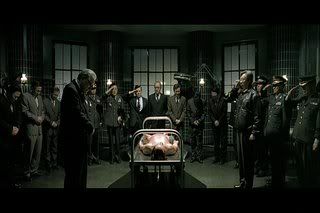
Im shows us the immediate consequences of the assassination as a comedy of errors: the President's bodyguards carry empty guns; there's no communication between the various arms of South Korea's government; when the Cabinet Council meets to discuss what's to be done, they discover that none of them really know; and a soldier guarding the army headquarters even refuses to let one of the characters in, failing to recognize him as the army Chief of Staff. While Kim never declares himself the assassin, he acts, in the aftermath of the killing, without fear, as though he thinks that the South Korean government is too obtuse or impotent to do anything about it.


The President's Last Bang is intended for a Korean audience, one that is acquainted with the historical event. As such, a Western viewer is left to find his or her own footing--which, admittedly, took me upwards of twenty or thirty minutes, as I tried to map out in my mind the characters and how they were all related. Luckily, there is some background information given at the start of the film, in the form of subtitles that I can only assume were added by KINO, since there is no accompanying Korean text on the screen.

The KINO DVD provides a few extras, and the subtitles seem accurate and easy to read. The transfer isn't perfect--there's some combing evident, but that only really showed up when I paused the film (or took some screen captures). Im has a real sense of visual flair, making The President's Last Bang an eye-catching film. Most impressive is Im's capacity to combine styles, so that this historical biopic features gritty, gangster-style violence and satirical laughs in equal measure. Basically, it's pretty fucking cool. Recommended for fans of foreign features, who'd like to see something a little different on their TV screen.