Saturday, September 19, 2009

Return Of The Streetfighter (aka Satsujin ken 2) (1974)

Photobucket

A padded retread of the first film in many ways, Return of The Streetfighter still features all of the elements which made the first film such a bloody blast to watch. There's still the funky score and outrageous visuals, we still get copious amounts of ultraviolence, and Sonny Chiba brings bucket-loads of charisma to the party. It's a shame then that the already scant 80 minute run time is stretched by some lengthy superfluous flashbacks to the first film. Fans will find plenty to love here, but if you didn't care for the original film there's little here that will change your mind.

Filmed almost immediately after the first film, director Shigehiro Ozawa starts this one off with a bang: Hired to kill a man in police custody, Takuma Tsurugi (Chiba) decides to get himself intentionally arrested by driving his motorcycle at ridiculous speeds and beating up on a bunch of cops. Once in the police station, Tsurugi finds his target and proceeds to pierce his vocal cords with his fingers before taking on the entire station and escaping out the window, all while wearing handcuffs! He escapes with the help of his new plucky, beat-talking sidekick: Pin Boke ("Kitty" in the english dub). This sequence is one of the best of the series, so it's a minor disappointment when the plot starts cover a lot of the same territory as the first film. Takuma has been hired by Isamu Otaguro, who runs a local karate dojo but is suspected (rightfully) of working with the mafia. After refusing to kill Kendo Masaoka (who Tsurugi tangled with in the first film) who has threatened to turn Otaguro in, Tsurugi soon becomes a target of Otaguro and his hired goons.

Photobucket

It's at this point where the film becomes a series of impressive set pieces with Tsurugi being attacked while skiing (which leads to a completely ridiculous eye-popping scene), at a massage parlor, and by his old nemesis Junjo (featuring an electronic voice box to replace the one torn out by Tsurugi in the first film). The confrontation with Junjo ends badly, and a despondent Pin Boke has to nurse him back to health before he goes off and kicks the ass of everyone left alive. No promises this time, but another sequel (again made in 1974!) was soon on its way.

We're all here to see Chiba (Viva Chiba!), and his character here is slightly softened and sympathetic compared to his sell-women-into-slavery ways in the first film. He's still an unrepentant prick with a chip on his shoulder, but he's a little more fun and even gets to crack a smile during a ridiculous conversation with a self proclaimed karate expert (who manages to severely burn himself on some sauna rocks). Chiba is still in top form with his karate skills, and may even show off a bit more acrobatics than the first film, and the film is as vicious and violent as ever - though only the eye-popping reaches the dizzying heights of the x-ray head smash from the first film.

Photobucket

Shigehiro Ozawa keeps the action under control while capturing every grimace and snarl from Chiba, and there's a nice touch where titles are presented to identify Japanese weapons being used in the early scenes. While these scenes feel a bit more like padding (and i'm unsure if they are included in the original Japanese version), seeing these weapons in action are always a lot of fun (and gave me Teenage Mutant Ninja Turtles flashbacks) - though not all actually come into play in the film.

Once again the secondary characters are a bit weak, and Kitty's jive talking must have seemed dated even when the film was related, but they get beaten senseless quite effectively. Bringing back Junjo was a nice touch, and the addition of the robotic voice-box adds a proper comic-book touch, though he doesn't get to show off his abilities like he did in the first film.

Photobucket

Image quality is a little rougher than for the first Streetfighter, but it's still a quite clean, apparently uncut print that is easily available because of its public domain status. The dubbing is a little rougher as well, and the habit of anglicizing names continues with Takuma once again referred to as "Terry". Sound is perfectly fine, with Toshiaki Tsushima's awesome funky soundtrack coming through loud and clear. I worried that we would be denied the awesome Streetfighter theme music, but it's saved for Tsurugi's climactic recovery and it is appropriately awesome.

Photobucket

While a step down from the revelation that is The Streetfighter, Return is still required viewing for fans of martial arts films, of Sonny Chiba, or for fans of scenes where characters appear astounded that their eyeballs have been punched out of their skulls. Almost all of the elements that made the original great return here, and you can watch the whole thing right here. After this film the series produced diminishing returns, but there's no excuse to not check this one out.

Wednesday, September 16, 2009

The Streetfighter (aka Gekitotsu! Satsujin ken) (1974)

Photobucket

To see the impact that the arrival of Sonny Chiba had upon American audiences in the 1970s, you need only watch the trailer for his 1976 film The Bodyguard. A rising chant of "Viva Chiba!" accompanies images of Sonny doing various bad-ass things until the chorus raises into a frenzy. At the time Chiba was (along with many, many others) being touted as the spiritual successor to Bruce Lee - despite being Japanese - but his films showed off a very different kind of appeal. Chiba was later deified by Quentin Tarantino in his script for True Romance, as well as casting him in Kill Bill, but it's the bloody, brutal The Streetfighter where most had their first taste of the genre legend.

Chiba is Takuma (Terry) Tsurugi, a Karate expert and mercenary who we first meet busting a criminal out of prison, before killing the prisoner's brother and selling his sister into slavery when they are unable to pay their bill. It's about at this point where viewers will realize that Tsurugi is an unconventional hero, and it speaks to Chiba's brooding charisma that it's diffcult to not root for him even when he's being dispicable. Anyway, after refusing to do a kidnapping job for the.. uh.. Chinese Yakuza (Tsurugi has an issue with the Chinese) they agree to kill him off, so he decides to protect the potential kidnapping victim (Sarai, an oil heiress) as revenge. He does this by killing everyone who comes near him in increasingly brutal ways - including eye plucking, spine snapping, and the requisite testical ripping. Things wrap up surprisingly neatly at the end with a promise of more Street Fighter action to come.

Photobucket

"If you've got to fight.. fight dirty!" bellowed the posters for The Streetfighter upon its initial U.S. release, but audiences used to the comparitively tame martial arts flicks of the time must have been shocked at the levels of violence and nastiness on display. Originally hit with an X rating, the film sticks closer to the Yakuza flicks of the 60s or the exploitation Samurai films of the 70s with a morally questionable protagonist that lives by a specific code of honor that allows the audience (and often characters in the film) to give them grudging respect. That Tsurugi can back up his eqo with his karate ability, while showing little affection or respect for anyone or anything besides his comical man-servant Rakuda/Ratnose, makes him a perfect antihero for the time it was released.

And Chiba fills this role with gusto, grimacing constantly while conveniently dispatching anyone who looks at him sideways. Totally believable as an ass-kicker, it's no wonder that audiences were drawn to him. Director Shigehiro Ozawa (who also helmed the sequels) obviously knew he had something special, and effectively structures the film to get maximum use out of this over-the-top character. Ozawa keeps the colorfuls action moving and uses little stylistic touches - particularly the infamous x-ray punch - which add to the comic book atmosphere.

Photobucket

Credit must be given to Koji Takada & Motohiro Torii's tight script, which neatly balances Terry's dickishness with flashes of humanity, while briefly touching on his past and his instilled sense of honor, to make him slightly more sympathetic. By the time we get to the final confrontation, both characters involved have a right to seek revenge which makes the final result slightly bittersweet.

The supporting cast are all game, but this is Chiba's show and he brings bright red blood with every swing. Veteran composer Toshiaki Tsushima (The Green Slime, The Yakuza Papers) provides an energetic score, which includes the awesome Streetfighter theme music which will stick in your brain for days after hearing it.

Photobucket

If you haven't seen The Streetfighter.. well, why not? A terrific uncut & widescreen print of the film is, for some reason, in the public domain and has become widely available on DVD and online from a variety of distributors. Though this is a dubbed version the translation, aside from some difficulty with a few of the Japanese names, is pretty servicable. A subtitled version is also available from the UK, but try the free version first.

The version in the Millcreek 50 Movie Pack is, indeed, the widescreen print and I would be surprised if any other films in the collection match up to it in terms of image and sound quality. This (and its sequel, also available in the public domain) is a welcome respite from the general sketchy quality in the collection as a whole.

Photobucket

Some viewers may have difficulty rooting for such a heel, but if you give in to the magnetism of Sonny Chiba it's near impossible to not enjoy The Streetfighter. It moves at a lightning pace, and is packed with enough violence and exploitation to placate the most rabid film fan. Everyone should see this one. Viva Chiba!

<

Saturday, September 12, 2009

T.N.T. Jackson (1974)

Photobucket

The combination of kung-fu and blaxploitation elements seems like an obvious blending, seeing as that the two genres came to prominance in the U.S. at around the same time period (early to mid 70s) and both types of films had wide appeal to an urban audience. There were attempts to meld the two styles, particularly after the success of Enter The Dragon, but it would be expensive to fly your production to China, or to fly in Chinese talent, so generally homegrown talent (like Jim Kelly) was used instead.

TNT Jackson is a low-rent version of Kelly's Black Belt Jones, with a bit of Foxy Brown thrown in for good measure. Director Cirio H. Santiago at least attempted to add a bit of legitimacy by setting the film in Hong Kong (though actually lensed in the Phillipines) and casting asian actors in secondary roles, though the results are a mixed bag.

Photobucket

October 1969 Playboy centerfold Jeannie Bell stars as Diana 'T.N.T.' Jackson, who travels to the seedy underbelly of Hong Kong in search of clues to the whereabouts of her brother. After kicking the butt of some random attackers, she finds helps from the kind-hearted Joe (Chiquito) as well as requisite baddies Charlie (Stan Shaw), Ming and Heroin dealer Sid (co-writer Ken Metcalf) who may be involved with her brother's disappearance. TNT uses her spine shattering, bone blasting kung-fu skills to get to the bottom of the mystery.

Co-written by Roger Corman veteren Dick Miller (A Bucket of Blood, Gremlins), T.N.T. Jackson's greatest pleasures (and limitations) come directly from its star. Jeannie Bell is attractive, but her fighting skills consist mostly of swinging her arms around until extras conveniently run into her fist. Occasionally she's doubled by someone (with a surprisingly manly figure) to show off with some flips, but mostly it's just her doing a weak impression of someone with actual martial arts skill. To cover this, Santiago speeds up the action by removing frames, making the fights look like outtakes from The Human Tornado (or Benny Hill).

Photobucket

Thankfully, Bell is supported by an able cast - particularly Stan Shaw (The Monster Squad!), who gets to show off both his huge afro and some generally convincing moves in his fight scenes. Chiquito, who was a massive star in The Phillipines, has to do most of the heavy lifting in the kung-fu department, and while the choreography (and direction) leave a lot to be desired, he's a lot of fun. The rest of the bad guys are pretty bland, though Pat Anderson as Sid's girl (with a secret) has some enjoyable bitchy interplay with T.N.T.

The film moves at a brisk pace, the brief 70 minute run-time working in its favor. Santiago, a veteren of exploitation films, knows how to keep things moving and throws in fights and a sprinkling of sex into mix when the pace threatens to slow down. Most memorably in a scene where Bell takes on a bevy of baddies topless, apparently having the advantage because the lights are off ("You want it black? You got it black."). Things come to a rather abrupt ending, and occasionally there seems to be some material missing, but the plot is thin enough that it's unlikely you'll ever be confused.

Photobucket

As per usual in the Millcreek 50 Kung-Fu film collection, T.N.T. Jackson is presented in a rough full frame transfer featuring plenty of print damage and grain throughout, though for once it feels appropriate. Sound is tinny and hollow sounding, but dialogue comes through clearly. You'll never forget the film's low budget origins, but it's watchable.

Like all of the films in the collection, the only extras are (four random) chapter selections. Hooray!

Photobucket

A lot of fun, T.N.T. Jackson may have risen above its meager ambitions with a more charismatic star in the lead (such as Pam Grier, who starred in Santiago's film Women In Cages), but as is it still provides a lot of entertainment value (and plenty of unintentional laughs). Definitely worth checking out - particularly since it's apparently in the public domain - but it's not one you're likely to return to, unless you're a sucker for topless kung-fu. Like me.

Thursday, September 10, 2009

The Black Godfather (1974)

Photobucket

Bury any thoughts of Francis Ford Coppola's films before dipping into this enjoyable but minor effort anchored by a strong lead performance from Rod Perry (S.W.A.T.). The Black Godfather is a fairly average blaxploitation production with some strong acting and a fun synth score rescuing it from total mediocrity. While the efforts at making this a "message" film are admirable, the heavy handed moralizing becomes a bit difficult to swallow by the film's end.

Perry stars as J.J., a small time thief rescued by local crime boss Nate Williams (blues musician Jimmy Witherspoon) after a robbery goes wrong. Soon (as in, after the opening credits) J.J. is the Black Godfather, though we don't actually see him commit any crimes. Instead, ol' Nate tries to run all of the heroin dealers out of town, as well as the white mobsters who put them there. Tony Burton (Don Chastain, hamming it up), doesn't take kindly to being leaned on, and soon he's all up in JJ's area. Will is all come down to a gunfight in a hospital basement? You bet it will.

Photobucket

I do have to give director John Evans credit for trying something a little different, and a little less exploitive, with his film. While the message of black solidarity and freedom from white oppression is conveyed through lots of talky dialogue scenes, at least the message comes through clearly and is made palatable through some occasionally sharp writing and charismatic performances. It's never subtle, but it's also rarely boring.

But more of the credit has to go to Rod Perry who shows off his chops and makes an appealing lead, even if you have to wonder when he gets a chance to commit actual crimes between personal crusades. As his mentor Jimmy Witherspoon won't be winning any awards, but his presence brings gravitas to the role. Better is Tony Burton (Apollo Creed's trainer in the Rocky films) who is a lot of fun as Nate's surly bodyguard. Don Chastain is required to be white and a douchebag, and does both very well.

Photobucket

As with most 70s blaxploitation films, this one comes equipped with a hip soul music soundtrack. The original songs by Martin Yarborough are a bit cheeseball, but the synth & bongos score goes over well and brings a little fun to what is an often humorless production. Though, there's plenty of humor to be found in the decor and clothing choices. Expect lots of frills and plaid.

Once again taken from the Millcreek 50 Kung-Fu Film collection, the fullscreen image is dark and murky. Thankfully, most of the film takes place during the day, though the night scenes - particularly a climactic airplane explosion - are a little hard to make out. The film appears to have been transferred from a VHS source, with occasional tracking lines. Audio is equally shaky, but dialogue isn't hard to make out.


Photobucket

Thanks to some strong performances The Black Godfather mostly overcomes a slow pace and preachy script. It's light on action, but worth the time for fans of blaxploitation and "take back the street" pictures.

Monday, September 7, 2009

Lie Tou (aka The Headhunter) (1982)

Photobucket

Not one of Chow Yun-Fat's proudest moments, Lie Tou (aka The Headhunter/The Long Goodbye) is a fairly average Hong Kong action thriller which is sunk by some atrocious dubbing and a talky, confusing script. Patient viewers (and fans of Chow's future work with John Woo and Ringo Lam) will enjoy the occasional fun action scene, but there's little here to hint at the superstar that Yun-Fat would become in the following decades.

Chow stars as Nguyen (or, in the English dub.. Andy!), a former soldier and Vietnam immigrant now living in Hong Kong as a film special effects technician - and part time assassin! Nguyen is, as usual, a killer with a conscience and is haunted by his experiences in the war, wishing only to pay for his family to join him so he can stop the killing. After falling for a beautiful TV reporter (Rosamund Kwan), the two discover that the film company that Nguyen works for has been manufacturing chemical weapons for the US. Eventually, Nguyen's past comes back to haunt him (in the form of Kim Tai-Yung, a fellow soldier out to murder him for abandoning him during the war), and someone eventually gets their head chopped off. Who will it be? You'll have to tune in!

Photobucket

Is the Headhunter a meditation on the long term effects of those traumatized by the Vietnam war? Or, is it simply a reaction to the dozens of "Vietnam Vet goes apeshit" movies coming out in the early 80s? While there are hints of a higher purpose, we're a long way from Taxi Driver and the story being told simply doesn't feel significant. The actors generally aquit themselves admirably, particularly Philip Chan as the unhinged Kim Tai-yung, but the dubbing negates most of the famous charisma that Yun-Fat brings to the table, and the reporter sub-plot is predictable. They even pull out the old gag of the reporter looking to make the big reveal to the police, only to find her evidence suspiciously missing.

It's in the unfortunately rare action scenes things do spring to life a bit, particularly during a string of assassinations early in the film. There are a few moments of actual martial arts action as well, though these are fleeting and sometimes hard to make out because of the dark photography. Director Shing Hon Lau shows some talent for building tension during these scenes, but generally his style is flat and uninvolving.

Photobucket

Part of the Millcreek 50 Martial Arts movie pack, The Headhunter is surprisingly presented in its original 1.85:1 aspect ratio, and appears to be uncut. There are various cuts of the film floating around - the one retitled The Long Goodbye is significantly shorter - but thankfully this version is complete. Despite that good news, the image quality is a mess with washed out color, grain, and the image sometimes being so dark to be almost unwatchable. The score seems to be patched together from library music, which actually is enjoyable when you recognize the music from other sources. Cult movie fans will definitely recognize a piece from the original Dawn of the Dead.

While likely dull even in subtitled form, the dubbing here is appalling, making the long scenes of dialogue embarrasing. This is particularly crippling later in the film when (thanks to some not-so-shocking deaths) the film takes a turn for the melodramatic.

Photobucket

What might have been a solid entry in the slate of Vietnam themed exploitation films in the early 80s, The Headhunter is sunk by an unfortunate focus on the love story which takes focus away from the more enjoyable exploitation elements. These faults are compounded by the weak dub-job and unfortunate image quality. Unless you're a rabid Chow Yun-Fat fan this film and presentation simply isn't worth your time.

Tuesday, September 1, 2009

Ran (1985)

Photobucket

Kurosawa. As directors go there are few that receive more reverence. And rightly so, with a cabal of films that defined action cinema for decades, including such classics as Rashomon, The Seven Samurai and Yojimbo. Incredibly prolific throughout the 50s and 60s, in the twilight of his career Kurosawa sadly had more difficulty finding financing for his projects. Always a perfectionist, the director was more and more unwilling to compromise his epic vision, which meant that his film Ran was in development for a decade before it was finally brought to the screen. Dealing with failing health (and eyesight) and the untimely death of his wife, the director still managed to create a beautiful and heartfelt Shakespeare adaptation which touched on some of his favorite subjects - honor, loyalty and revenge.

The plot follows King Lear rather faithfully in parts, while diverging in some key details. After a rattling dream, Lord Hidetora decides to bestow his kingdom to his three sons - Taro, Jiro and Saburo. While Taro and Jiro accept their new positions with glee, Saburo warns his father that the unity of their family will not remain strong. Angered, Hidetora banishes Saburo. Soon, Saburo's predictions come to pass, as Hidetora is abandoned by his sons who eventually even try to murder him and his men when they take refuge in the kingdom's third castle. Stripped of his family and title, Hidetora is brought to the brink of madness as his keepers try and find Saburo to help regain the family throne.

Photobucket

Kurosawa was no stranger to Shakespeare and Shakespearean themes going into the production of Ran, having translated both Macbeth (Throne of Blood) and Hamlet (The Bad Sleep Well) previously. Transplanting these works into Feudal Japan wasn't particularly unique, especially considering Kurosawa's own work The Seven Samurai was adapted into The Magnificent Seven, proving that these stories were strong enough to endure many levels of interpretation. However, despite the Elizabethan origins, Ran feels entirely like Kurosawa working at his peak. Huge battle scenes, breath-taking photography, and an attention to detail that borders on obsessive.

The film's centerpiece (literally) is the attack and burning of the Third Castle which required the construction of an actual building on the slopes of Mount Fuji. The fire raining down on Hidetora as he descends the steps is all very real, and Kurosawa directs the scene with a master's touch. Even in the age where computer effects make even the most fantastical things possible, it doesn't take knowing what you're seeing is real to be impressed.

Photobucket

This scope of action carries onto the battle scenes, where Kurosawa makes his 1400 extras look like ten times that many. The colorful costumes mark each soldier's designation, making things much easier to follow when the soldiers begin to clash. And Kurosawa doesn't shy from the horrors of war, with the bloodshed being both graphic and plentiful. He leaves his most strikingly violent image, however, for a memorable decapitation scene near the end of the film.

Part of what makes Ran so rewarding to watch is the level of character development afforded to secondary characters. Lady Kaede (played with sometimes shocking passion by Mieko Harada) is not merely playing a variation on Lady Macbeth, but is also setting her own plans of revenge into motion. Kyoami is not just a jester, but also comments on the action while showing frustration at his station and having to care for Hidetora out of loyalty. He also brings such much needed comic relief to material that sometimes edges towards melodrama. But it's Tatsuya Nakadai as Lord Hidetora who is really the star here, bringing an otherworldly quality to the anguish his character through reflected by the dramatic (and intentionally obvious) make-up changes his character goes through. While some have pondered what Toshiro Mifune may have brought to the role, Nakadai pours himself totally into the performance and he's excellent here. It's difficult to not see Kurosawa himself reflected in the character of Hidetora, abandoned by his children and being haunted by the actions of his past.

Photobucket

I viewed the Masterworks Edition of Ran released by Fox Lorder after some negative response to their initial DVD of the film. I should mention that there has also been a Criterion release of Ran that would likely be the definitive release up to this point. Video quality is good, preserving the carefully constructed 1:85 ratio compositions (though the image appears slightly cropped and sometimes soft) and containing a great deal of detail. There is a short feature on the DVD dealing with the restoration of the image, comparing it to previous versions, and the difference is dramatic. The soundtrack by Tôru Takemitsu is outstanding, forgoing the bombast of usual epic soundtracks for a more contemplative and eerie score.

The DVD includes the film's trailer, but the real treat is a pair of commentaries, each focusing on a different aspect of production. The first by Stephen Prince is a real treat, exploring the thematic concerns of the film, the similarities and differences from King Lear, and other fascinating (though, often rather scholarly) points. It remains screen specific, and packs an incredible amount of information into the running time. The second commentary is by Peter Grilli who gives a much more anecdotal commentary, speaking about his experiences with Kurosawa and being on the set of Ran during filming. While plagued by long gaps, and rarely referring to what is actually occurring onscreen, it remains a terrific counterpoint to Prince's commentary. We also get a couple of trailers and the restoration video.

Photobucket

Akira Kurosawa's final masterpiece, Ran is a beautiful film which ended up benefitting greatly from its extended development time. Despite the epic 160 minute run time, there is hardly a wasted frame or line of dialogue in the film and when the battle begins to rage in the final half hour, the groundwork has been adequately laid for the tragic and dramatic ending.

Wednesday, August 19, 2009

Cemetery Man (Dellamorte Dellamore) (1994)

CM Title

Here’s what movie fans need to know about Cemetery Man: the director, Michele Soavi, was the assistant director to both Italian giallo-Master Dario Argento and Monty Python alumni-turned-auteur Terry Gilliam, and Cemetery Man sort of looks like a film designed for the former and filmed by the latter. And that alone makes it terribly interesting.

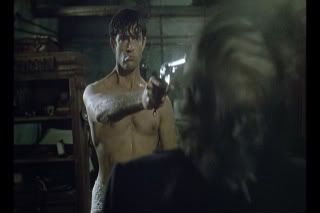
For anyone to whom those names mean nothing, this is what Cemetery Man is about: Francesco Dellamorte (Rupert Everett) is the caretaker of an Italian cemetery, a position which would be fairly simple for him if it weren’t for the fact that the dead have a tendency of coming back, newly endowed with a taste for human flesh. And so it is Dellamorte’s job to kill them by breaking their skulls. Dellamorte lives in the cemetery with his Igor-like assistant, Gnaghi, and ensures that these “returners” rest eternally.

CM1

The odd thing is, the zombie storyline only goes so far, and then seems to sputter out about half or three quarters of the way through. Instead, the film focuses on Dellamorte’s fixation on (and connection to) “She,” a woman played by the gorgeous (and often topless) Anna Falchi. “She” enters Dellamorte’s life again and again, in at least three incarnations: first, as a sexy widow, then as various girls he encounters, and even as some sort of uber-zombie.

So, is she a doppelganger? Or is her recurring appearance merely an affect of Dellamorte’s obsessed mind? I, for one, couldn’t tell you. I can tell you, however, that the whole thing drives Dellamorte mad, and he ends up causing more chaos than any of the zombies ever did. Meanwhile, Gnaghi seems to be having more luck with the ladies. He cuts off the head of the mayor’s (recently deceased) daughter and stashes it in his broken TV set, and soon the two are a happy couple (her brain not being destroyed, she is free to live on, and even take a few bites at Dellamorte in the process).

CM2

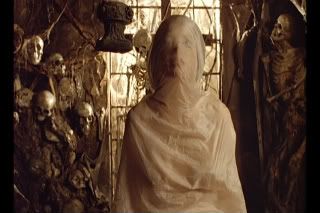
Soavi certainly learned a few things from working with his quirky masters, and it isn’t hard to see a bit of Gilliam in some of his better-composed shots. This is what a Terry Gilliam horror movie would look like--and what The Brother’s Grimm (which Soavi also worked on) probably should have been. In fact, the main reason you should watch this film is for its stunning visuals, which you often don't expect in a horror film.

CM 3

It must be said, though, that some of the special effects are fairly transparent (though they’re all conventional effects, which is something I appreciate). Especially bad is a scene in the cemetery with floating balls of blue flame … each of which are visibly tied to strings which lead them around. However, the viewer should be quick to forgive this--it’s so obvious that if the shot had worked it would have been beautiful.

One of the biggest detractors to Cemetery Man is the film’s overly enthusiastic fans, who have been known to speak of the film as though it were less a horror-comedy and more a philosophical treatise on love and mortality. And it isn’t--not unless you think the same thing about Bazooka Joe cartoons, at any rate. But it doesn’t have to be. It doesn’t have to be deep and intellectually stimulating. It just has to be a fun movie. Which it is. So stop thinking so hard and see it.