Showing posts with label John Cleese. Show all posts

Saturday, January 24, 2009

The Strange Case of the End of Civilization as We Know It (1977)

Photobucket

PLOT:

After the death of diplomat Henry Gropinger (an obvious parody of Henry Kissinger), the evil Professor Moriarty holds the world hostage with a threat to the end of civilisation as we know it. Representatives from around the world (including Indiana Jones' actor Denholm Elliott) convene and decide to contact Sherlock Holmes' grandson (John Cleese) to deal with the problem. Holmes, along with an incredibly dimwitted Watson (Arthur Lowe), come up with a plan to lure Moriarty out of hiding by having a gathering of the world's greatest detectives.

Photobucket

REVIEW:

Scattershot, but occasionally inspired, hour long feature from 1977 with John Cleese in fine form as the bumbling last surviving relative of Sherlock Holmes. Cleese gets plenty of oppotunities to show off the silly wordplay and physical comedy that was his trademark in Monty Python, but too often The Strange Case Of The End Of Civilization As We Know It lets down what could have been an inspired premise

Early scenes with Henry Kissinger and Gerald Ford impersonators play off some dated political humor, but the introduction of Cleese as Holmes (through a tremendously misguided fight scene) and, particularly, Arthur Lowe as an almost supernaturally dim (and possibly bionic) Watson soon liven things up. Lowe's Watson is a logical progression of Nigel Bruce's blustering Watson from the Basil Rathbone films, constantly pronouncing amazement at even the most obvious of Holmes discoveries with. In one of the film's highlights, he even manages to kill the police commissioner (with Holmes watching in disbelief) through some incredible ineptitude.

Photobucket

The scenes between Holmes and Watson work best in the film because they play to the strengths of the two leads. Cleese's barely contained rage at his partner's bungling is always amusing, while Lowe steals most of his scenes by seemingly being blissfully unaware of anything at all that is going on. As Holmes says, "he understands very little.". When it deviates from these strengths, particularly in some lengthy boardroom scenes which feature some borderline racist humor, the film suffers.

The final scenes, concerned with a meeting of the world's great detectives, is a showcase for some awful impressions (of Columbo, Poirot, Steve McGarrett, etc) and brings things to a grinding halt before the final reveal of Moriarty brings things to an amusing conclusion. The film is awfully disjointed, with some rather lame instances of drug humor obviously thrown in to be edgy, but serve as a distraction from some of the more amusing elements.

Photobucket

The White Star DVD presents the film in piss-poor fullscreen transfer obviously sourced from a VHS copy. The video is grainy, and there are even a few tracking problems in one scene. The audio is muffled, which makes some of the quicker dialogue exchanges difficult to make out.

The DVD features no special features. A shame, because it would be interesting to hear how this project came together.

Photobucket

Occasionally worthwhile but generally disappointing, The Strange Case Of The End Of Civilization As We Know It features enough amusing moments (thanks to Cleese and Lowe) to be deserving of a watch, but is too uneven to be strongly recommended.


Thursday, May 29, 2008

Erik the Viking: The Director’s Son’s Cut (1989/2007)

Photobucket

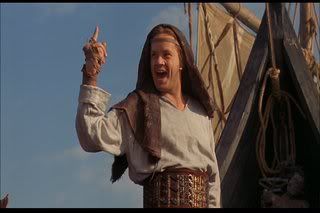
When I was but a lad, I was lucky enough to get a copy of Terry Jones’ Erik the Viking (1989) by taping it off of Super Channel when they were running a free preview month. The video quality was sketchy, and the beginning and ending were missing, but I watched that damn tape until it nearly disintegrated. Erik the Viking had everything, as a kid, that I wanted in a film--swords, violence, magic, and humour. Turns out, upon viewing Erik the Viking: The Director’s Son’s Cut (2007), that this is almost exactly what I want in a film as an adult. A journey of magic and wonder, Erik the Viking is like Monty Python doing The Seven Voyages of Sinbad the Sailor (OK, I know, wrong country, wrong period--but still, I maintain, the description fits!).

It starts with an unlikely situation for a comedy: Erik’s (Tim Robbins) attempted rape of Helga (Samantha Bond). Erik is unable to complete this routine Viking task, since he’d prefer that the two develop a loving relationship before proceeding any further. He’s not, it would seem, a very good Viking. In the following moments, Helga is accidentally killed, and Erik, in turn, decides that he will enlist his fellow Vikings in a journey to Valhalla, where he will end Ragnarök, make Fenrir the wolf cough up the sun, and hopefully bring Helga back to life in the process. His Viking friends--chief among them the fearless warrior Thorfinn Skullsplitter (Richard Ridings) and Sven the Berserk (Tim McInnerny)--agree to follow Erik, if only because to refuse might be seen as a sign of weakness.
EV1

“You don’t go through all the hardships of an ocean voyage to make friends!” Thorfinn Skullsplitter tells our hero, Erik, with a large degree of contempt, and in doing so illustrates the major differences between Erik and his Viking brethren--Erik is, for the most part, a nice guy. With his belief in love and selfless action, he sticks out like a sore thumb amid his brutal kinsmen, and former Python member Terry Jones knows how to play this intrinsically comedic situation for some hearty laughs. In fact, on close inspection, it turns out that Erik the Viking is set up like a series of sketches: it’s Sven’s argument with his dad over what it means to be a berserk, followed by Erik’s pitifully bad goodbye speech, followed by the chaotic tussle with the Dragon of the North Sea… Each comedic set-piece fits perfectly into the overall story, so that the narrative never seems herky-jerky, and most of these scenarios provide a good laugh.

Much of the film’s strength comes from Erik’s shipmates. My favourites among them are Sven and Sven’s Dad; the latter of which is constantly lecturing his son on how to properly be a berserk (“You must only let the red rage take hold of you in the thick of battle!”), which inevitably leads to Sven loosing his cool and, in doing so, disappointing his father. Freddie Jones is suitably hilarious as the hapless Christian missionary, John Gordon Sinclair lightens up all the scenes he’s in as the cowardly drummer, Ivar the Boneless. Jones’ old Python compatriot, John Cleese, is cast as the villain of the piece, Halfdan the Black. Much like the character of Erik is made funny by contrasting his personality (kind and caring) with his occupation (marauding Viking), Cleese’s Halfdan turns out to be, rather humorously, a fairly well-mannered despot.
It’s hard to imagine a movie like Erik the Viking being made by anyone else--save, of course, another Python alum, Terry Gilliam. Jones, who has a degree in Modern History from Oxford, had already cut his teeth as a director in the Python vehicles Holy Grail and Life of Brian. In those films, as in Erik the Viking, you can see that Jones is every bit as interest in depicting the gritty, stinky details of the historical period, as he is in revelling in its absurdities. Certainly he does not attempt a faithful recreation of the period, but his historian’s eye for detail helps him craft a world that feels suitably authentic--and that makes it all the more funny.

Unfortunately, the only version of Erik the Viking available on DVD is The Director’s Son’s Cut. This new cut reorders a scene or two, but most of the editing involves “trimming” each scene. Most noticeable, however, is some audio editing, which involves some audio close-ups of special effects sounds which end up being really distracting (the “roaring” during the battle with Halfdan the Black is the most obvious--and painful). The ending suffers the most, with the last few scenes racing along, and the cutting from scene-to-scene becoming disjointed. This anemic cut of Erik the Viking comes with a reasonable amount of extras, including a behind-the-scenes look at the making of The Director’s Son’s Cut, which leaves the viewer with the (probably correct) impression that the director’s son has no idea what he’s doing.
The changes made in The Director’s Son’s Cut are not all bad--it speeds up the middle of the film nicely (even though humour sometimes needs those extra few seconds to really pay off)--but on the whole I think they’re probably detrimental to the film. That being said, it’s the only version available on DVD, so you’d be foolish to pass it up just because of the editing. Erik the Viking: The Director’s Son’s Cut is highly recommended to anyone who enjoys Pythonesque humour, or fans of Vikings.